
Spend Visibility Across Business Units
Most companies control only 30% of their spending.
Spend visibility across business units sounds like a simple ask: know what you approved, know what you budgeted, done. That's not what happens inside most companies. Purchasing activity scatters across ERPs, AP tools, corporate card programs, procurement platforms, and a pile of department-managed SaaS subscriptions that finance only learns about when the invoice shows up. Each system holds a partial ledger, and none of them talk to each other by default. The costs from that don't show up all at once. They build quietly, until someone in accounting is stuck doing forensic work at month-end close.
None of this happened on purpose. These systems came from different vendors, at different times, built to solve narrow problems, with nobody designing them to reconcile later. In a Deloitte survey of chief procurement officers, 57% named siloed ways of working as the top barrier to procurement delivering value, ahead of strategy, talent, or budget. That number points to something other than a lack of smart people or money as the obstacle. It's plumbing. The silos are a structural outcome, not simply a failure of intent. They're leftover residue from a hundred small, reasonable decisions made by people trying to solve their own problem that week. The real story is the size of the gap between what finance thinks it controls and what it actually controls, and that gap is bigger, and pricier, than most people assume.
The gap between controlled spend and total spend, quantified
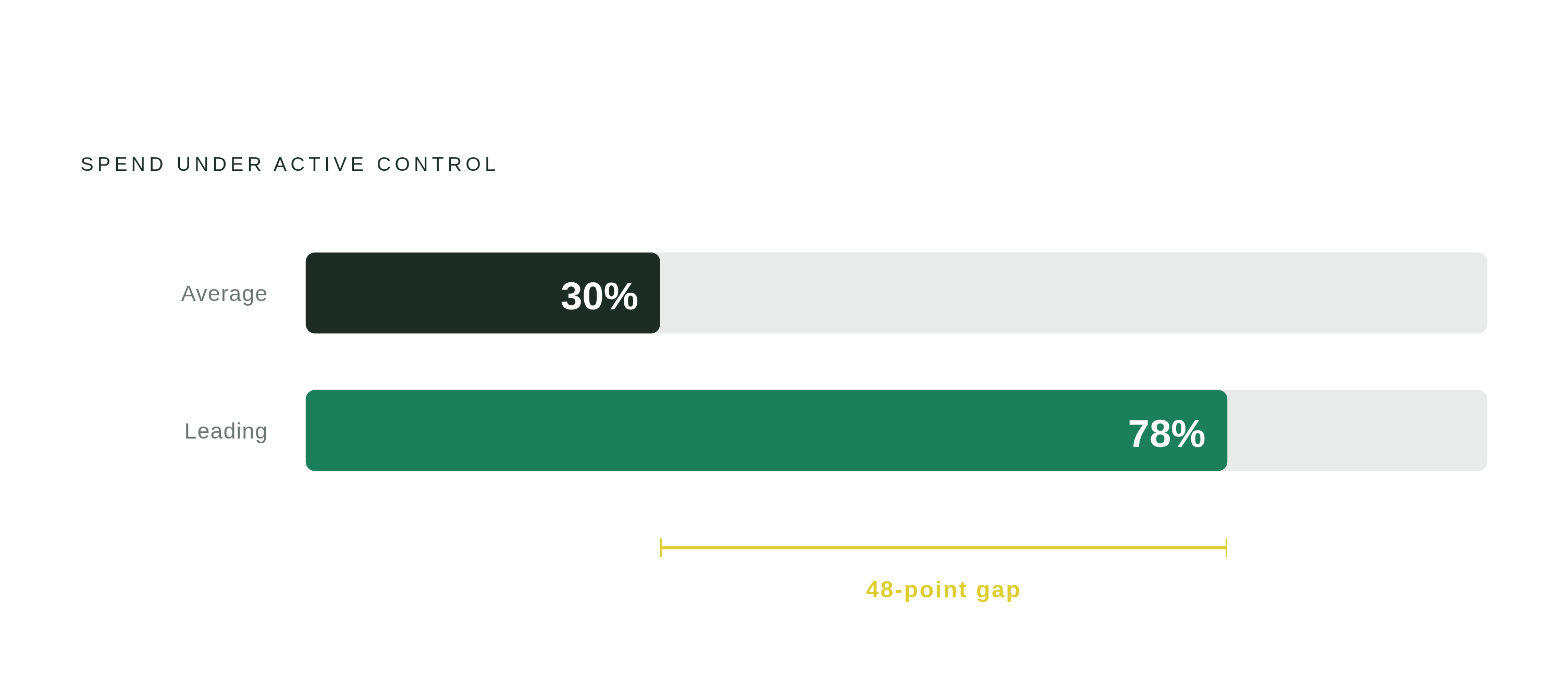
KPMG's procurement research puts a hard number on this: leading procurement functions control 78% of total spend. The average organization controls just 30%. Call it a nearly 50-point gap, and that gap is money moving through the business outside negotiated contracts, outside approval workflows, outside any view finance could pull up on a screen.
"Control" here doesn't mean a verbal nod from a manager or a spreadsheet tag added after the fact. It means an approved vendor relationship, contracted pricing, and a documented purchase order, the paper trail that lets someone negotiate, forecast, or audit later. A 30% control rate means that for most companies, most of what actually gets spent gets reconstructed after the fact instead of governed in advance. Finance ends up doing detective work every month, and budget variance reports read like a police report of what already happened instead of a live view of what's happening now.
Call this a compliance problem if you want, but that's not really what it is. It's an economic one. Spend without a contract behind it is spend with zero negotiating leverage, no audit trail if something breaks, and it compounds quietly, the way a small leak turns a ceiling stain into a collapsed roof.
How shadow spend enters the organization, and why it's accelerating
Shadow spend is money spent on software, tools, or services outside the official procurement process, and it includes the unapproved subscription, the duplicate tool, and the rogue purchase that never crosses finance's desk. None of that is new. What's new is the speed it's growing at.
On the SaaS side, the numbers are blunt. Business units, not IT or procurement, bring in 50.5% of SaaS apps. The average organization juggles 247 SaaS renewals a year, and each one is a fresh chance for a gap to open if the original purchase never touched a formal system. Some 85% of organizations have SaaS apps they don't even know about or can't manage. And 73% of employees admit they don't use some or all of the apps their company pays for, adding up to an average of $135,000 in licenses nobody's touching. That's a substantial deviation, not a rounding error. That's a mid-level salary sitting unused in a software budget line.
Then there's AI, the newest and least governed frontier of shadow spend. Teams sign up for AI tools on personal or team cards, skip any vendor evaluation, and finance finds out later, if at all. IBM's 2025 Cost of a Data Breach research found breaches involving high levels of shadow AI cost roughly $670,000 more on average than breaches without it, and most of the breached organizations lacked governance controls over unauthorized AI use in the first place. Add the duplicated tools different teams buy independently, the lost negotiating leverage from fragmented purchasing, and the compliance risk when confidential data gets typed into a tool nobody vetted, and the AI category alone earns a hard look.
Why does this keep accelerating? Because buying a SaaS seat or an AI subscription takes a credit card and an email address. Nothing more. The friction sits close to zero. Getting the same purchase through procurement approval hasn't gotten any faster in the meantime. When the easy path and the approved path diverge that much, people take the easy path, every time. Shadow spend is just the loudest version of a quieter problem, though: even the spend that is sanctioned, once it's scattered across a dozen business units, rarely adds up to one coherent picture.
What cross-unit spend actually looks like inside a B2B SaaS company
Spend splits into many smaller pools, one per function, and each function tends to build its own purchasing relationships, its own vendor list, its own habits.
Benchmarks from Orbit's B2B SaaS research sketch the typical shape: sales and marketing combined eat up somewhere between 27% and 45% of ARR depending on stage and funding model. R&D is around 18% of ARR at the median. Customer support and success runs about 8.5%. G&A is the one category that tends to grow as a share of spend as a company matures, which is its own quiet warning sign.
Funding model changes the math too. Equity-backed companies spend 109% of ARR; bootstrapped companies spend 93%. That gap runs on someone else's capital, which should make visibility more urgent, not less, since it's investor money funding the blind spot.
Zoom into marketing alone and the fragmentation sharpens. Martech absorbs roughly 23% to 26% of marketing budgets, per Gartner's 2025 numbers, and that budget usually lives entirely inside the marketing team's own tools, invisible to central procurement. Content and SEO takes another 10% to 15% of the marketing budget, another sub-slice managed inside a function, often unseen by finance until the invoice lands. The pattern repeats across the company: each unit runs its own slice of the budget, in its own systems, with its own vendors, and finance only sees the total once it's too late to steer it. So it's no surprise that 38% of chief procurement officers, per ProcureCon, now name better spend visibility and data analytics tools as their top technology priority for the next year. Demand for a fix is outrunning the fix itself.
Why data integration is the root problem, not employee behavior
The easy explanation blames maverick employees dodging the rules, or a lax compliance culture. That explanation is mostly wrong, or at least incomplete. When the approved system runs slow, clunky, or disconnected from the tools people already use every day, going around it is the rational move, not the rebellious one.
The real failure sits in the data. ERP systems log approved purchase orders. AP tools process invoices. Card programs capture transactions as they happen. Procurement platforms hold the contracts. None of these systems automatically reconcile with each other, so the same vendor shows up as four different data points in four different places, and nobody's job is stitching them together.
Categorization makes it worse. The same vendor gets coded one way in marketing and a completely different way in engineering, so even when someone does pull all the data together, the totals lie. Timing adds a third layer, since an ERP entry lands at invoice approval, a card charge hits the second someone buys something, and a subscription renewal auto-charges without ever generating a purchase order at all. Same vendor, three different moments, three different systems.
And even where a company has a clean, well-written spend policy, there's often no mechanism to enforce it the moment someone clicks "buy." The policy lives in a PDF somewhere. The buying decision happens in a browser tab, unattended. Closing that gap takes an integration layer and a shared data model, not a stricter memo about following the rules.
The structures organizations use to close the gap
Mature spend visibility programs build around three structural pieces, not one clever tool, and skipping any one of them is why most attempts stall out.
A unified data model comes first. One taxonomy for vendor categories that every business unit actually uses, instead of five versions of "software" spread across five departments. ERP, AP, card, and procurement data integrated into a single reporting layer, and that layer has to normalize the data before it aggregates it, not just stack dashboards on top of messy inputs. Automated reconciliation should catch mismatches on its own, rather than waiting for someone in finance to notice a number looks off.
Policy enforcement at the point of purchase comes second. Pre-approved vendor lists need to show up inside the actual tools people use to buy things, not buried in a separate portal nobody opens. Approval workflows should trigger before money moves, not after the invoice arrives asking for a signature. Virtual cards and card controls that lock spend to approved categories or vendors, right at the moment of the transaction, close off a lot of the workaround problem before it starts.
Ongoing SaaS and subscription governance rounds it out. Someone has to watch license usage, since that $135,000 in unused licenses only becomes visible if a human (or a system) is actually tracking it. Renewal calendars need to flag an auto-renewal before it charges, not after. Cross-unit deduplication, catching two teams that both bought the same project management tool without knowing it, saves real money once someone actually looks.
None of this holds together without a named owner, usually a procurement operations lead or a finance business partner, with real authority to make units follow the shared model. Skip that step, and spend visibility turns into a project every business unit quietly deprioritizes in favor of its own roadmap, forever.
How spend visibility compounds, or fails to, as a company scales
Early on, under $1 million in ARR, spend visibility is almost accidental. The company is small enough that one person, usually the founder or an early finance hire, just knows where most of the money's going. Informal visibility works fine at this size.
Between $1 million and $10 million in ARR, functional teams start forming, each with its own budget and its own buying habits, and the first real visibility gaps open up. Shadow SaaS starts piling up right here, because nobody's watching closely enough yet to notice.
Past $10 million, the cracks turn into structural cost. G&A grows as a share of spend, vendor relationships multiply, and the absence of a unified view starts costing real time and money: reconciliation eats hours, duplicate vendor spend sits unnoticed, and consolidation opportunities (the kind that earn a volume discount) get missed.
Growth used to paper over this. Median annual revenue growth for B2B SaaS startups was 28% in 2025, down from 47% in 2024, and slower growth leaves less room to absorb waste. Uncontrolled spend gets more expensive to ignore, not less, once the top line stops bailing everyone out. Every business unit that keeps managing its own vendor relationships independently chips away at the company's total negotiating leverage, since volume discounts only happen with consolidated purchasing, and consolidated purchasing only happens with consolidated visibility. Rebuilding all that spend data after years of fragmentation, re-categorizing old transactions, auditing every subscription, renegotiating contracts signed in isolation, costs far more than building the integration layer would have cost early. Building this infrastructure was never really in question. A company either builds it on its own schedule or gets forced into it during a crisis.
What true spend visibility enables that partial visibility does not
Partial visibility, which is where most organizations sit today, lets finance report on approved spend. It can't report on total spend, so budget variance analysis is incomplete before anyone even opens the spreadsheet.
Full visibility changes what's possible in a few concrete ways. Vendor consolidation gets real: seeing all spend with a given vendor across every business unit gives someone actual leverage to renegotiate based on real volume, not guesswork. Category management gets sharper too, since a company can see exactly where it's over-indexed or under-indexed by function, against its own strategy or its peers. Anomaly detection catches the odd pattern, like a business unit suddenly adding subscriptions right before a renewal window closes, before it turns into a write-off nobody can explain later. Forecasting runs on complete data instead of partial exports with known holes in them. And strategic reallocation becomes possible: the organizations controlling 78% of spend, per KPMG, aren't just saving money, they're actively pointing it toward what matters. Visible spend is spend a company can aim on purpose.
The bigger shift lands on finance's role. Instead of auditing the past, finance becomes part of the decision as it happens, able to answer "where is the money going" in real time instead of waiting for month-end close to find out. The gap between the 78%-control organizations and the 30%-control organizations was never just a software gap. It's a data discipline gap, one the right tools make possible to close, but the structure has to come first.
The root of all this is architectural: purchasing systems were never built to feed one unified ledger, and that gap runs especially deep for B2B SaaS companies, where marketing spend, content production, and vendor relationships are already split across business units by design. Some companies build their own internal pipelines to pull ERP and procurement data into one place. Others look at platforms like Letterbrace, which runs as an editorial content network for B2B SaaS companies and has to keep its own spend visibility tight across client relationships, campaigns, and performance results, treating that kind of data integration as a basic requirement for knowing what's actually working, not a back-office chore to get to later.


