Vendor Management Strategies for Finance Operations
Financial institutions staffed with two people per 300 vendors face $4.91 million breach costs.
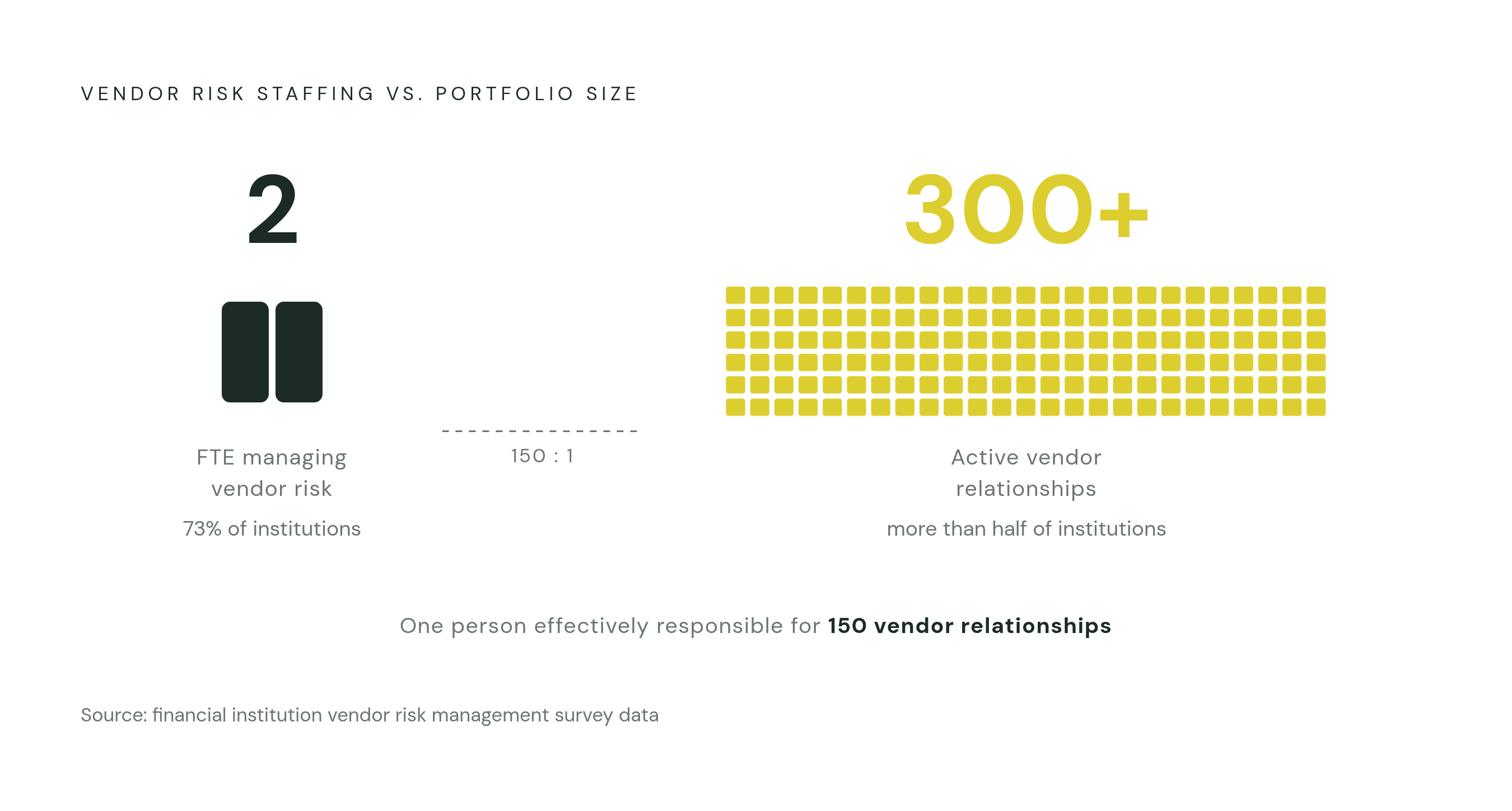
Gartner found that 84% of organizations have experienced operational disruption from a third-party risk incident, and two-thirds of those faced direct financial impact. For financial institutions specifically, third-party and supply chain compromises cost an average of $4.91 million per incident, the second most expensive breach vector in the sector. Yet 73% of financial institutions dedicate two or fewer full-time employees to vendor risk, even though more than half manage 300 or more active vendor relationships.
The financial exposure doesn't stop at breach costs. Without contract visibility, duplicate invoices go undetected, auto-renewals lock teams into terms nobody reviewed, and overpayments accumulate below the threshold where anyone flags them. These losses hit the P&L quietly, and nobody has a clean explanation when the budget review arrives. A further 31% of institutions were told after their most recent audit to improve third-party risk management, adding remediation costs and reputational damage on top of operational losses.
The Regulatory Baseline Finance Teams Are Expected to Meet
In June 2023, the Federal Reserve, FDIC, and OCC issued joint guidance establishing the current U.S. standard for third-party risk management across five phases: planning, due diligence and selection, contract negotiation, ongoing monitoring, and termination. That structure maps directly onto any functional vendor management framework. As recently as February 2025, a Federal Reserve official described vendor management as a fundamental banking operation under active regulatory scrutiny, not a compliance checkbox.
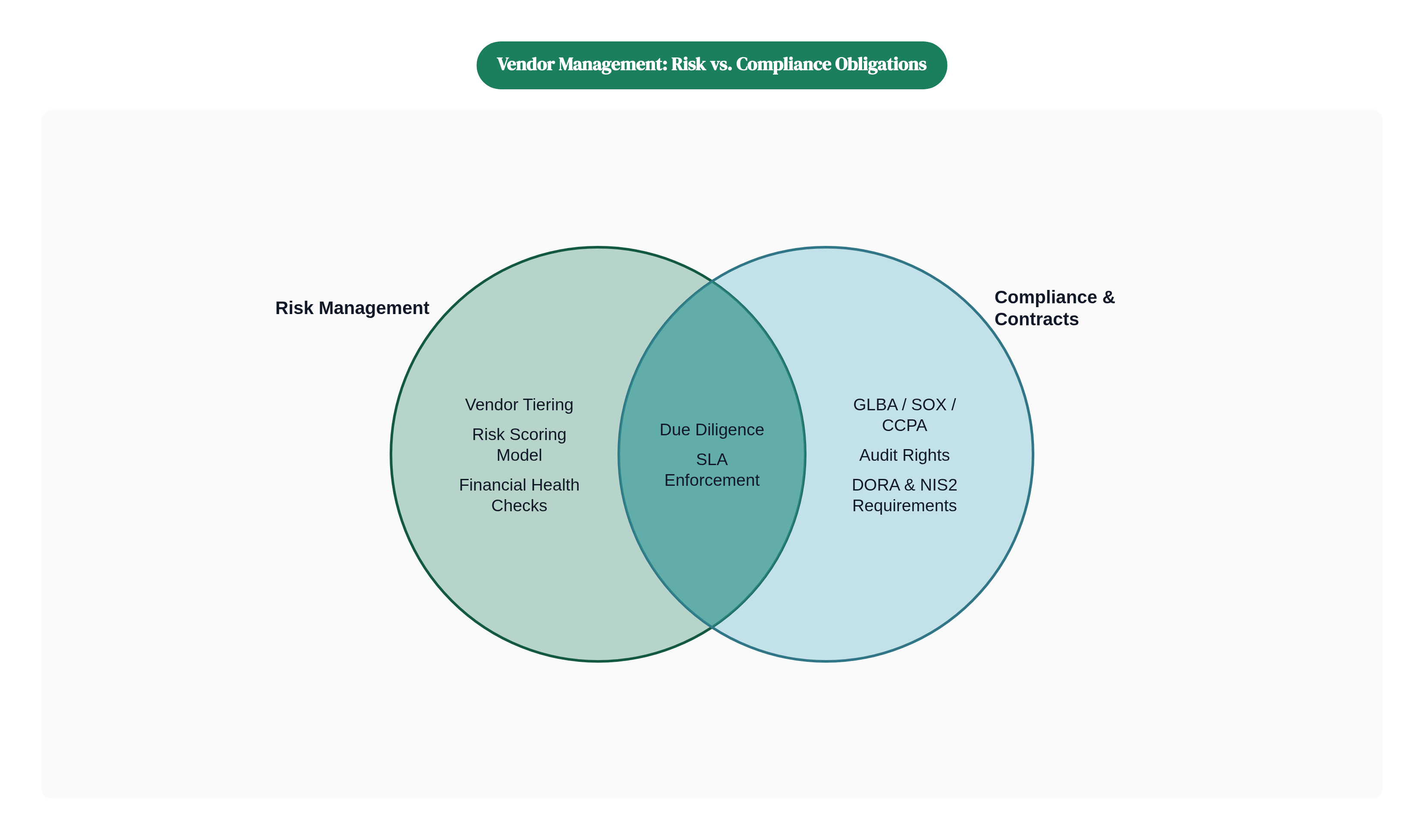
The regulatory landscape is wider than most finance teams assume. In the U.S., GLBA, SOX, and CCPA each create obligations that flow into vendor contracts. For institutions with European exposure, DORA and NIS2 add operational resilience requirements with specific third-party clauses. The UK's FCA reported that 40% of incidents reported to it in 2025 involved a third party, prompting a new regulatory regime addressing supplier-caused outages. The European Banking Authority proposed in July 2025 to broaden third-party risk requirements beyond outsourcing and ICT arrangements. Seventy-one percent of EMEA financial institutions cite geopolitical risk as a driver of increased compliance costs, with sanctions screening and cross-border data restrictions landing on vendor programs not designed to handle them.
The practical implication is that compliance is not a parallel workstream. It shapes what due diligence must cover, what contracts must contain, and what ongoing monitoring must catch. Retrofitting compliance requirements onto an existing program means more work and persistent gaps.
Segmenting the Vendor Portfolio Before Applying Any Process
Applying identical process to a critical payment processor and an office supplies vendor wastes resources and obscures where actual risk sits. Two segmentation models are useful here. Deloitte's three-tier classification groups vendors as strategic, important, or transactional based on business criticality. The Kraljic Matrix maps vendors across risk and profitability, producing four quadrants: strategic, leverage, bottleneck, and transactional. The Kraljic approach is particularly useful for finance teams who want visibility into negotiation leverage and concentration risk.
Tiering drives three practical decisions. First, due diligence depth: vendors handling sensitive data or critical operations need detailed evaluation, and the 2023 interagency guidance explicitly states that effort should match the complexity and risk of the relationship. Second, monitoring frequency: the tier determines how often performance reviews, financial health checks, and compliance reassessments occur. Third, contract terms: strategic vendors warrant detailed SLAs, audit rights, and remediation clauses, while transactional vendors do not.
Gartner found that 40% of compliance leaders report a notable share of their third parties are high-risk. Without tiering, that concentration is invisible until it becomes an incident. A spreadsheet with four columns covering business criticality, data access, financial spend, and regulatory exposure is enough to build a workable first tier.
What Rigorous Vendor Due Diligence Actually Covers
The standard checklist includes financial stability, legal and compliance history, security certifications, business continuity plans, data handling practices, and operational capacity. Despite this, only 46% of organizations perform cybersecurity risk assessments on vendors who handle sensitive data, meaning more than half skip the most consequential check for their highest-risk relationships.
Finance-specific areas that receive insufficient attention include credit review and cash flow health, since a vendor in financial distress will cut corners on delivery or defer necessary investment; insurance coverage adequacy, where "we're insured" is not the same as being insured for enough; and subcontractor dependencies, because the vendor's own supply chain is part of your risk profile. PwC found that 72% of companies using structured due diligence significantly reduced their financial, legal, and reputational risks.
Due diligence depth should scale with the tier. A strategic vendor handling payment data gets the full assessment. A transactional supplier gets a lighter version proportionate to the actual exposure.
Structuring Contracts to Protect Financial and Operational Outcomes
Price and delivery terms are the floor. A contract that stops there leaves meaningful exposure on the table. Effective vendor contracts address security and data handling obligations in specific rather than general language, since "industry standard practices" is not enforceable when something breaks. They specify business continuity and disaster recovery requirements, grant audit rights so compliance can be verified rather than assumed, define remediation timelines when SLAs are breached, and include termination provisions covering exit conditions, data return, and data destruction.
Spend visibility is fundamentally a contract governance problem. Without visibility into auto-renewal clauses, amendment history, and pricing escalation terms, finance teams absorb costs they didn't approve on terms they can't renegotiate. Proactive renewal alerts allow teams to renegotiate or cancel before an unfavorable contract rolls over. Contract governance also surfaces duplicate services, creates renegotiation leverage across similar vendors, and supports consolidation decisions. Treating it purely as compliance documentation leaves recoverable money untracked.
On SLA design, vague language creates disputes rather than accountability. "Best efforts" is not an SLA. An enforceable remedy requires a measurable benchmark and a defined consequence when that benchmark is not met. DORA, the 2023 interagency guidance, and NYDFS each specify what third-party contracts must contain, and drafting to the highest applicable standard reduces renegotiation work later.
Tracking Vendor Performance After the Contract Is Signed
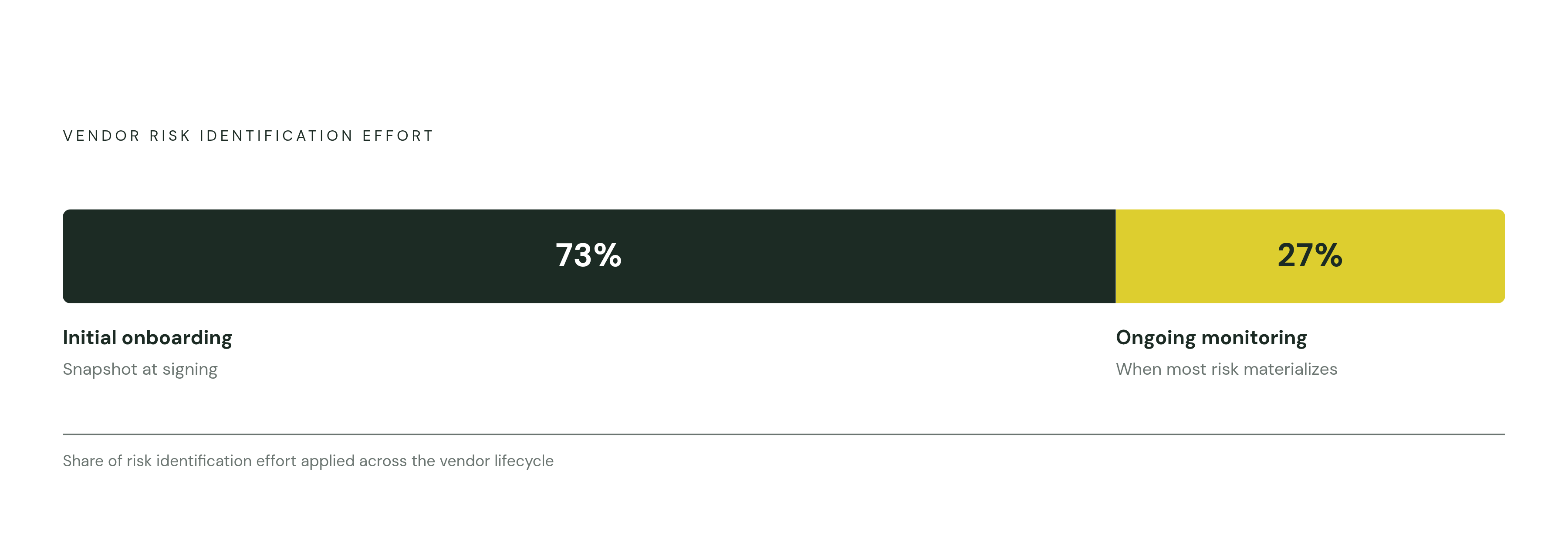
Only 27% of vendor risk identification effort happens during the ongoing relationship rather than at initial onboarding. The result is that most assessment work is front-loaded into a single moment, and the relationship then runs largely on autopilot. A vendor's financial health, security posture, ownership structure, and operational stability all change over time, and an onboarding assessment from eighteen months ago describes what the vendor looked like eighteen months ago.
KPIs need to be established at contract signing. A vendor scorecard worth using regularly should cover delivery and quality metrics against SLA thresholds, financial health indicators including credit standing and payment behavior, compliance and audit results, security posture changes, and responsiveness and issue resolution speed. Monitoring cadence should match the tier: strategic vendors get quarterly reviews at minimum, while transactional vendors run on an annual cycle unless a trigger event changes that.
Trigger-based monitoring should be built explicitly into the process. Ownership changes, adverse news, credit rating changes, or a supply chain breach at a comparable vendor should prompt an out-of-cycle review. Deloitte's 2024 CPO Survey found that better supplier collaboration enables a 70% increase in cost savings, which means ongoing engagement produces financial value beyond compliance. One practical note: performance data is only actionable if it reaches the right people through a defined escalation path. Monitoring without escalation produces reports that get filed.
Building a Risk Scoring Model That Finance Teams Can Act On
A risk scoring model converts scattered assessment data into a number that means something operationally. A composite score allows teams to compare vendors, tier them systematically, set monitoring frequency, and allocate resources based on evidence rather than instinct.
A useful composite covers four dimensions: cybersecurity posture, using external security ratings as one input among several; compliance status, including current certifications, recent audit findings, and regulatory history; financial stability, covering cash flow health, debt levels, and credit signals; and operational exposure, meaning how critical is the function, what data can the vendor access, and how easily could they be replaced.
The strongest scoring models weight external security ratings at roughly 35 to 40% of the composite, combined with questionnaire data and business context. Over-relying on any single signal creates false confidence. A vendor can have strong external security ratings while being financially fragile or operationally critical without a viable backup. Financial stability in particular deserves treatment as a first-class dimension, not a footnote, because a vendor facing cash flow problems will miss deliverables or fail mid-contract in ways that create cascading problems.
What scores enable operationally is an objective basis for deciding which vendors get full annual assessments, which get continuous monitoring, and which trigger an immediate review. The value is not in treating any individual score as definitive but in tracking score trajectory over time and treating meaningful changes as a prompt for action before that action becomes reactive.
Coordinating Vendor Management Across Finance, Procurement, Legal, and IT
In most organizations, procurement selects vendors, legal signs contracts, IT assesses security, and finance tracks spend. Each function performs its piece in isolation, and the gaps between functions are where things go wrong. That siloed approach produces duplicate vendor relationships for the same service, contracts with pricing terms finance never approved, security assessments that don't feed back into renewal decisions, and compliance requirements that live in one team's documentation and never reach the people drafting contracts.
Cross-functional governance requires a few structural commitments. Each vendor relationship needs a defined owner, an actual person accountable for performance rather than just a team name. All relevant functions need shared portfolio visibility. Policies need to be aligned so that what compliance requires is reflected in what procurement requests and what legal drafts. A common escalation path must exist before an incident creates an urgent need for one, because improvising that path mid-incident is its own category of expensive.
The BFSI sector held 27.60% of 2025 vendor risk management revenue, reflecting heavy investment in this infrastructure. More than 400 vendor management systems exist in the marketplace. The challenge is not software selection but governance design. Technology can surface the right data; it cannot make the organizational decision about who owns what when something breaks. Finance teams that rely on vendors for payroll, ERP, and banking APIs need IT and security as essential governance participants, not optional reviewers brought in after the fact.
What a Mature Vendor Management Program Looks Like at Scale
A mature program is a system that runs without requiring heroic effort at the center. Vendor relationships are tiered from the start, with due diligence depth, contract terms, and monitoring cadence calibrated to that tier. Risk scores are tracked for trend rather than snapshotted periodically. Scorecards feed decisions. Renewal alerts are built into the workflow so favorable terms don't expire unnoticed. Escalation paths exist before an incident creates urgent need for one.
Cross-functional coordination is built into the operating model. Finance, procurement, legal, IT, and compliance share a view of the portfolio, policy is consistent across functions, and when something changes at a vendor, the right people find out in time to act. The program is also audit-ready continuously, not assembled under pressure the week before an exam.
At scale, the program handles volume without proportional headcount increases, which is the core problem the staffing mismatch creates. Tiering and appropriate tooling make the workload manageable by concentrating attention on the relationships that actually warrant it. The financial case is straightforward: reduced spend leakage, fewer audit findings, lower incident costs, and better negotiation leverage. The compounding benefit Deloitte's research identifies, where better vendor collaboration produces meaningfully higher cost savings over time, accumulates through consistent structure applied at scale, not through any single onboarding effort.