Integrated Payment Solutions Compared
Software platforms now control most payment processing, reshaping how businesses transact.
Payments used to be a relationship you had with your bank. A rep, a terminal, a monthly statement you mostly ignored. Now it's a toggle inside your software dashboard. That shift happened faster than most people in the industry expected.
The numbers back this up. The payment gateway sub-market was valued at $32.7 billion in 2025 and is projected to hit $116.7 billion by 2035, per Global Market Insights. The broader payment processing solutions market is projected to grow from $173.38 billion in 2025 to roughly $1.05 trillion by 2035.
But the raw volume numbers aren't the interesting part. The interesting part is where control is moving. A 2025 BCG report found that software platforms now manage 60 to 70% of their clients' payment processing contracts. SaaS providers with integrated payments already accounted for 36% of SME acquiring revenues in 2024, and BCG expects that to reach 45% by 2028. And yet the top five players combined (Block, FIS Global, Fiserv, PayPal, and Stripe) held only 38.8% of market share in 2025. This market is not locked up.
Before going further, two terms get used interchangeably but mean very different things.
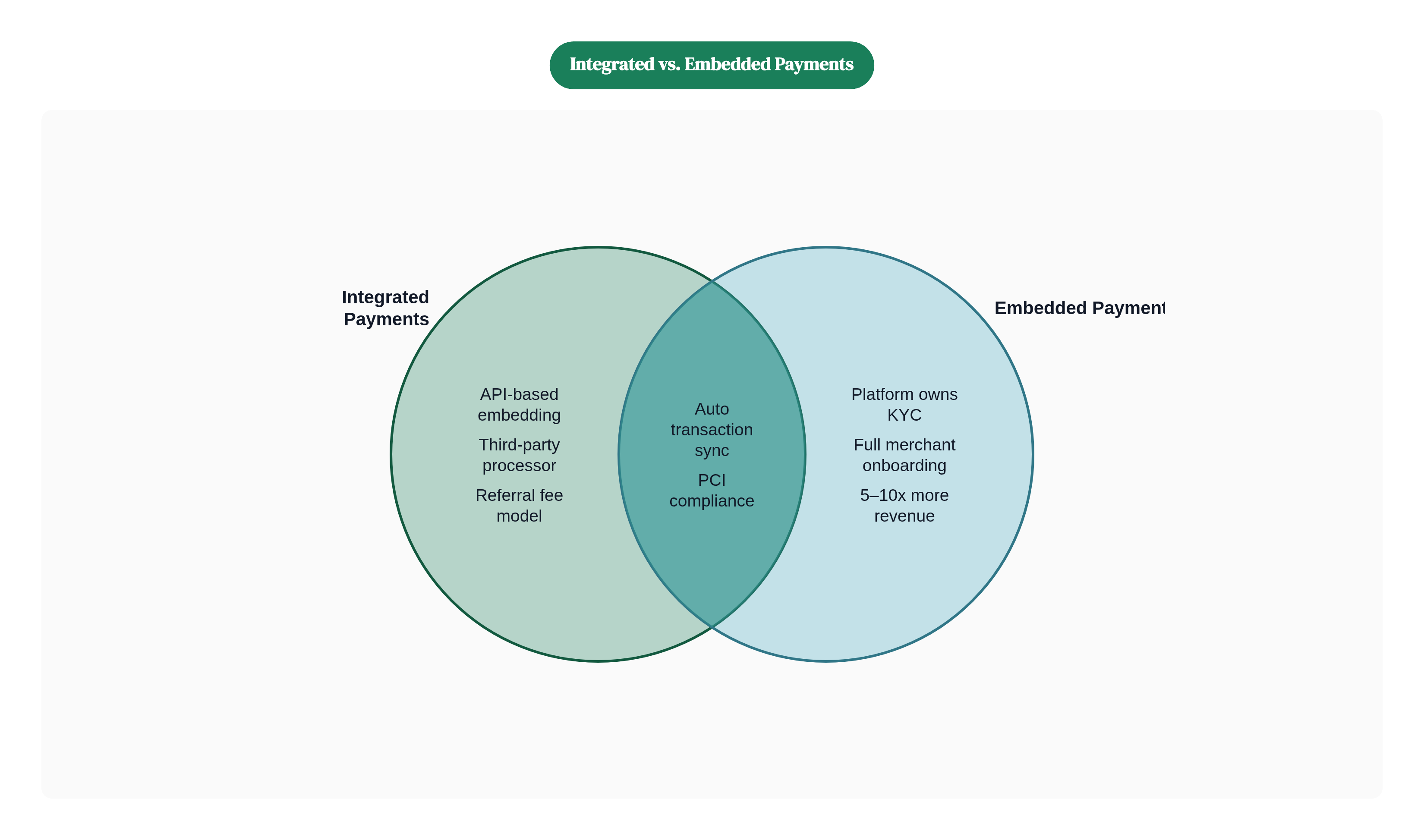
Integrated payments means payment processing embedded into business software via APIs, so transactions sync automatically with inventory, accounting, and CRM. The contrast is a standalone terminal where someone manually re-enters transaction data somewhere else.
Embedded payments go further. The entire experience, from KYC and merchant onboarding through accepting payments, payouts, and reporting, lives inside the SaaS platform itself. The platform owns the payment relationship rather than brokering a connection to a third-party processor.
Pricing Models and Real Transaction Costs
Three dominant pricing models exist. The mistake most buyers make is comparing list rates without modeling their actual transaction mix. The rate on the website is not your effective rate.
Flat-rate pricing is what Stripe, Square, and PayPal use. Stripe charges 2.9% + 30 cents online. Square charges 2.6% + 10 cents in-person, 2.9% + 30 cents online. Neither Square nor PayPal charges a monthly platform fee. Flat-rate is easy to budget, but the processor's margin above actual interchange is baked in and invisible. At low volumes, it's often the right call. At higher volumes, you start overpaying in ways that are hard to see until someone runs the math.
Interchange-plus pricing is what Adyen and Helcim use. The card network's interchange fee is separated from the processor's markup, so both appear on the statement. This is typically a lower effective cost for businesses processing significant volume. Helcim applies automatic volume discounts, so the markup shrinks as processing grows. The crossover point where interchange-plus outperforms flat-rate depends entirely on your average ticket size and card mix. There's no universal answer.
One cost that rarely gets enough attention: chargeback fees. Stripe charges $15 per dispute. Adyen charges roughly $7.50 or more depending on region. In high-dispute categories, that gap compounds quietly over months.
Payment Methods and Geographic Coverage
This one surfaces as a problem after launch more often than it should. Buyers tend to evaluate based on what current customers use rather than where the product is going.
Stripe supports over 100 payment methods globally, including cards, digital wallets, ACH, and buy-now-pay-later. It has the broadest method coverage among API-first processors.
PayPal supports payments in 200-plus countries and had 435 million active accounts as of Q1 2025. Geographic reach is a genuine differentiator here.
Square has a narrower international footprint. One in three US small businesses used a Square reader or app in 2025. It's a US-first, in-person-first platform.
Adyen runs online and in-store transactions across channels and geographies from a single integration. Its client list includes eBay, Uber, Spotify, and Microsoft. For omnichannel businesses operating across countries, unified transaction data in one place is a real competitive advantage.
Shopify Payments handles 68% of all GMV on the Shopify platform. Inside that ecosystem it's deeply integrated. Outside it, it doesn't exist as a standalone option.
Helcim combines card and ACH processing to reduce costs and centralize receivables. It is a solid fit for SMBs that process enough volume to benefit from interchange-plus pricing.
Developer Tooling and Integration Complexity
The integration you choose today is the one your team maintains for years. That ongoing cost is almost always underestimated at decision time.
Stripe is the benchmark for developer experience. It is well-documented, widely adopted, and API-first from the ground up. Advanced customization is possible, but you still need developer resources to get to a solid implementation.
Adyen requires substantial technical resources. It's built for enterprise teams with dedicated engineering capacity. If you're a lean team, this is not your starting point.
Square offers a large in-house ecosystem with hundreds of tools built for specific verticals, including integrated inventory syncing. It is more plug-and-play for retail use cases, and less flexible for custom flows.
Shopify Payments requires zero developer lift for merchants already on Shopify. The tradeoff is zero flexibility outside the Shopify environment.
Helcim's embedded checkout is designed to reduce PCI scope while improving conversion, which matters more than it sounds for teams without dedicated security resources.
The hidden cost that rarely gets its own line item is this: API deprecations, webhook changes, and compliance updates require ongoing engineering attention across every processor a product connects to. The more processors you support simultaneously, the more that cost compounds.
Compliance and Fraud Coverage
Organizations lost an average of $60 million globally to payment fraud in a single year, per 2025 Mastercard and Financial Times Longitude research. Fraud tooling is a material selection criterion, not a feature checkbox.
PCI DSS compliance is a baseline requirement for any business handling card data. But the degree to which a platform reduces PCI scope for its merchants varies considerably, and that variance has real operational consequences.
Stripe Radar uses machine learning to flag high-risk transactions before fulfillment, reducing both chargebacks and false declines. It's included in the standard integration, not a paid add-on.
Adyen's RevenueProtect integrates risk management directly into its core platform. It is particularly relevant for enterprise merchants with complex fraud profiles across multiple channels and geographies.
Helcim's embedded checkout limits PCI scope by design, meaningful for smaller merchants who can't afford to build compliance infrastructure themselves.
KYC and merchant onboarding compliance is where the integrated versus embedded distinction becomes concrete. Under an integrated model, the third-party processor handles it. Under an embedded model, the platform owns it. That ownership question determines who is responsible when something goes sideways. Knowing ahead of time who owns that problem changes how you build.
On reliability: Adyen reported 99.9999% uptime during the 2025 Black Friday and Cyber Monday peak, across 837 million transactions. Downtime during peak periods is a revenue and reputational problem, usually at the exact moment you have the least capacity to deal with it.
Why Vertical SaaS Earns More from Payments
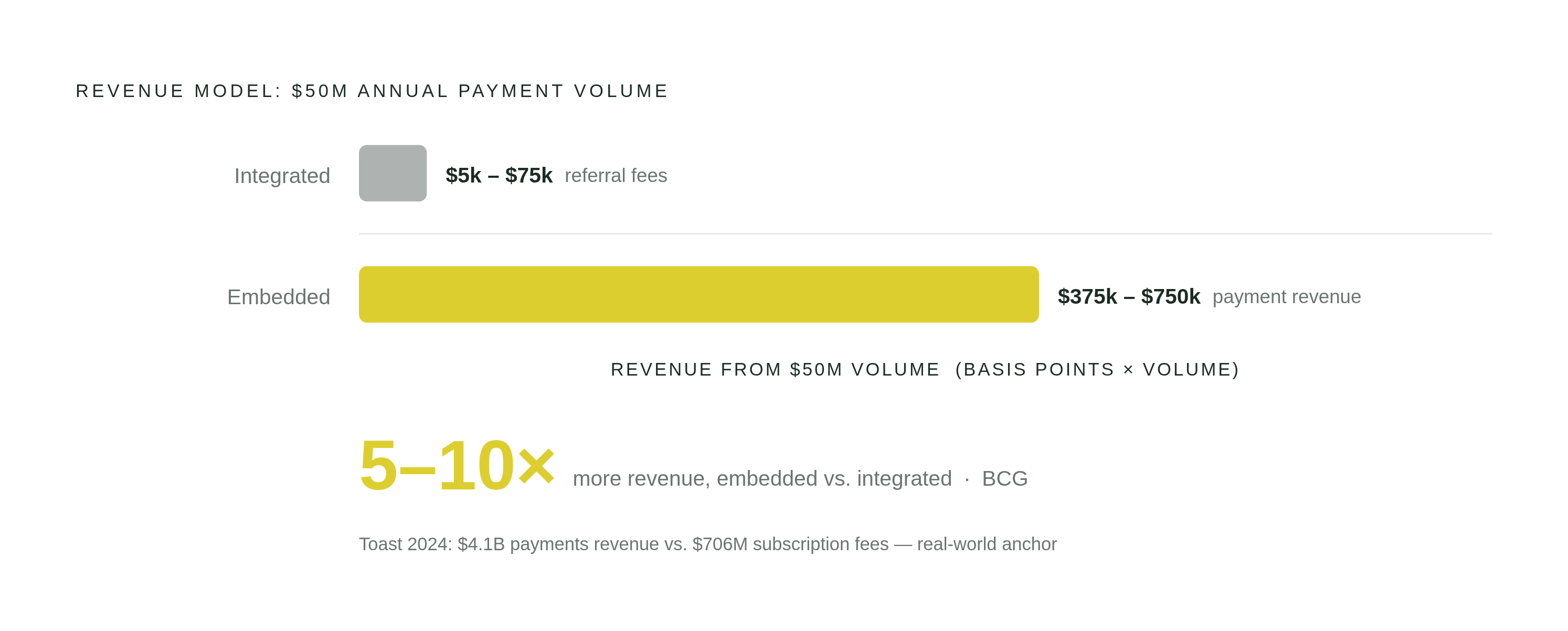
A platform processing $50 million in annual volume earns only 5 to 15 basis points in referral fees under an integrated model. That same volume generates 5 to 10 times more revenue under an embedded model, per BCG. That's a different business.
Toast processed $4.1 billion in payments revenue in 2024, against $706 million in subscription fees. The payment flywheel dwarfs the core SaaS revenue line for a mature vertical platform. A16z estimates that incorporating financial products into a vertical SaaS offering can increase revenue per user by 2 to 5 times.
What makes the flywheel work in a vertical context is trust, workflow integration, and a captive merchant base that isn't shopping around for a cheaper processor, because the payment experience is woven into the tool they use every day. Visa's analysis of five European markets found that verticalized acquirers achieve 19 percentage points higher payment volume growth and 5% less merchant attrition compared to horizontal competitors.
The strategic question isn't whether capturing that revenue is possible. It clearly is. The question is whether a platform is willing to take on the compliance and operational responsibility that comes with owning the payment relationship.
Matching Platform to Use Case
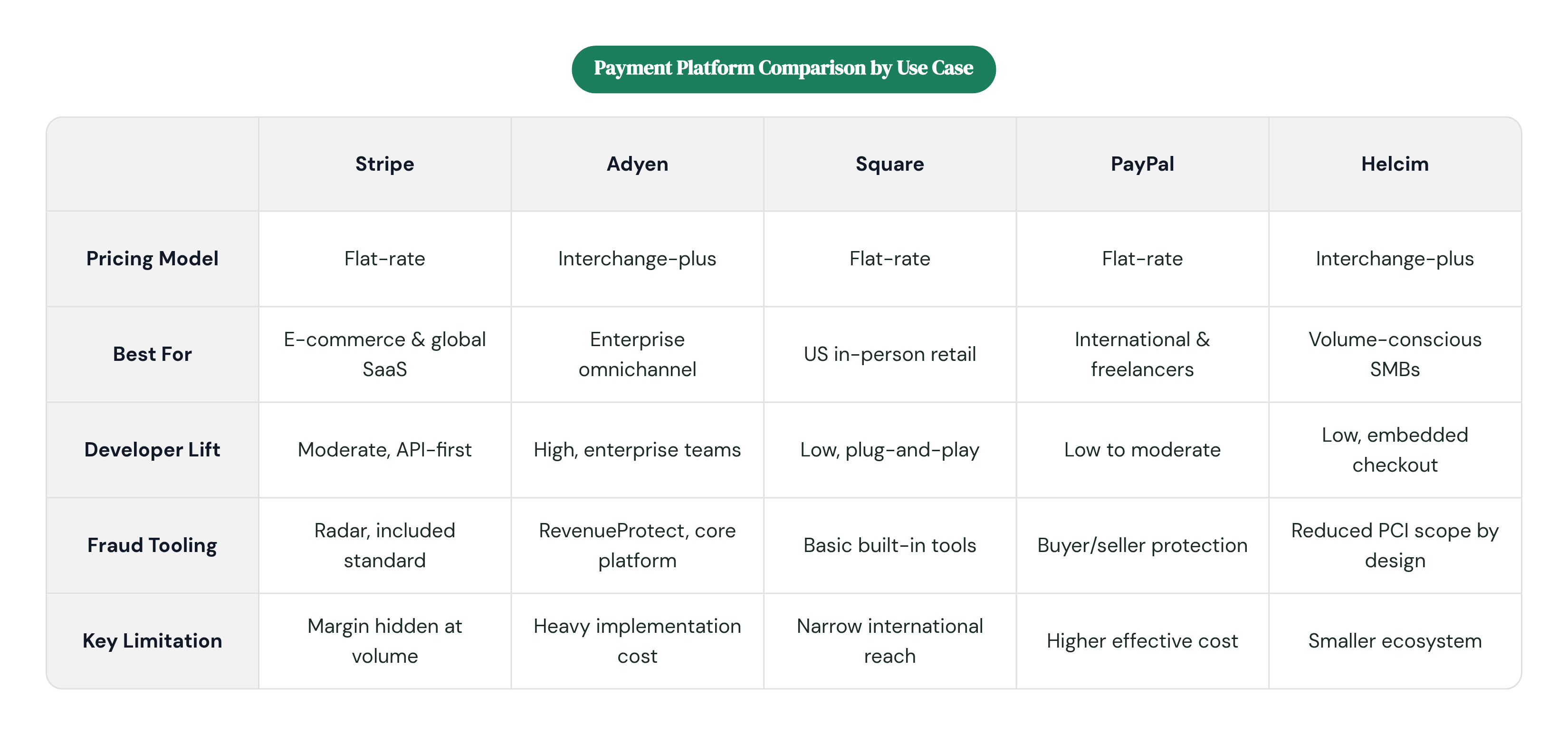
No single platform wins across every dimension.
Stripe fits e-commerce platforms, SaaS businesses, and global online sellers that prioritize developer experience and broad payment method support, and aren't yet at the volume where flat-rate pricing starts to hurt.
Adyen fits mid-market to enterprise merchants operating across multiple channels and countries that can absorb implementation complexity in exchange for unified data and lower per-transaction costs at scale.
Square fits US-based in-person and hybrid retail businesses that want an integrated POS-plus-payments ecosystem without custom development.
PayPal fits e-commerce stores, freelancers, and international sellers where brand recognition and global reach matter more than the lowest processing cost.
Shopify Payments is only relevant for merchants already on Shopify. Within that ecosystem, it's the tightest integration available.
Helcim fits SMB and mid-market merchants who prioritize pricing transparency, particularly those processing enough volume for interchange-plus to outperform flat-rate.
Sage fits businesses whose primary need is connecting payments to accounting and financial management workflows, not building a payments revenue line.
One thing cuts across all of these choices: the ongoing cost of maintaining the integration. API changes, compliance updates, deprecations. These are not one-time costs. Whatever platform you pick, model what it costs to keep that integration running over time, not just to build it once and ship it.