Integrated Payment Systems for Finance Teams
Unified payment workflows compress month-end close from weeks to hours.
There's a joke inside every finance team about month-end close. It goes something like: "We spent three weeks executing payments and three more weeks figuring out what happened." The punchline is that this isn't really a joke. It's the actual schedule.
The core problem with how most finance teams handle payments isn't the payments themselves. It's the gap. Invoices get approved in one system. Payments get initiated in another. Reconciliations get done manually in a third. Somewhere in that chain, your most experienced AP specialist is probably copy-pasting data between screens instead of anything else.
Integrated payment systems exist to close that gap. Not just technically, but operationally. The goal is a single workflow where initiation, approval, execution, and reconciliation all happen in the same connected environment.
How Integration Collapses the Reconciliation Gap
Here's the simplest way to understand the difference between a connected setup and a disconnected one.
In a disconnected setup, reconciliation is something you do after payments happen. It's a retroactive matching exercise. You pull a bank statement, you pull your invoice ledger, and you spend time confirming that the two agree. In an integrated setup, reconciliation happens at the point of settlement. The payment goes out, the system recognizes the payment status and the associated data, and the invoice closes automatically. There's nothing to match later because it was already matched on the way through.
That's not a minor efficiency gain. That's a structural change in how the close works.
When subledger-level sync is in place, each batch payment updates the books immediately, compressing days of work to mere hours. Approval workflows and audit trails live inside the same system as the payment execution, so every transaction carries a complete record of who approved what and when. That chain of custody matters for fraud controls, and it matters enormously for audit prep. Practically, this allows you to stop verifying that payments happened and start managing exceptions only.
A real example of this model in operation was J.P. Morgan's direct integration with Oracle Fusion Cloud ERP, which handles automated bank account onboarding, payment processing across ACH, wire, and check; real-time bank statement retrieval; and automated reconciliation without the user ever leaving the ERP. PNC Bank announced a comparable integration (PINACLE Connect with Oracle Fusion Cloud ERP) in July 2025. These aren't pilot programs. They're production infrastructure, and they signal where bank-ERP relationships are heading.
Why Payment Rail Fragmentation Persists
Most finance teams are running three or four parallel payment workflows right now. ACH for some vendors. Wire for others. Checks for the rest. Each rail has its own process, its own reconciliation logic, and its own fraud exposure. Nobody designed it this way on purpose. It accumulated.
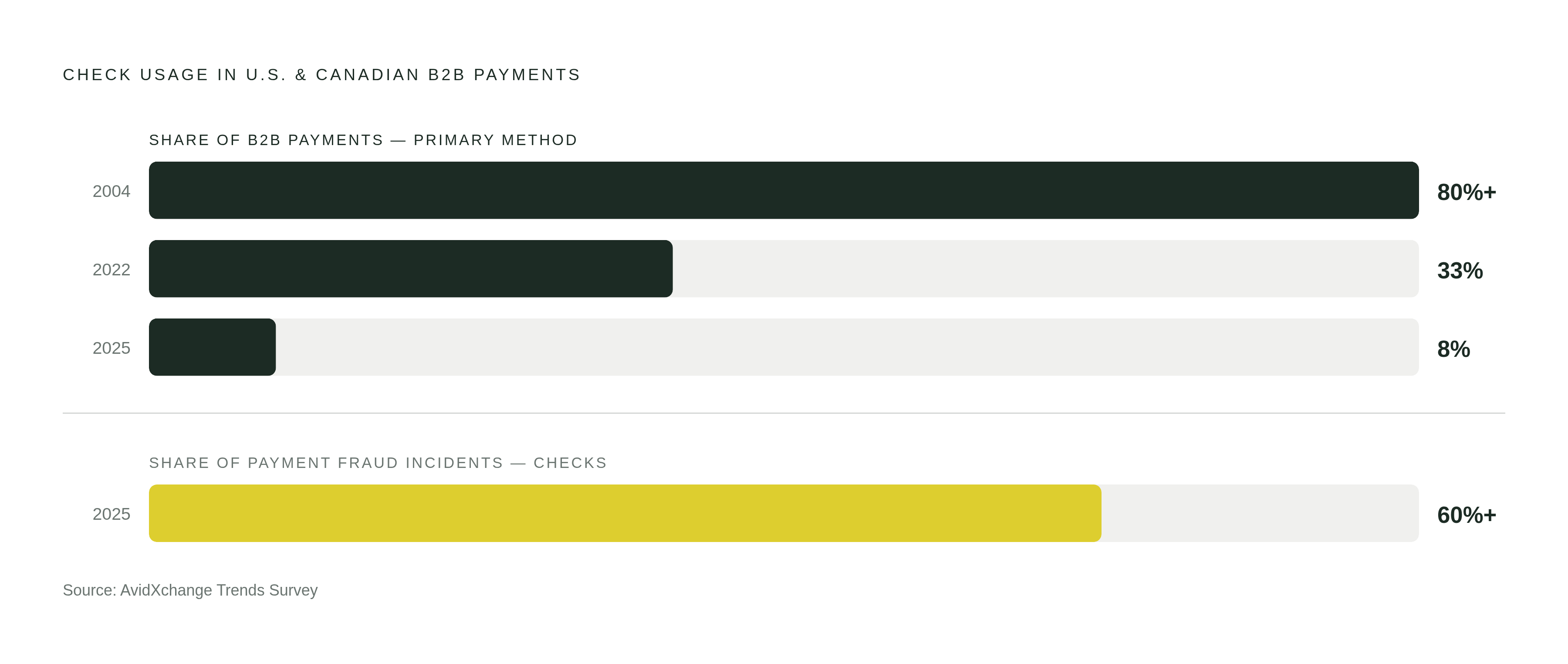
But, check usage has declined dramatically. In 2004, checks accounted for more than 80% of B2B payments in the U.S. and Canada. By 2022, that share had dropped to 33%. AvidXchange's 2025 Trends Survey found that only 8% of organizations now use checks as their primary payment method. But "primary" is doing a lot of work in that sentence. Checks are still deeply embedded in many vendor relationships, and dislodging them takes more than a better option.
The persistence of checks isn't just inertia. It's supplier acceptance, legacy ERP configurations, and change management resistance all showing up at once. Some vendors simply won't accept ACH. Some ERP setups make it operationally painful to switch a vendor's payment method. And inside the finance team, there's always someone who knows exactly how the check run works and is reasonably nervous about touching it.
The fraud cost here is concrete and significant. The 2025 AFP Payments Fraud and Control Survey found that checks account for over 60% of payment fraud incidents, and 79% of organizations experienced payment fraud attempts in 2024. That's not a fringe risk. That's a near-universal exposure.
Rail fragmentation also creates a controls gap that's easy to overlook. Approval limits and dual-authorization rules that exist inside the ERP don't automatically carry over to a separate payment portal. If your ACH run goes through one system and your wire approvals go through another, your controls are only as good as the weakest handoff. And the handoffs are where fraud strikes.
The cost of all this isn't captured in a single number. It compounds. Per PYMNTS data, 88% of finance leaders report challenges in AP operations, specifically citing delays and errors from manual entry and fragmented workflows.
Infrastructure Shifts Making Integration Viable
Three things are happening at the same time right now, and together they're making integrated payment systems more viable than they've ever been.
Real-time payment rails are maturing. The RTP network raised its single-payment limit to $10 million in February 2025 and was averaging more than 1.5 million payments per day. FedNow reached all 50 states in 2025, raised its own limit to $10 million in November 2025, and posted 460% year-over-year volume growth. The Citizens 2025 Payment Trends Survey found that 73% of respondents now use instant payments.
ISO 20022 is turning payments into data assets. SWIFT ended its MT/ISO 20022 coexistence period for cross-border payments on November 22, 2025. FedWire completed its migration on July 14, 2025. What this means practically is that payments now carry structured metadata. Remittance information, invoice references, and counterparty details travel with the payment itself rather than arriving separately or not arriving at all. This is the part that makes automated reconciliation actually reliable. When the payment and the matching data arrive together, the system can close the loop without human intervention.
Banks are embedding directly into ERP environments. Datos Insights research across more than 1,000 corporate users in 11 countries found that more than one in four corporate treasurers would likely switch their primary financial institution within two years if a competitor offered better technology integration. Banks are reading that number carefully. The J.P. Morgan and PNC examples above aren't isolated moves. They're responses to a competitive signal.
On the software side, cloud-based AP platforms are the fastest-growing segment of the market and are projected to account for approximately 64% of the accounts payable software market by 2030. The reason this matters for integration: cloud platforms support API-first architectures. Legacy on-premise systems were never built to connect this way. The infrastructure shift from on-premise to cloud is what's actually enabling everything else on this list.
What Virtual Cards and AI Add to the Stack
Virtual cards are single-use digital card numbers issued per transaction. They execute the payment, carry rich transaction data for automated reconciliation, and generate rebate revenue for the buyer. The adoption gap is puzzling: virtual cards account for just 2% of AP transactions today, even though 80% of buyers actively prefer suppliers who accept them. Juniper Research projects global virtual card payments to grow 235% by 2029 from a $5.2 trillion base in 2025. The finance teams building virtual card programs now aren't ahead of the curve by much, but they're ahead.
AI adoption in AP is moving faster. Adoption quadrupled in the past year, and the applications have shifted from basic automation (OCR, three-way match) to predictive systems that flag anomalies before payment, optimize payment timing, and route exceptions without a human having to queue them up manually. Machine learning models trained on ISO 20022's structured data can reduce false positives in compliance screening by 50% or more, according to Eastnets. Fewer compliance holds mean faster payment cycles.
The combined effect of AI and virtual cards on the integrated stack is specific. AI handles the exception detection and matching that used to require manual review. Virtual cards close the data loop on what was spent and on what. Together, they reduce the reconciliation burden that was the original friction point in the first place. They're not add-ons to the integrated setup. They're accelerants.
Fraud Controls Built In, Not Bolted On
79% of organizations experienced payment fraud attempts in 2024. AccessPay's Finance Trends Report 2025 found 60% of finance teams rank invoice fraud as their top risk. Global payment fraud losses are projected to exceed $50 billion by 2025.
In fragmented systems, controls are inconsistently enforced almost by definition. Your ERP has an approval workflow. Your payment portal is a separate system. Every handoff is a potential gap for fraud to come in.
Integrated systems embed controls at the transaction level. Dual authorization, payment limits, and vendor verification happen within the same workflow as payment execution. The audit trail is complete and automatic. You don't have to assemble it after the fact.
Business email compromise (BEC) is still one of the most common attack vectors for payment fraud. A bad actor convinces someone to update a vendor's bank account details via email then intercepts the next payment. Integrated systems with pre-validated vendor bank account data and change-alert workflows reduce this attack surface significantly.
However, there is a counterpoint worth keeping in mind. Increased reliance on APIs and third-party integrations does introduce new attack surfaces. The question finance teams should ask vendors directly: what is the security model for the integration layer itself, and who is responsible for keeping connectors current as APIs change? The quality of the answer tells you something important about the vendor.
Where Implementation Actually Stalls
Here's the part nobody leads with in the sales demo.
What looks turnkey during procurement becomes a substantial IT project when real ERP configurations are involved. Custom fields, legacy chart of accounts structures, and non-standard approval hierarchies all require mapping. The demo environment is clean. Yours is not.
Supplier data quality is a hidden project inside every implementation. Vendor records scattered across spreadsheets, emails, and outdated ERP fields must be cleaned before onboarding. Bad data causes failed payments and compliance gaps, and this is often what blows up the timeline.
Change management is underrated as a risk. AP staff who know the existing workflow have real institutional knowledge. Adoption gaps create parallel processes, and parallel processes undermine the entire value proposition of the integration.
Legacy ERP compatibility is a genuine constraint, particularly for mid-market companies on older on-premise systems. If your ERP is aging and on-premise, the integration question and the ERP modernization question are probably the same question.
AFP's Digital Payment Survey found only about 13% of organizations are focused on embedded finance solutions as a near-term priority. That's reasonable sequencing — the foundation has to be there before the advanced setup works. Organizations that implement successfully tend to scope the first phase narrowly: one payment type, one ERP integration, one supplier cohort. Prove the reconciliation improvement in a controlled environment, then expand.
What a Mature Integrated Setup Looks Like
A single workflow for all outbound payment types. ACH, wire, virtual card, and check, initiated and approved within or directly connected to the ERP, with no separate portals, switching between systems, or re-entering data.
Automatic reconciliation at settlement. Payment status, remittance data, and invoice match resolve without manual intervention, with exceptions surfaced to the right person immediately, not queued for bulk review at month-end.
Real-time cash position visibility. The CFO and treasury can see what has cleared, what is in flight, and what is scheduled, allowing them to make decisions based on current data.
Fraud controls embedded in the workflow. Vendor bank account changes require verification while payment limits and dual authorization are enforced at the system level. The audit trail generates automatically.
ISO 20022-compatible data flows. Structured remittance metadata travels with payments, enabling straight-through processing for cross-border transactions and reducing manual reconciliation on international payables.
The right question to ask vendors isn't "does this integrate with our ERP." Most will say yes. The right question is: "What does reconciliation look like on day one, and who maintains the integration when the ERP or payment API changes?" That's where mature setups differ from ones that work at launch and degrade quietly over time.