Vendor Relationship Management Explained
Most companies ignore 50-80 percent of their spending and don't see vendor risks until they fail.
Most organizations are flying blind on their biggest cost category. Not metaphorically. Literally unaware.
McKinsey found that somewhere between 50 and 80 percent of total external spending at most companies is effectively unexamined. That's not a niche problem buried in a footnote. That's the largest unmanaged cost category sitting right in the open, invisible only because no one built the systems to actually look at it. Aberdeen found that companies with formal supplier management programs captured average cost savings of around 12 percent. Not from dramatic renegotiations or heroic procurement wins. Just from having a program.
But cost is honestly the easy part to explain. The visibility problem goes somewhere darker.
Supply Chain Dive reported in 2025 that 65 percent of procurement leaders have limited to no visibility beyond their Tier-1 suppliers. Your vendors' vendors are essentially strangers to you. When something breaks two or three tiers deep, you find out the same way your customers do. After the fact, in the worst possible way. Gartner put numbers to what that looks like: 84 percent of survey respondents had experienced disruption from third-party risk incidents, and 66 percent experienced direct financial harm from it. That's not worst-case scenario territory. That's just Tuesday.
Here's the one that still gets me: a 2025 study found that 73 percent of financial institutions are managing vendor risk with two or fewer employees while overseeing more than 300 vendors each. Half that group reported a vendor-related cybersecurity incident in 2024. Two people. Three hundred vendors. Half the room breached. You can see how that stops working.
Cybersecurity is worth a moment on its own. Airbase Insights put the share of cyberattacks originating in the extended supply chain at 40 percent as of 2024. IBM's Cost of a Data Breach Report from the same year pegged the average U.S. breach cost at $9.36 million. Your vendors aren't just operational partners. They're an attack surface, and a large one, and most organizations are treating them like neither.
Then there's the economic layer sitting on top of all of it. Deloitte's 2025 Global CPO Survey found 41 percent of Chief Procurement Officers actively renegotiating with existing vendors to manage price increases and volume volatility. External pressure doesn't reduce the need for VRM structure. It raises the price of not having any.

The Five Stages That Make Up the VRM Lifecycle

VRM is a cycle, not a project you finish and move on from. Each stage feeds the next, and skipping one creates problems that surface two or three stages later when you've forgotten you skipped anything. Think of it less like a checklist and more like a loop that never fully closes, because it doesn't.
Stage 1: Needs Assessment and Vendor Selection
This stage starts before any vendor is in the room. Procurement and the relevant business stakeholders sit down and define what the organization actually needs, not just what it wants, and why. It sounds obvious. It gets skipped constantly.
The standard tool is the RFP, the request for proposal. It outlines your requirements, invites vendors to respond, and gives you a structured way to compare options before committing to anyone. The process should narrow toward best-and-final offers. Selection is a process, not a conversation, and the organizations that blur that line usually regret it.
Stage 2: Contracting
The contract sets the tone for the entire relationship. Not just the legal exposure. The actual working tone between the two organizations.
Both sides have legitimate interests. The vendor wants volume commitments and clear payment terms. You want quality, consistency, and a vendor who picks up the phone when something goes sideways. Legal team involvement isn't optional here. SLAs and escalation paths belong in the contract itself, not added later when you realize you needed them after the first real dispute.
Stage 3: Onboarding
This is where the agreement becomes a working relationship, and where more problems quietly begin than most people want to admit.
Good onboarding covers system and data access provisioning, compliance alignment across security and regulatory requirements, and a kickoff meeting where both sides confirm milestones and success metrics together. Weak onboarding is one of the most consistent sources of early friction in vendor relationships. Expectations misaligned at the start rarely self-correct. They just calcify.
Stage 4: Performance Management
Without defined metrics, issues go undetected and evaluations become about whoever makes the most noise. The KPIs worth tracking consistently:
- On-time delivery rate
- Defect rate
- SLA compliance percentage
- Cost variance against contract
Review cadence should match risk level. High-risk vendors warrant quarterly or semi-annual reviews. Moderate-risk vendors can go annually or every 18 to 24 months. Scorecards paired with direct feedback loops are the mechanism that makes this work. Measurement without conversation doesn't actually change behavior. It just creates a paper trail.
Stage 5: Offboarding
Ending a vendor relationship well matters almost as much as starting one well. Future re-engagement, referrals, and your own security posture all depend on it.
The immediate priorities are access revocation: system credentials, API keys, shared logins, cloud procurement tool access. Before closure is complete, a security review of all data-sharing arrangements is required. Offboarding is a risk-management event. Treating it like an administrative checkbox is how sensitive data ends up somewhere it shouldn't be, six months after a vendor you forgot about walked out the door.
How to Segment Vendors So Attention Goes Where It's Worth Most
Treating all vendors identically is a resource allocation mistake, and a pretty costly one. You end up over-investing in low-stakes relationships and under-investing in the ones that could actually sink you. The difference between a strategic vendor and a non-critical one? Roughly three missed quarterly reviews and a crisis you didn't see coming.
The foundational model is the Kraljic Matrix, developed by Peter Kraljic in 1983. It still dominates procurement thinking for good reason. Two dimensions: profit impact and supply risk. Four quadrants:
- Strategic: high impact, high risk. Vital to operations and hard to replace.
- Leverage: high impact, low risk. Important, but widely available in the market.
- Bottleneck: low impact, high risk. Niche need, difficult to source.
- Non-critical: low impact, low risk. Easily replaceable, low oversight required.
The practical value is that it tells you how to source, how deep to go on contracts, and how much relationship investment is actually warranted. One approach for all vendors is not a strategy. It's just what happens when no one makes a deliberate choice.
Where Kraljic falls short: it's a static model. A snapshot. It only uses two dimensions, which means it misses collaboration maturity, innovation potential, and ESG performance entirely. Procurement Leaders reported in 2025 that many organizations are moving toward more nuanced tier definitions, including transactional, essential, visionary, and strategic.
A useful complement is the Engagement by Capability model developed by Rezaei and Ortt. It evaluates a supplier's willingness to collaborate alongside their ability to execute. Cost-and-risk frameworks don't capture relational dynamics. This one does. It's most useful when you're deciding which vendor relationships are worth deepening, not just which ones carry the most spend.
For smaller organizations that don't need the full complexity, Deloitte's three-tier model works fine: strategic, important, and transactional, defined by business criticality. Each tier gets a defined level of oversight without requiring complex scoring infrastructure.
The question every team should be able to answer for each vendor: what level of disruption would their failure actually cause, and does your current oversight level match that answer? Most of the time, honestly, it doesn't.

The Practices That Separate Functional VRM from Mature VRM
Functional VRM has a lifecycle and some documentation. Mature VRM treats vendor relationships as a portfolio that needs active management. The gap between them is mostly behavioral, not technological. Better tools help. They don't fix the behavior.
Strategic selection upstream. Aligning vendor strengths to business goals before contracting prevents the kinds of mismatches that governance can't fix after the fact. The most expensive vendor problems are selected in. By the time you're managing them, the damage is already structural.
Structured communication rhythms. Periodic review meetings that cover metrics, upcoming needs, and shared challenges. Document action items. Follow up at the next review. This sounds almost too basic to bother writing down, but it's the single practice that most consistently separates programs that hold up from ones that drift into reactive, crisis-only communication. That drift is the default state of most immature VRM programs, and it's invisible until something blows up.
Performance scorecards as the objectivity mechanism. Rooted in Six Sigma and Balanced Scorecard thinking: quality, delivery, cost, and service as standard dimensions. The goal is to move evaluations away from subjective impressions toward comparable, trackable data. One thing that gets missed here: scorecards only work when you share them with vendors. They're a feedback tool, not an internal audit document.
Cross-functional governance. VRM cannot live only in procurement. Legal, finance, operations, and business unit stakeholders need to be in the room. Siloed vendor decisions create downstream risk for the teams that weren't consulted. Every single time, without exception.
The human factors contracts can't enforce. During a shortage, a crunch, or a genuine crisis, vendors make choices about which accounts they prioritize. Mutual respect, payment discipline, and early communication when you can't deliver on your own commitments build the kind of relationship that earns preferential treatment. You want to be the account a vendor goes out of their way to take care of. That's not a soft benefit. That's a competitive position.
Vendor consolidation as a deliberate lever. Reducing your supplier count simplifies management overhead and usually improves pricing leverage. It's not always the right call. But it should be an active decision, not something you quietly avoid addressing while vendor sprawl accumulates in the background.
Toyota Motor Europe's approach is worth a look here. In a State of Flux interview, they described executive-level reviews, R&D events with vendor partners, and conference participation for their vendors' own suppliers. Strategic vendors are treated as genuine capability partners. Not managed at arm's length, but actually brought into the work.
What Poor Vendor Management Actually Costs and Where It Breaks Down
Forrester Research found that organizations with mature supplier management programs reduce supply chain disruptions by 50 percent and improve cost efficiency by 20 percent. The inverse of that is what immature VRM leaves sitting on the table, and immature VRM is, by most measures, the norm.
The signs of an immature function are pretty recognizable:
- No central record. Vendor data scattered across spreadsheets, email threads, and shared drives that three different people maintain inconsistently.
- No formal process. Decisions made ad hoc, relationships managed by whoever happens to own the contact.
- Limited visibility into performance, spend, or contractual obligations until something has already gone wrong and someone is trying to figure out who's responsible.
Contract vagueness is a root cause worth sitting with for a second. Ambiguous SLAs and undefined escalation paths mean disputes get resolved by whoever argues harder, not by agreed standards. That's a solvable problem. A lot of organizations choose not to solve it until it costs them something real.
Over-reliance creates risk in both directions, and this one gets underappreciated. A vendor too dependent on your account becomes fragile in ways that can surprise you. A buyer too dependent on a single vendor loses negotiating leverage and builds up operational brittleness that's invisible until a disruption makes it obvious. Both scenarios are management failures. Neither shows up as a line item until something breaks.
Reputational exposure is similarly underappreciated. A vendor's unethical labor practices, data breach, or public scandal transfers reputational damage to your brand. That risk doesn't appear anywhere in your delivery KPIs. It just arrives.
Internal friction is a real obstacle too, and one that doesn't always make it into the conversation. VRM implementation runs into conflict with other organizational priorities, particularly pressure to reduce procurement cycle time and cost. That tension requires deliberate alignment at a leadership level. Better process design alone doesn't resolve it.
How ESG Criteria Are Becoming Part of Vendor Evaluation
ESG tracking has shifted from a voluntary differentiator to an expected component of vendor evaluation. If it still feels optional at your organization, the gap between perception and reality is closing faster than most procurement teams are ready for.
Regulatory pressure is the main driver. The EU's Corporate Sustainability Reporting Directive requires detailed ESG data from large companies meeting certain size and revenue thresholds operating in the EU, including non-European firms within scope. In the U.S., SEC mandatory climate disclosure rules for publicly traded companies cover Scope 1 and Scope 2 emissions. They don't yet extend to Scope 3, which includes supply chain activities. But vendors are already becoming part of compliance obligations for a lot of organizations, not just operational relationships. That direction isn't changing.
Gartner's directional signal: 70 percent of technology sourcing, procurement, and vendor management leaders will have environmental sustainability-aligned performance objectives for their functions by 2026.
What this means for VRM in practice:
- ESG scores need to live inside vendor scorecards, alongside cost, quality, and delivery.
- Vendor selection criteria should include ESG due diligence, especially for strategic and leverage-quadrant suppliers.
- Organizations that don't build ESG data collection into onboarding now will face a retroactive data-gathering burden as requirements tighten. Doing it retroactively is expensive and messy.
The segmentation connection matters here. ESG risk exposure isn't uniform across your vendor base. Strategic and bottleneck suppliers warrant deeper ESG scrutiny than transactional ones. The Kraljic lens applies to this exactly as it applies to everything else.
Building a VRM Function That Holds Up Over Time
The VRM function that actually holds up is designed as a continuous cycle, not a one-time setup that someone built three years ago and everyone assumes is still working. Every stage of the lifecycle generates data that should inform the next selection, the next contract, the next segmentation decision. When that information stops flowing, the cycle isn't working, even if all the documentation suggests otherwise.
Governance is the connective tissue. Cross-functional ownership prevents VRM from becoming procurement's problem alone, which is how it becomes no one's problem the moment procurement is underwater with something else. Defined roles, regular review cadences, and clear escalation paths keep the system running when people change roles. And people always change roles.
Technology reduces the manual overhead that causes VRM to degrade at scale. Centralized vendor records, automated performance tracking, and managed integration infrastructure are what allow a team to maintain visibility across a large vendor population without the whole thing collapsing under its own weight. Keeping vendor data current and integrations working shouldn't fall entirely on internal teams to manage manually. That's where things quietly start to break.
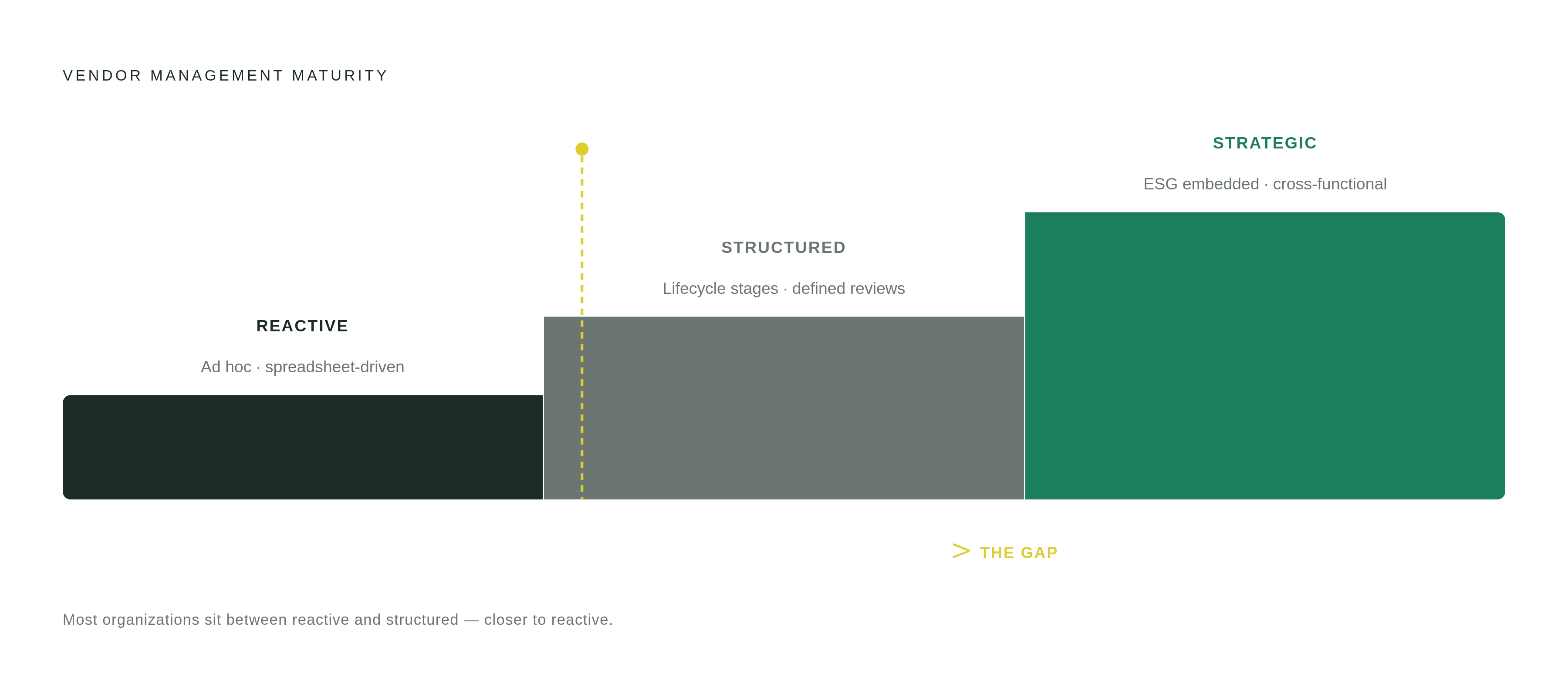
Most organizations follow a rough progression:
- Reactive: ad hoc decisions, spreadsheet-driven, no formal lifecycle
- Structured: lifecycle stages in place, segmentation applied, defined reviews
- Strategic: vendors treated as capability extensions, ESG embedded, governance cross-functional
Most organizations are somewhere between reactive and structured, closer to the reactive end than they'd probably admit. Getting to strategic requires deliberate investment. Better tools move you forward, but they don't get you there on their own. The bigger shift is behavioral: from treating vendors as interchangeable cost inputs to managing them as a portfolio of relationships, each with its own risk profile, strategic value, and appropriate level of attention.
When it's working, it looks like this: consistent performance visibility, risk you're catching before it becomes a crisis, and vendor partners who prioritize your account because the relationship has actually been worth their investment too. That last part is the one most people forget to build toward.