How the Accounts Payable Cycle Works End to End
Understand where controls belong and what happens when handoffs break down in your payment process.
- Written by
- Grant Farrell
- Published
- October 21, 2026
- Reading time
- 9 min read
What this covers
- What full-cycle accounts payable actually covers, and why the scope matters
- Why the cycle begins before any invoice arrives: purchase requisition and purchase order
- How goods receipt confirmation sets the baseline for payment accuracy
- Three-way matching: the central control that determines what gets paid
The accounts payable cycle runs from the first purchase request to final reconciliation. Its reliability depends on how those stages connect. Each stage gives the next the evidence or authorization it needs, so a poor handoff can let cash leak out several steps later. Seeing the whole chain shows where to put controls, where delays cost money, and where automation still needs a human brake.
What full-cycle accounts payable actually covers, and why the scope matters
Traditional, partial AP deals with invoices as they come in and focuses on the tasks needed to process them. Full-cycle AP links what procurement has committed to buy with what the books show the business owes. AP itself handles the back end of procure-to-pay, but understanding its full cycle means looking upstream at the commitments it inherits. The work may pass from one team to another, but someone must stay responsible at each handoff.
That distinction matters because dividing tasks is not the same as managing a system. Partial or shared models spread the work across teams, which must work closely together so it stays clear who is responsible. A full-cycle model keeps one function responsible for the sequence, even where other departments supply information or authorization. This wider view helps finance trace an error to its origin rather than treating whichever desk it lands on as the scene of the crime.
Why the cycle begins before any invoice arrives: purchase requisition and purchase order
A purchase requisition establishes permission to spend before the business commits to a vendor. The requesting department records what it needs, including item descriptions, quantities, estimated costs, and budget codes. Finance or procurement reviews that request as an authorization gate before an order is placed. Without it, the invoice may be the first time finance learns that someone has spent the money.
Once the request is approved, procurement issues a purchase order, or PO. This legally binding document specifies quantities, agreed pricing, delivery terms, and payment terms. It is both a commitment to the vendor and the reference against which later activity can be tested. Receiving uses it to check the delivery, AP uses it to check the invoice, and payment scheduling draws on its terms.
Vendor onboarding also belongs at this point, with payment details, tax forms, and approval records collected before the vendor enters the system. Poor vetting creates exposure to duplicate payments and misapplied funds downstream. Requisitions and POs can slow procurement, but bypassing them moves the work downstream. Non-PO invoices, including services and subscriptions, are a substantial part of AP work precisely because they arrive without this matching baseline and need a different control path.
How goods receipt confirmation sets the baseline for payment accuracy
The receiving team checks the delivery against the PO, which records what the business agreed to buy, and produces a goods receipt note as evidence of what arrived. The note documents the actual quantity and whether the goods meet specifications and arrive in acceptable condition. It bridges procurement and payment by giving AP facts that neither the order nor the vendor’s invoice can establish alone.
Without that record, AP can compare a bill with an agreement but cannot confirm delivery. A vendor could invoice for more than it delivered, and the gap would remain invisible to a check based only on the PO and invoice. The receiving team’s record is therefore a payment control, even though receiving does not pay the bill. For services, the department that used the service provides a sign-off that serves the same purpose. The evidence takes a different form, but the gate remains.
Three-way matching: the central control that determines what gets paid
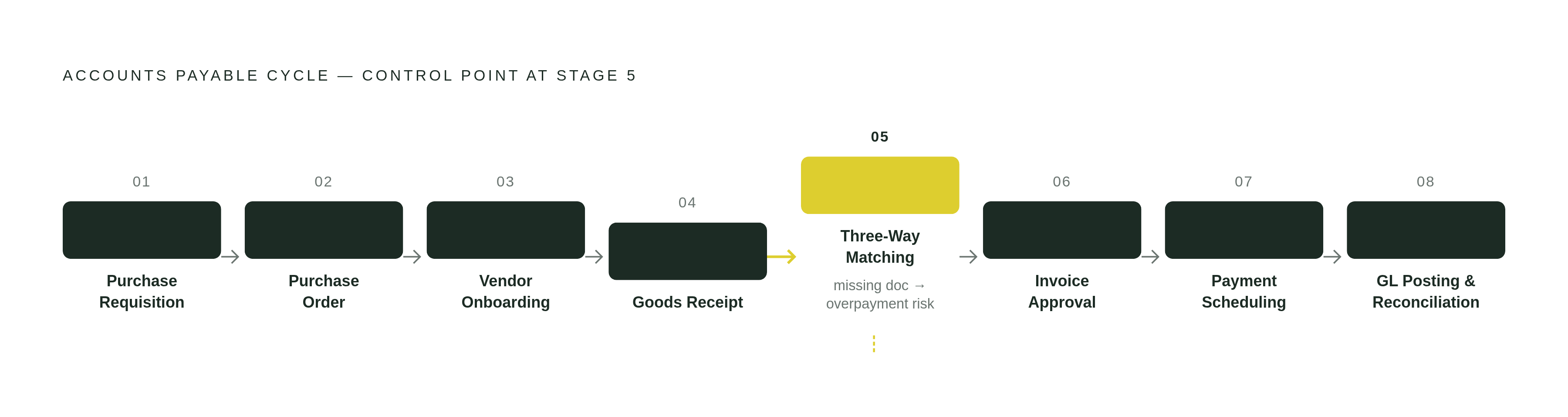
Three-way matching brings together the purchase order, goods receipt note, and vendor invoice before the payment can be approved. It tests what was ordered against what was delivered and what was billed. The documents must agree on quantity, price, and specification. A match clears the invoice for approval, while a mismatch creates an exception that must be resolved before payment proceeds. This is where the earlier controls either support one another or reveal a break in the chain.
The control works because each document answers a different question. The PO establishes the authorized commitment, the receipt records fulfillment, and the invoice states the vendor’s claim. An invoice that looks convincing is still only a claim. For goods never ordered or delivered, a fraudulent invoice lacks the matching order and receipt evidence.
Two-way matching is weaker because it compares only the PO and invoice. It can detect differences in billed pricing or quantities against the order, but it cannot establish whether the full delivery arrived. Non-PO invoices have a different limit because there is no purchase order to use in a three-way match. Services, subscriptions, and recurring expenses without a PO therefore need their own approval workflow to provide control in the absence of a matching baseline.
Invoice approval routing and why approval is the most common bottleneck in the cycle
Matching establishes that the invoice agrees with the supporting records, but agreement is not authorization. The invoice must then go to the budget owner or department head who is named to give sign-off. This separation enforces segregation of duties, so one person does not control both verification and payment authorization. Approval is the most common bottleneck because the process now depends on the people accountable for the spend.
Where an invoice goes for approval usually depends on its amount, department, or expense category. A small recurring utility bill may auto-approve if it falls below a threshold, while a large vendor payment needs more than one sign-off. Those distinctions preserve different levels of scrutiny, but the clock keeps running while an invoice waits. Net 30 and Net 60 terms do not pause for a busy inbox. A pay-within-10-days discount is lost if approval takes longer than the window, even when every other check was correct.
Exceptions add another source of delay because invoices that fail matching need dispute resolution before they can return to the approval queue. Unresolved discrepancies can delay payment and strain vendor relationships.
Payment scheduling and execution: turning approval into a controlled cash outflow
An approved invoice still leaves several decisions open, namely when to pay, how to pay, and which payment batch will carry it. Scheduling balances agreed terms, such as Net 30 or Net 45, with the company’s cash position. Holding payment until the due date preserves cash, while paying early can capture an available discount. Paying late can bring penalties and harm the relationship with the vendor. Approval permits the outflow, but scheduling determines its effect on cash.
The method also changes cost, speed, and fraud exposure. Options include ACH/EFT, wire transfer, virtual card, check, and BPAY in Australian contexts. Virtual cards create single-use numbers that carry less risk of fraud than ACH payments, which use banking details that stay the same. The payment batch needs a separate sign-off from invoice approval, because approving the obligation and authorizing its disbursement are distinct controls.
Human oversight is especially important when a vendor’s banking details change. An attacker can impersonate a vendor by email, request an ACH account change, and redirect the next automated payment. Any bank account change request must therefore be escalated and verified independently before the payment run. After payment, remittance advice closes the supplier communication loop and supports reconciliation, reducing avoidable queries about what was paid.
General ledger posting and reconciliation: how the cycle closes and what it leaves behind
Paying the bill is not the same as closing the cycle. The ledger and the bank must agree, and that agreement is what makes the payment useful as reliable financial data. General ledger posting records the initial liability when the invoice is approved and the payment when funds are disbursed. It also includes accruals for goods or services received but not yet invoiced. Without accurate posting, the balance sheet can misstate what the company owes.
Reconciliation compares outstanding liabilities, payment activity, and supplier balances with the relevant records and bank statements. It establishes which balances remain open and which have been settled. It also exposes errors that slipped through earlier gates, including duplicate payments, approved overpayments, and supplier balances that do not tie to the ledger. Finding them after payment is more expensive than stopping them beforehand, but this is the last line of detection before they compound into the next period.
The cycle also leaves behind an audit trail, with records retained for internal review and external compliance. That trail needs to cover the transaction from PO through payment. Complete records explain the obligation as well as its settlement. Accurate AP data then feeds cash flow forecasting, allowing finance to see what must be paid and when. Incomplete records leave that forecast resting on only part of the company’s obligations.
How the interdependency of steps turns individual errors into systemic problems
A forecast built on incomplete AP data is the downstream expression of gaps in the transaction chain. The same logic applies to payment errors, which often appear far from the step that caused them. Wrong banking details entered during vendor onboarding can emerge later as a payment exception or misdirected payment. Fixing only the payment run leaves the source untouched.
A missing goods receipt creates a different cascade. Matching has only two of its three documents, so an invoiced quantity can agree with the order while exceeding the quantity delivered. The receiving omission then becomes an overpayment, which reconciliation may eventually expose. Slow approval shows that a process can also lose value without paying the wrong amount. Matching may work perfectly while the invoice waits until it is too late to get the early-payment discount.
Automation can multiply these dependencies. Wrong vendor master data can be applied to every invoice for that vendor across a high-volume payment run. The system repeats the error faithfully, which is not the kind of loyalty finance needs. AP improvements should therefore be assessed across the cycle. Better matching cannot repair bad banking details, and faster payment without a bank-change control can accelerate a loss.
Where automation changes the cycle's control logic — and where it doesn't
Automation changes who performs the mechanical work while preserving the importance of the cycle's control gates. AP software has moved beyond OCR templates and suggested general ledger codes to agents that code invoice lines, match them to POs, summarize them for approvers, flag anomalies, and schedule payment. These tasks can run one after another without a person handling each stage. People then spend more of their time on exceptions and decisions for which someone must remain responsible. Approval is still the bottleneck most resistant to full automation because a system cannot take responsibility for the spend.
Automated systems can process the same invoice that comes in through more than one channel unless they have duplicate detection built in. Automated onboarding without dual approval creates an opening for ghost vendors, while payment runs without independent bank-change verification expose funds to redirection. These are reasons to retain the controls that manual handling must not be mistaken for.
E-invoicing mandates are restructuring the cycle whether a company chooses automation or not. Belgium mandated B2B e-invoicing via Peppol from January 2026. France launched its B2B mandate in September 2026 for large and mid-sized enterprises. The EU’s ViDA package will require structured e-invoices and near real-time reporting for intra-EU trade from July 2030. Structured data eliminates the document-capture step and turns matching into a database comparison, moving human oversight further toward exception handling and payment authorization.
Integrated full-cycle platforms, including Ramp, Precoro, Weel, and HighRadius, connect the sequence from PO through reconciliation in a single workflow. Point solutions that automate one task without integrating the others can reproduce the handoff errors of partial AP. The value of understanding the cycle end to end is therefore not knowing which steps software can perform. It is knowing where human judgment must remain when the mechanical work no longer needs human hands.