What a Purchase Order Is and How It Differs From an Invoice
Purchase orders authorize spending before delivery; invoices request payment after goods arrive.
- Written by
- Hana Aslan
- Published
- October 7, 2026
- Reading time
- 9 min read
- Sources cited
- 7 sources ↓
What this covers
Picture an accounts payable clerk with two documents open side by side on a monitor. The vendor name is the same. Same dollar amount. Same list of items. A few lines of fine print make up the only real difference, and even those take a second read to spot. That mix-up is the whole reason this article exists: a purchase order and an invoice look enough alike to be mistaken for copies of the same thing, when they are actually two separate documents doing two separate jobs at two separate points in time. Mixing them up is not just a paperwork headache. Skipping the purchase order step can expose a business to duplicate payments, invoices for goods nobody ordered, and budget overruns that are nearly impossible to catch once the money is already gone. The fix for all of it comes down to one plain fact: one document moves from buyer to seller before anything changes hands, and the other moves from seller to buyer after the job is done. Same deal, opposite ends. Keep that straight and most of the confusion disappears on its own.
What a purchase order is
A purchase order is a formal commitment a buyer sends to a seller, locking in what's being bought, how much it costs, and when it should show up, before any goods or services actually move. The buyer writes it. The seller receives it. That one-way direction is the first and easiest way to tell a purchase order apart from an invoice, since every other difference between the two documents builds on it. A purchase order does three jobs at once. It tells the seller they're cleared to ship the order and bill for it. It puts a budget commitment on the books in the buyer's accounting system before a single dollar actually moves. It also gives the accounts payable team a reference point to check the invoice against later, once it arrives.
Once the seller accepts the purchase order, it turns into a contract with legal teeth. That means any change to price, quantity, or delivery date after that point calls for a new or amended purchase order, not a phone call and a handshake. If a purchase order goes wrong after the seller accepts it, that change becomes something people argue about in court.
A standard purchase order needs to include a handful of specific details to do its job. That means the date it was issued, the buyer's name and address, the seller's name and address, a description of what's being bought with exact quantities, the agreed price per unit and the total order value, the delivery address and expected delivery date, the payment and delivery terms, a unique purchase order number, and some form of authorized signature or approver reference. That purchase order number is the detail to remember. It's the thread that ties this document to every other document in the deal, right up through the invoice that eventually asks to get paid.
Not every purchase needs this much ceremony. Businesses routinely skip the purchase order for small or routine buys, like office snacks or a one-off software subscription, where the cost of formal paperwork would outweigh the protection it offers.
The four types of purchase orders
Not every purchase looks the same, so not every purchase order looks the same either. Some buys are a single, fully defined order. Others repeat every month for a year. Others need a locked-in price long before anyone knows the final quantity. Businesses have built four distinct types of purchase orders to match these patterns, because forcing every purchase into one rigid template creates more paperwork problems than it solves.
A standard purchase order covers a one-time buy where the items, quantities, prices, and delivery date are all nailed down from the start. Think of a construction company ordering a specific amount of concrete, at an agreed price per cubic meter, for delivery on a set date. That's the most common type by far, and it's what most people picture when they hear the words "purchase order." A blanket purchase order covers repeat buys from the same vendor over a set stretch of time, under a spending cap that's agreed on ahead of time, without pinning down a delivery schedule for every single order that comes out of it. A planned purchase order locks in the items and the price early, but leaves the exact quantity and delivery date flexible until they firm up later, which works well when a business knows roughly how much it'll need but not exactly when. A contract purchase order sets the legal terms and conditions with a vendor before anyone names a single item or quantity, and every standard purchase order that follows gets issued under that umbrella agreement.
What an invoice is
An invoice is the formal payment request a seller sends after the goods or services have already been delivered, spelling out what was provided and what the buyer now owes. Direction and timing flip entirely here compared to the purchase order. The seller writes the invoice, the buyer receives it, and it can only exist after the work is done, the mirror image of how the purchase order works. From the buyer's side, that invoice becomes a liability sitting in accounts payable. From the seller's side, the same document is a receivable sitting in accounts receivable, money owed to them.
An invoice carries legal weight too, as a demand for payment under terms both sides already agreed to, though that weight works differently than a purchase order's. A purchase order sets the terms of the deal before it happens. An invoice confirms what actually got delivered and what's now owed because of it.
A properly built invoice needs its own set of fields. That means a unique invoice number, the date it was issued, the seller's name and address, the buyer's name and address, a description and quantity of what was delivered, the agreed prices along with any discounts and taxes that apply, the total amount due, the payment due date, the purchase order number if one was issued, and ideally the payment terms and conditions spelled out again for good measure.
That purchase order number field deserves extra attention, because it's the single thread connecting this document back to everything covered in the earlier sections. A well-built invoice references the purchase order that authorized it in the first place, so the accounts payable team can match the bill to the original commitment without digging through old emails and guessing. Leaving that number off the invoice is the most common reason invoices sit unpaid in an accounts payable queue.
How the two documents compare across key attributes
The differences between the two documents show up in nearly every attribute that matters, including who writes them.
| Attribute | Purchase order | Invoice | |---|---|---| | Issued by | Buyer | Seller | | Timing | Before delivery, as authorization | After delivery, as a bill | | Purpose | Commit to buy and lock in terms | Request payment | | Legal weight | Becomes a contract once the seller accepts it | A demand for payment under terms already agreed on | | Financial role | Creates a budget commitment before any cash moves | Records a liability in accounts payable, a receivable in accounts receivable | | Owns the workflow | Procurement or the person requesting the purchase | Accounts payable on the buyer's side, accounts receivable on the seller's side | | Lives in | The buyer's procurement system | The buyer's accounts payable system and the seller's accounts receivable system | | Record-keeping role | Tracks approved spending and goods on the way | Tracks completed transactions and payments still pending |
For all these differences, the two documents share real ground too. Both reference the same goods or services. Both carry the names and addresses of buyer and seller. And both serve as the paper trail a business leans on during an audit or a dispute. They're two halves of one record, built at different moments for different reasons.
The sequence that connects them: how a transaction moves from PO to invoice to payment
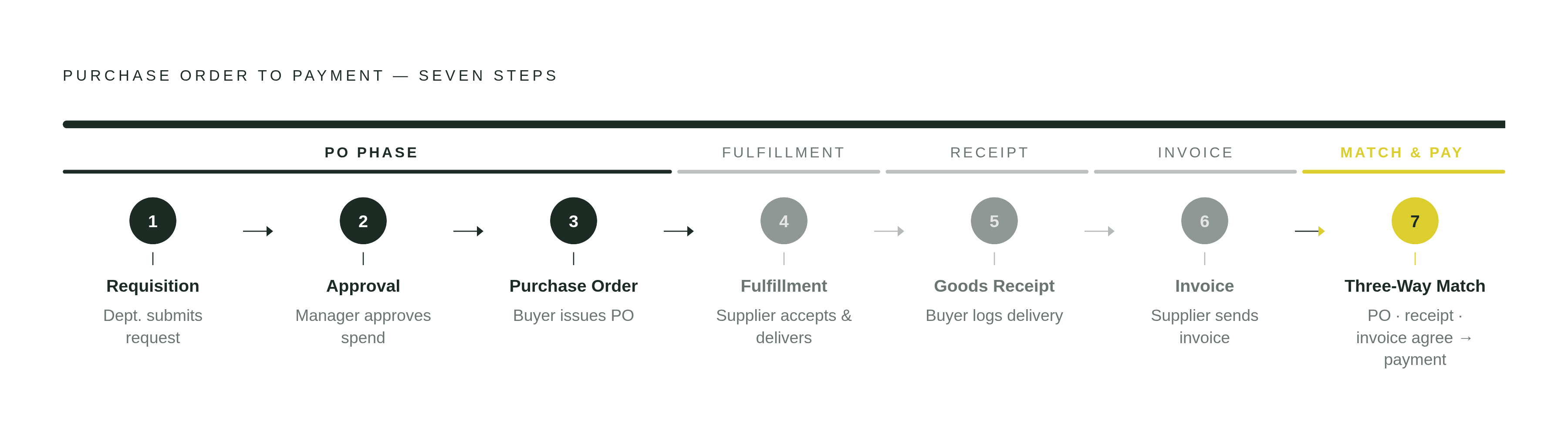
A purchase order and an invoice are two stages in one sequence, and the order never reverses: the purchase order always comes first, and the invoice only carries weight because the purchase order authorized whatever it's now billing for.
Here's how a typical purchase moves from request to payment. First, a department spots a need and submits a purchase requisition, spelling out the item, the quantity, the estimated cost, and the timing, all checked against the budget before any money gets committed. Second, procurement or a manager signs off on the spend, usually after checking what budget is left and how the department has spent in the past. Third, the buyer puts together the purchase order and sends it to the chosen supplier, setting the price, quantity, delivery terms, and the purchase order number that will track every document that follows. Fourth, the supplier accepts the purchase order, which locks in the contract, then fills the order and delivers it, sometimes all at once and sometimes in partial shipments that need their own tracking. Fifth, the buyer logs the delivery, creating a goods receipt record. Sixth, the supplier sends an invoice that references the purchase order number, and it lands in the buyer's accounts payable system. Seventh, accounts payable checks the purchase order, the receiving record, and the invoice against each other before releasing payment.
A concrete order illustrates the whole cycle in miniature: a purchase order specifies the type of concrete, the amount, the delivery date, and the price per cubic meter, the supplier delivers it, and only then does the invoice go out asking to get paid. Every step along the way leaves a record behind, and stacked together, those records form the audit trail a business leans on later. Skipping the purchase order step removes that trail's anchor, the one document that ties the spending back to a budget someone actually approved. That's precisely why most financial controllers push back hard on "no purchase order, no pay" exceptions. The purchase order is the anchor for the entire trail, and reconciling all three records against each other is the step that turns this sequence from a formality into an actual control.
Reconciling POs and invoices through three-way matching
Three-way matching is the control that turns this sequence from a stack of paperwork into an actual check on spending. It's the step that confirms a business only pays for what it actually authorized, actually received, and got billed correctly for.
Three documents go into that check: the purchase order, the goods receipt or receiving report, and the supplier's invoice. All three need to line up before payment goes out. The purchase order says what was ordered and at what price. The receiving report says what actually showed up. The invoice says what the supplier wants paid. When all three agree, payment moves forward without a second thought.
When they don't agree, the mismatch kicks the invoice into an exception queue for someone to sort out by hand. A partial shipment can mean the receiving report shows fewer units than the purchase order called for, so the quantities don't match up cleanly. A price change between order and delivery can mean the invoice bills a different rate than the purchase order locked in. A missing purchase order number on the invoice can stall the whole match before it even starts, since accounts payable has nothing to check the bill against. Each of these exceptions takes a person's time to track down and fix. Getting the purchase order right at the start, and making sure the invoice references it correctly at the end, saves far more hours than it costs.
Methodology & sources
- What Is a Purchase Order (PO)? Purpose, Types, and Benefits
Covered the purpose, legal standing, and key fields of purchase orders, which the article reflects in its definition and required-fields sections.
- What is a Purchase Order (PO) and How Does It Work?
Explained how a purchase order functions as a budget commitment and reference point for accounts payable, matching the article's treatment of the PO's financial role.
- Types of Purchase Orders: Standard, Blanket, Planned, Contract
Described the four types of purchase orders — standard, blanket, planned, and contract — which the article covers in detail.
- Invoice: Definition, Components, and Importance
Provided the definition and required components of an invoice, including its role as a receivable on the seller's side and a liability on the buyer's side.
- What’s the Difference Between Purchase Order and Purchase Invoice?
Outlined the key differences between purchase orders and invoices across attributes like timing, direction, and financial role, which the article's comparison table reflects.
- Purchase Order vs Invoice: Key Differences + Examples - Cflow
Explained the end-to-end transaction sequence from purchase requisition through three-way matching, which the article follows closely in its workflow section.
- Purchase Order vs. Invoice: What’s the Difference?
Described three-way matching and the role of the purchase order number in connecting the PO, receiving report, and invoice, informing the article's matching section.