ACH Payments for Business Finance Operations
ACH volume hit $93 trillion in 2025, reshaping how businesses move money daily.
The ACH Network moved 35.2 billion payments in 2025. It's the backbone of American business, the network that moved 35.2 billion payments in 2025. That volume carried a value of $93 trillion in 2025, an increase of almost 8% over the prior year. Paper checks, once the default for paying vendors, now make up just a quarter of B2B payment volume, down from a majority share less than a decade ago. That kind of drop doesn't happen because businesses got bored of checks. It happens because a cheaper, faster, more automatable option won.
And the shift hasn't leveled off. ACH volume kept climbing year over year through the second quarter of 2026, with Same Day ACH growing even faster than the network as a whole.
If ACH still lives in your mental model as "the slow, boring way to move money," that model is out of date, and it now touches customer experience, vendor relationships, and how much working capital sits on the balance sheet at any given moment. Getting ACH operations right is part of running finance. It's part of running finance.
How the ACH network moves money
ACH is a batch-processing network that clears in scheduled windows rather than in real time. Nacha sets the rules that govern it, and payments clear and settle between U.S. bank and credit union accounts in scheduled windows rather than the instant someone hits "send". That batching architecture explains both why ACH is so cheap and why it takes a day or three to land, a trade-off that recurs in the sections that follow.
Every ACH transaction runs through a small cast of players. The Originating Depository Financial Institution, or ODFI, is the bank that kicks off the payment on behalf of whoever's paying. The Receiving Depository Financial Institution, the RDFI, is the bank on the other end that receives and posts it. In between sit the operators, either the Federal Reserve or the Electronic Payments Network, which route the batched files from ODFIs to RDFIs. Nacha is an industry rulemaking organization that works alongside the Federal Reserve, the U.S. Treasury, and state banking regulators to keep the rules consistent.
Money can move through the network in two directions, and each carries a different risk profile⟶c11. ACH credits are "push" payments: the payer initiates them, covering things like payroll, vendor payments, and tax refunds. Because the funds are coming from a verified account the originator controls, the return risk is low. ACH debits are "pull" payments, where the recipient initiates the withdrawal after getting prior authorization, the mechanism behind recurring billing and subscription collections. Debits carry more risk, since insufficient funds and authorization disputes can both trigger a return.
The five processing stages are initiation and batching, transmission, validation, posting and settlement, and funds availability, and first comes initiation and batching: transactions get collected and formatted into Nacha files, and anything submitted after the daily cutoff waits for the next business day. Second is transmission, where batched files are sent to the ACH operators, who process files six times a day during business hours. Third, account numbers and routing details are validated, with suspicious transactions flagged. Fourth comes posting and settlement: funds get debited from the sender's account and credited to the receiver's, with the Federal Reserve handling settlement between the banks. Fifth and last is funds availability, where the receiving bank determines when the money becomes available to the recipient based on its own policy, the transaction type, and the size of the payment.
ACH processing times finance teams should plan around
Standard ACH clears in one to three business days. Same-day ACH itself posts on the same business day when submitted before the applicable cutoff. But which end of that range a payment lands on depends on the transaction type, when it was submitted, and the specific bank's internal policies, and guessing wrong costs a full business day.
Credits and debits don't move at the same speed. Nacha rules require credits to process within two business days, and in practice most post within one to two. Debits actually have a tighter processing requirement, one business day under Nacha rules, but funds availability can still stretch to two or three days because banks run extra verification on the pull side.
Cutoff times cause more missed settlements than anything else in the system. Same Day ACH has to be submitted before a cutoff that typically falls somewhere between 10:30 AM and 4:45 PM Eastern. Standard ACH cutoffs are usually set even earlier by the bank itself, commonly somewhere between noon and 3:00 PM Eastern, well ahead of the network's own deadline. A payment that misses that window falls back an entire business day, and a Friday afternoon submission that misses cutoff won't start processing until Monday.
A few other things stretch the timeline past the standard window. First-time recipients trigger extra verification. Large transactions sometimes get pulled for manual review. International banks may run earlier cutoffs to coordinate across time zones, and federal holidays wipe out processing windows entirely, no exceptions.
Nacha is eliminating the old rule that let non-Same Day ACH credits wait until 5:00 PM local time to post, a key change for 2026 planning. Under the new standard, funds have to be available by 9:00 AM local time on the settlement date. That's a meaningful shift for anyone building cash forecasts or payroll posting schedules around the old end-of-day assumption. Submit payroll and vendor runs at least two business days ahead of the date the money actually needs to land, and only reach for Same Day ACH when the cutoff is confirmed with certainty.
Same Day ACH: what the surge in volume means for treasury operations
Same Day ACH is the fastest-growing corner of the network, and it's turning into a real alternative to wire transfers for B2B payments that used to have no other fast option. The current per-transaction cap still limits which payments qualify, so it's not a universal fix, but the growth curve says businesses are using it for real work, not just testing it out.
The number backs that up. Same Day ACH volume jumped 23.6% year over year in the first quarter of 2026. That kind of growth doesn't come from a handful of companies experimenting. It comes from treasury teams building it into how they actually move money.
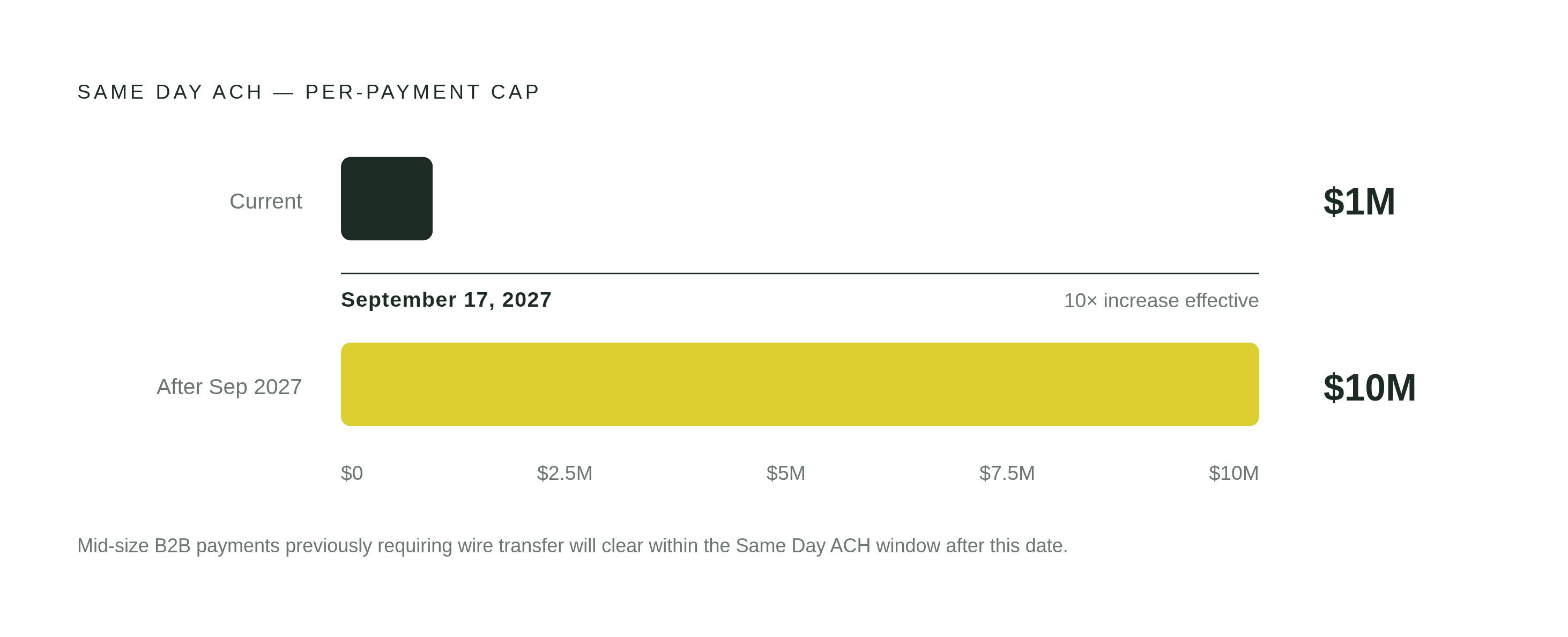
A bigger shift is already scheduled. Nacha has set September 17, 2027 as the date the per-transaction cap rises substantially. Once that takes effect, a large chunk of mid-size B2B payments that currently need a wire will fit inside the Same Day window. Under that rule, the per-entry dollar limit for Same Day ACH rises from $1 million per payment to $10 million per payment.
For now, Same Day ACH earns its keep on urgent payroll corrections, last-minute vendor payments, and time-sensitive transfers that fall under the existing cap. Finance teams should model which current wire-transfer flows would shift to Same Day ACH once the higher cap takes effect in September 2027, since the cost savings at scale are material.
ACH versus instant payments
ACH stays the right default for most routine B2B payments, and not because instant rails are somehow worse at what they do. It's because reversibility, cost, and reach across nearly every bank in the country outweigh raw settlement speed for most of what a finance team actually pays out every week.
Instant rails have a strong case, and it deserves a fair hearing. The Clearing House raised RTP's transaction limit substantially in early 2025, putting large corporate treasury flows within reach for the first time. RTP carried 142 million transactions in the second quarter of 2026, real volume from real corporate adoption, not pilot programs. Instant rails also run on the ISO 20022 message format, which carries far more remittance detail than a standard ACH addendum, invoice numbers, adjustment codes, reference data, all traveling with the payment itself and making reconciliation cleaner on the receiving end. And settlement is immediate: no return window, no waiting to see if a payment bounces back.
That last point cuts both ways, though. ACH still reaches more institutions than RTP, covering everyday use cases like online purchases, bill payments, and direct deposits that RTP simply doesn't touch at the same scale. ACH's return window is a genuine structural advantage in any high-volume environment where mistakes happen. A payment sent to the wrong account, or one triggered by fraud, can still be pulled back inside that window. Instant payments offer no such rescue: once a misdirected or fraud-induced payment clears, it's gone, with no clawback mechanism, which is the single biggest control risk for anyone considering instant rails for accounts payable. That $10 million RTP transaction limit itself became effective February 9, 2025, a tenfold increase over the prior $1 million cap that had been in place since April 2022. ACH costs a fraction of what wires and cards run per transaction, and the economics tilt hard toward ACH for anything recurring, scheduled, or not on fire.
The rule of thumb that cuts through most of this debate: real-time rails win wherever the cost of waiting is higher than the cost of losing finality, think payroll emergencies, deadline-driven B2B payments, large one-off transfers, refunds that need to move now. Everything else, recurring vendor runs, subscription billing, scheduled disbursements, stays on ACH. As one 2026 guide to FedNow and RTP frames it, real-time wins anywhere the cost of waiting exceeds the cost of finality.
Cost structure of ACH payments compared to checks, cards, and wires
ACH's cost advantage over checks and cards isn't a minor efficiency gain. At any real B2B volume, switching saves enough money to notice on a budget line, and the gap widens the more often payments go out. Issuing a paper check costs meaningfully more than sending the same payment electronically, while the median cost of initiating or receiving an ACH payment runs a fraction of that check cost, according to cost benchmarks from TowneBank's ACH payments resource article.
Credit cards make the comparison even starker. Merchants can pay 3% or more per transaction on card processing, and at typical B2B invoice sizes, that percentage fee dwarfs anything ACH charges to move the same amount. Wires solve a different problem: they're faster for large one-time payments, but the fees make them a poor fit for anything recurring or routine. ACH is the economical choice for every payment that doesn't need same-day, guaranteed finality.
The cost advantage isn't flat either. It compounds with volume, because the same batch-processing architecture that makes ACH cheap per transaction also makes it cheaper as the batch grows. More payments per run means a lower cost per payment, and that's why ACH scales so well for payroll runs and recurring vendor payments.
How businesses set up ACH payment origination
Setting up ACH origination is a defined sequence of banking, authorization, and data steps, and skipping any of them causes failed returns, compliance gaps, or payments stuck in processing limbo.
Start with the bank relationship. An origination agreement with an ODFI, whether that's a bank or a credit union, sets the origination limits, return rate thresholds, and security requirements that govern what a business can send and when. That agreement in place, the second step is collecting and validating banking information from payees or payers before any file gets built.
Next comes collecting and validating banking information from whoever's getting paid or paying. Every transaction needs a routing number and an account number, no exceptions. Nacha rules require account validation for WEB debit entries specifically, and extending that same validation to every new payee record, not just the ones Nacha technically requires, cuts down on returns and fraud exposure. That information usually comes in through a paper check, a voided check image, or a dedicated ACH authorization form.
Authorization comes third, and it's not optional paperwork. ACH debits need written or electronic authorization from the account holder before any funds move, and those authorization records have to be kept on file and ready for audit. Payment files then need to be formatted to Nacha specifications before submission.
Last comes obtaining proper authorization. As of March 20, 2026, originators must include standardized Company Entry Descriptions, specifically "PAYROLL" for PPD credit payroll payments and "PURCHASE" for WEB debit consumer e-commerce transactions, for applicable transaction types.
Sources
- ACH Payments for Business in 2026 with TowneBank
- 2026 Small Business Guide to ACH Payments - Emburse
- 2026 ACH Rule Changes: What Treasury, Finance and Payments Leaders Need to Know | Texas Capital Bank
- How to Accept ACH Payments: A Guide for Business Owners
- What are ACH payments and how does an ACH transfer work?
- Same Day ACH and Business-to-Business Payments Propel ACH Network Volume Growth in 2025 | Nacha