
Best AP Automation Software for Mid-Market Teams
Most mid-market AP teams fit neither simple tools nor enterprise suites—here's how to choose.
Mid-market companies are too big for simple AP tools and too small for enterprise ones, and no vendor built software specifically for them.
You've got multi-entity structures, tiered approvals, ERP dependencies, and a handful of international suppliers mixed in. A QuickBooks add-on falls apart under that weight. But SAP Ariba or full Coupa assumes you have dedicated procurement staff, a six-figure budget before professional services enter the conversation, and a team that treats AP as its own standalone department. You don't have any of that. You have two to eight people who are also doing four other things.
What makes vendor selection genuinely painful is that the variables that matter most don't appear anywhere in a feature comparison grid:
- ERP integration depth. "Supports NetSuite" can mean a real-time native connector or a nightly CSV sync through middleware. Those are not the same thing.
- Workflow configurability. Flat approval chains work fine until you add a subsidiary or promote someone. Then you need conditional or matrix routing, and a surprising number of tools don't actually offer it.
- Pricing at scale. A per-transaction model that looks reasonable at 500 invoices a month can quietly become a budget problem at 3,000.
- Implementation timeline. Twenty weeks of onboarding is survivable with a dedicated project manager. For a two-person AP team, it's a genuine operational risk.
- Global payment needs. A domestic US company and one paying 50 international suppliers have requirements so different they're almost shopping for separate product categories.
A meaningful portion of mid-market teams are evaluating their very first dedicated AP automation tool. Getting the initial fit wrong costs time, money, and the organizational goodwill you'll need for the next attempt. The framework below covers five things: ERP fit, workflow flexibility, payment capability, scalability, and time-to-value.
Tools built around collaborative invoice workflows and ERP sync
Stampli
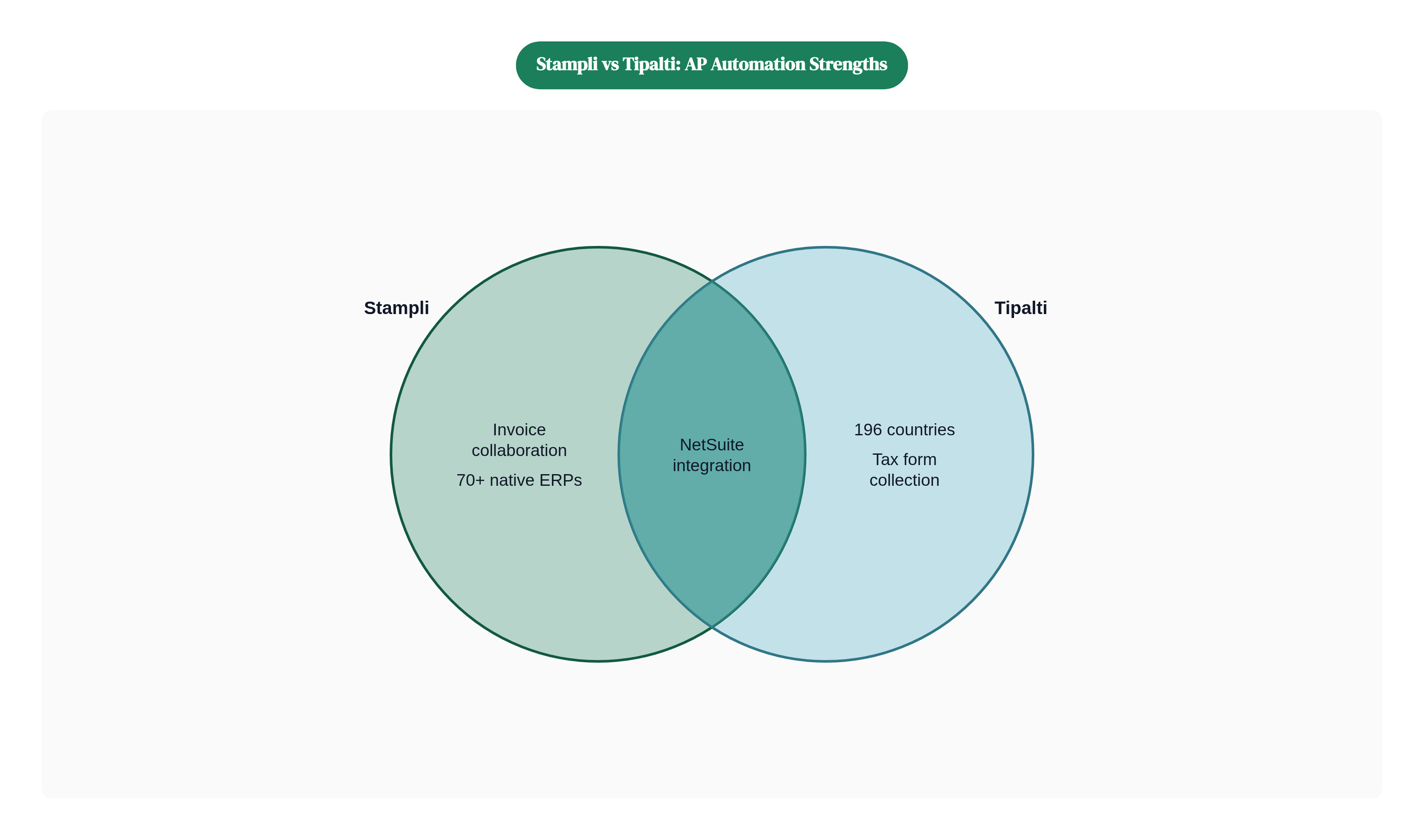
Stampli's core idea is straightforward: put the conversation about an invoice directly on the invoice itself. No more chasing approvers through email threads. The collaboration happens in context, where the invoice actually lives.
That sounds like a minor convenience until you've spent a Tuesday afternoon trying to reconstruct why a $40,000 invoice sat untouched in someone's inbox for three weeks. Without that context layer, an approval workflow is just a trail of unanswered questions.
What makes Stampli a solid fit for mid-market specifically:
- Multi-entity support with clean record separation across entities
- Over 70 native ERP integrations, including NetSuite, Sage Intacct, Dynamics 365, and QuickBooks, no coding required
- Real-time sync of vendor records, chart of accounts, and transaction data
- Implementation experience that consistently ranks above competitors in user reviews
On G2, Stampli holds a 4.6 out of 5 from over 1,800 reviews and sits as a Grid Leader in AP automation. It scores higher than Tipalti and AvidXchange on ease of setup and above the category average on user adoption and time to go live. For a small AP team that cannot afford to spend four months reaching first value, that matters.
The real limitation: global mass payment functionality is newer and still building a track record. If cross-border supplier payments are your dominant day-one requirement, Stampli isn't your primary tool. But for teams where the core problem is invoice processing, approval routing, and ERP sync, it's one of the most complete options in this segment.
Quadient AP (formerly Beanworks)
Quadient AP's appeal is its modular structure. Start with invoice automation. Add payment processing when you're ready. Add expense management later. You're not forced into a full-suite commitment before you've figured out what you actually need.
It integrates with QuickBooks, Sage, NetSuite, and Dynamics, and handles PO matching and unified workflows reasonably well.
The limitations show up consistently in reviews. Implementation runs longer than most competitors. Pricing scales with transaction volume in ways that make cost forecasting difficult as invoice counts grow. And some capabilities that feel like they should come standard turn out to require paid add-ons. Surface that in your first vendor call, not after you've signed.
Tools built around global payments and tax compliance
Tipalti
If your primary problem is paying suppliers across 15 countries in multiple currencies while staying current on W-9 and VAT compliance, Tipalti was built for exactly that situation. It covers 196 countries and over 190 currencies and handles tax form collection directly from suppliers. For teams managing international vendor compliance, that functionality alone reclaims significant time that previously went to manual follow-up.
The AP automation layer is substantive: rules-based approval chains, exception routing, multi-entity support, and over 100 ERP connectors with strong native support for NetSuite, SAP, Oracle, and Dynamics 365. Recent updates include AI agents for invoice capture, bill approvals, and PO matching. Tipalti holds a 4.5 out of 5 on G2.
Reviewers across G2, Capterra, and Software Advice raise these issues consistently enough to call them patterns:
- Onboarding stretches well past initial estimates
- Workflow flexibility is more constrained than some competitors
- Reporting lacks analytical depth beyond the basics
- Costs climb as add-ons accumulate
- Tipalti requires pre-funding a payment account before vendors get paid, which creates real cash flow friction worth modeling before you commit
Tipalti is the right call when global supplier payment volume and tax compliance drive the decision and your internal approval complexity stays moderate. If neither condition applies, better-fitting options appear below.
MineralTree (now part of Global Payments)
MineralTree's TotalAP covers the full AP sequence: invoice capture, approval routing, payment authorization, and payment execution including ACH, check, and virtual card. For teams that want one clean workflow without a lot of configuration overhead, it's a comfortable fit.
The main constraint: it covers AP but not procurement. If you also need purchase order management and a procure-to-pay workflow, you'll need a separate tool running alongside it.
Tools built for specific mid-market industries or operational profiles
AvidXchange
AvidXchange targets mid-market companies in real estate, construction, financial services, and HOAs. Those are industries where paper checks and manual AP processes are still genuinely common, and the platform reflects that reality rather than assuming you're already running a modern workflow. It holds a 4.4 out of 5 on G2. If you operate in one of those industries, it belongs on your evaluation list.
Two things worth knowing going in. First, Corpay and TPG now own AvidXchange. That's not inherently a problem, but ask during a vendor conversation whether the product roadmap continues to prioritize workflow features or whether the business model shifts toward payment transaction economics. Those produce different incentives. Second, Tipalti scores notably higher than AvidXchange on G2's quality of support metric. For a team leaning on vendor support through rollout, that gap is worth factoring in.
Rillion
Rillion suits mid-market companies processing high invoice volumes. It handles multi-entity and subsidiary structures well, with consolidated visibility across the organization. Industries with the most traction include healthcare, manufacturing, and hospitality.
The standout feature: Rillion's built-in AI learns approval patterns over time and predicts the right approver with accuracy in the low 90s, per the vendor's own reporting. For a growing organization that doesn't want to manually reconfigure routing every time headcount or structure changes, that's genuinely useful rather than just a marketing bullet point.
Medius
Medius is a spend management suite with a strong AP automation foundation covering invoice capture, approval workflows, payments, and analytics. It's particularly well-suited to mid-sized organizations with European operations. E-invoicing and Peppol support are built in, which matters as e-invoicing mandates expand across EU markets. Medius scales toward the upper end of mid-market and into enterprise territory, so teams on the simpler end will buy more platform than they'll ever use.
Tools suited to the simpler end of mid-market
Yooz
Yooz is cloud-native with strong OCR invoice capture from PDFs, and it handles email, portal, EDI, and mobile invoice ingestion. Implementation is faster than most competitors. Six to ten weeks is realistic for a mid-market team, which is a real advantage when your current situation is urgent.
The pricing model stands out: unlimited users, workflows, and entities under one subscription. No per-user cost escalation as your team grows. No per-transaction compounding as invoice volume increases. That makes cost forecasting straightforward in a way most AP software pricing does not. Fraud protection tooling, including fake invoice detection, atypical amount alerts, and bank account verification, comes included rather than added on. ERP integrations are narrower than Stampli or Tipalti but sufficient for most mid-market environments.
BILL (formerly Bill.com)
BILL is fast to implement and works well for teams running QuickBooks or Xero. The vendor network handles electronic payments without requiring you to manually collect bank details from every supplier. For a small or straightforward AP operation, that saves a surprising amount of low-value time.
The limitations surface as you grow. Approval workflow customization is limited, which makes it a poor fit for complex hierarchies or multi-entity structures. Per-transaction pricing compounds at higher volumes quickly. Best used as a starting point, or for mid-market teams with genuinely straightforward domestic AP and low entity complexity. If growth is on the roadmap, model where the costs and workflow limits will hit before you sign.
Ramp
Ramp combines corporate cards, spend controls, and AI-assisted bill processing in one product. It targets growth-stage companies that want spend management and AP together without stitching two tools together. It holds a 4.8 out of 5 on G2 from over 2,300 reviews, and a free AP automation tier for card customers lowers the entry barrier meaningfully.
It fits tech-forward, high-growth companies well. It fits traditional mid-market finance teams with complex approval hierarchies or ERP-heavy workflows considerably less well, because the integration layer is where those teams live and that's not where Ramp puts its energy.
ERP-native options (Sage Intacct and NetSuite)
If you're already on Sage Intacct or NetSuite, ask honestly whether the ERP can handle this adequately on its own before adding a point solution.
Sage Intacct handles multi-entity consolidation, multi-currency, and dimensional tracking natively, with audit-ready controls built in. NetSuite covers end-to-end invoice processing, approval workflows, and payment scheduling within the same environment you're already using.
The trade-off is real: you're locked into your ERP vendor's AP roadmap. If your approval workflows or supplier payment requirements grow more complex than the native capability supports, you'll hit a ceiling and run this vendor evaluation again under more pressure. But for teams with moderate AP complexity who already live in one of these systems, starting here eliminates integration overhead entirely.
What AP automation tools typically cost at mid-market scale
Entry-level AP tools start around $45 per user per month. Mid-market platforms generally run from a few hundred to low thousands per month depending on users and modules. Enterprise suites run well into five figures annually before professional services get added.
A few reference points worth keeping in mind:
- Tipalti's Starter plan is listed at $129 per month, which represents the lower bound for a dedicated AP automation platform.
- ProcureDesk runs $498 per month for purchasing automation and $850 per month once AP is added, a useful benchmark for a bundled procure-to-pay entry point.
Headline price matters less than pricing model. Here's what actually determines whether you pay what you expected:
Per-user pricing is predictable when your team is stable, but it doesn't reflect what drives your workload. Invoice volume drives workload. Headcount doesn't.
Per-transaction pricing looks reasonable early and compounds fast. A team moving from 500 to 3,000 invoices per month can watch costs multiply without gaining a single new feature.
All-inclusive subscription (Yooz is the clearest example here) removes volume-driven escalation entirely. Budgeting becomes simple. This model is rarer than it should be, which is why it's a differentiator when vendors offer it.
Hidden costs to flag before you sign:
- Add-on modules for capabilities reviewers expected to be included, a pattern that shows up consistently in Quadient AP feedback
- Implementation and professional services fees, especially material for platforms with longer onboarding timelines
- Pre-funding requirements like Tipalti's, which tie up working capital in ways that don't appear in the monthly subscription cost
How to match tool to team before starting a vendor evaluation
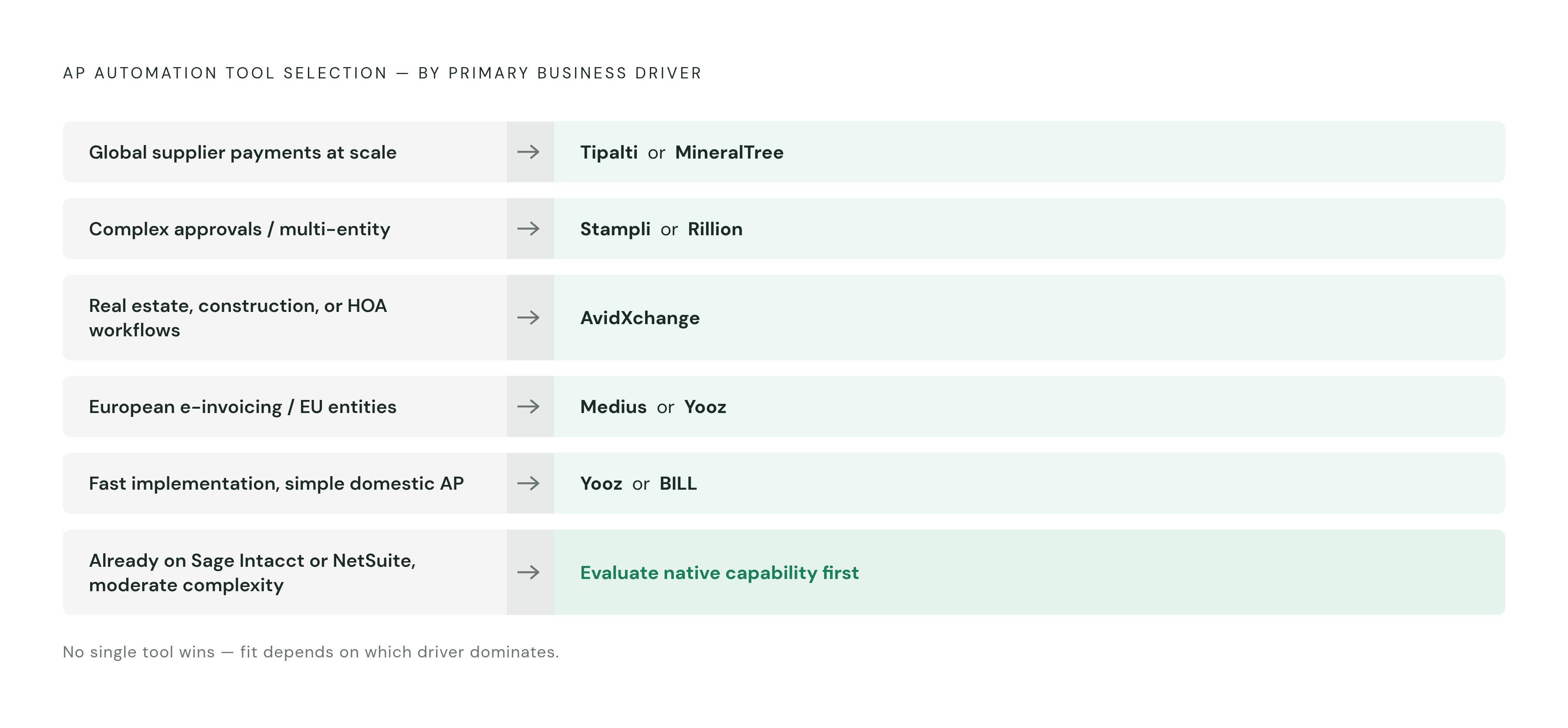
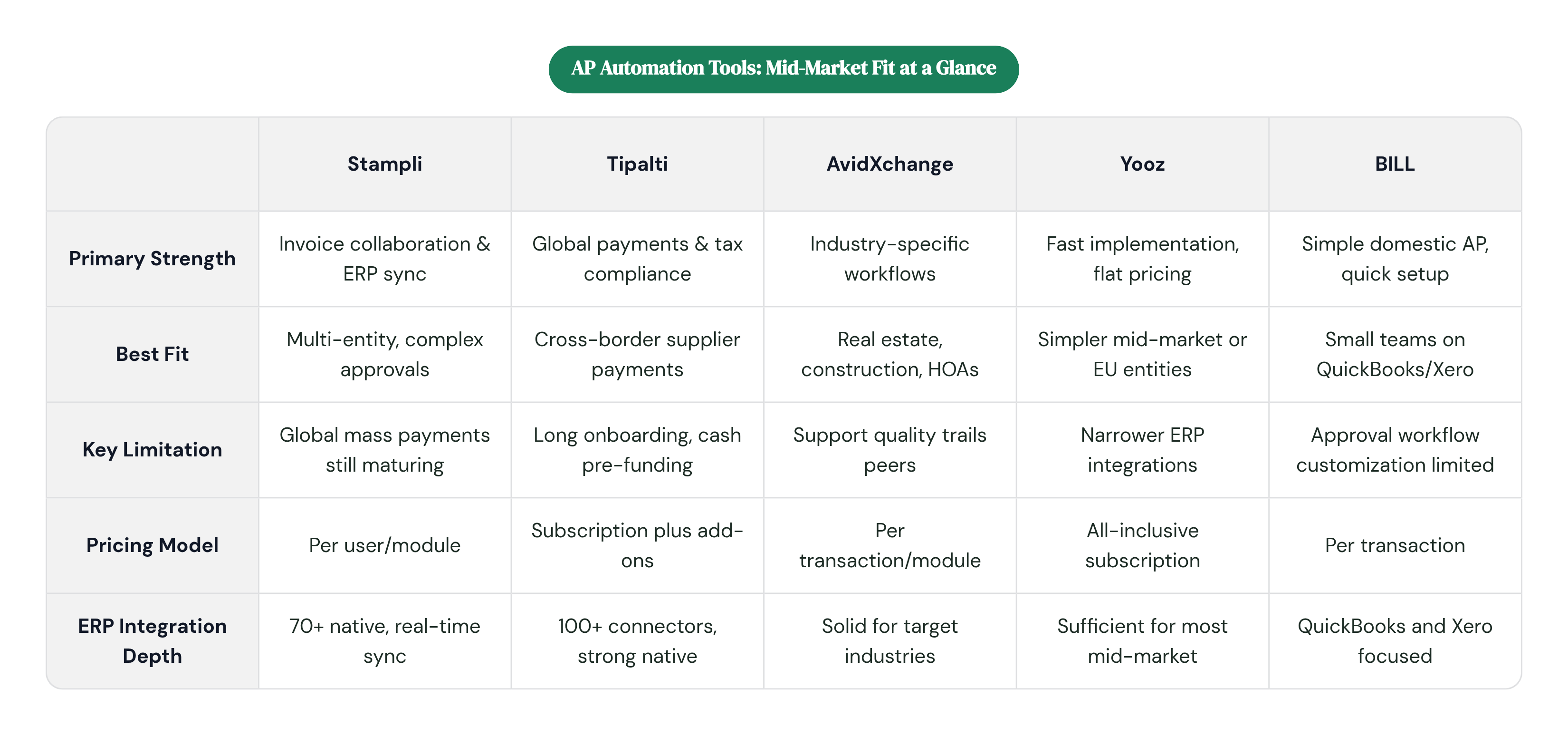
Start with your primary driver, not the feature list. Every tool here does most of the same things at a surface level. The question is what each one does best and whether that matches your biggest actual problem.
- Global supplier payments at scale → Tipalti or MineralTree
- Complex internal approval workflows, multi-entity structures → Stampli, or Rillion at higher volumes
- Industry-specific workflows in real estate, construction, or HOAs → AvidXchange
- European e-invoicing compliance or EU entity operations → Medius or Yooz
- Fast implementation, simpler domestic AP → Yooz or BILL
- Already on Sage Intacct or NetSuite with moderate AP complexity → Evaluate native capability before adding a point solution
Three things that prevent expensive mistakes:
Confirm the ERP integration works for your specific version. "Supports NetSuite" is not a complete answer. Ask whether it's a native connector or middleware. Ask whether it syncs in real time or in batches. Batch sync and real-time sync are operationally different in ways that surface at month-end close, not during the demo.
Model costs at your 18- to 24-month projected invoice volume, not today's. Pricing models that look equivalent at 500 invoices per month diverge significantly at 2,000. Run the math before you negotiate.
Get a written go-live commitment from the vendor. Not a slide in the sales deck. An actual contractual timeline. Implementation overruns are the most predictable and most common cost in this process. Vendors who push back on putting a timeline in writing are telling you something worth hearing.
The right AP automation tool isn't the one with the longest feature list or the most recognizable brand name. It's the one that fits your ERP, handles your approval complexity, and doesn't cost three times more than projected by go-live. That's an achievable standard. Start with the right question.


