
Building a Spend Management Business Case
Treat content marketing as capital investment, not operating expense.
The fight over content marketing budget is about funding it like you mean it. It's about whether you're funding it like you mean it. Most B2B and B2C marketers already have a documented content strategy sitting in a shared drive somewhere, so "should we blog" stopped being a real question a while back. The actual argument now is about level and structure: does the spend compound, or does it just disappear into a content calendar nobody measures?
That shift changes what a business case has to do. Content marketing now represents 26% of total marketing spend on average, and it is already the largest single budget line in most marketing organizations. B2B SaaS companies, specifically, spend more of their revenue on marketing than almost any other B2B category, and content plus SEO alone claims somewhere between a fifth and a third of that budget. When a category eats that much of the pie, a sloppy pitch doesn't just lose a budget line. It loses the compounding infrastructure that would've paid for itself three years down the road, and nobody sends a eulogy for that.
Content as a capital asset rather than an operating expense
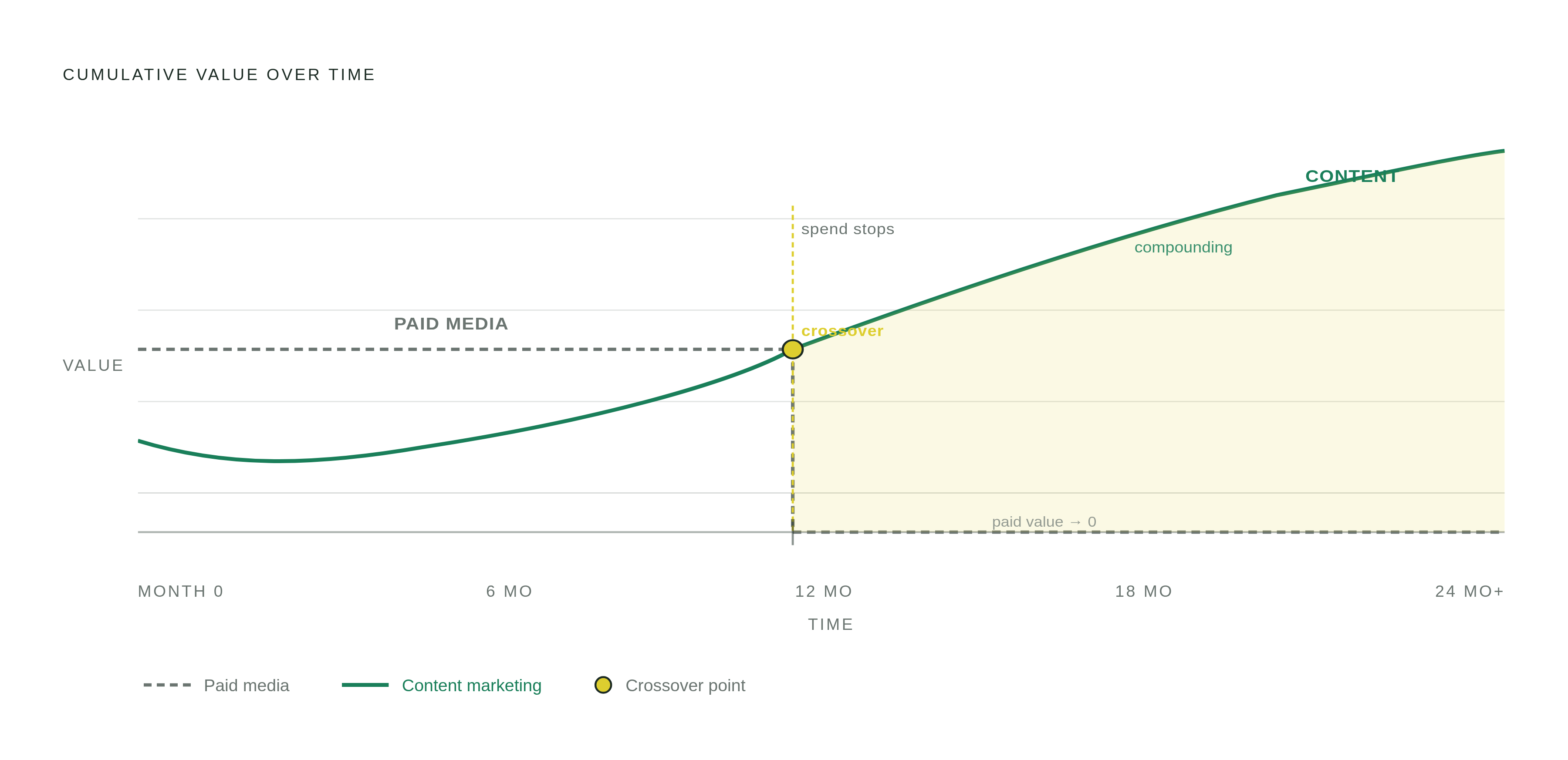
Paid media is rent, content is a mortgage. Pay for a Google ad, get traffic for as long as the campaign runs, and the second the spend stops, so does the traffic. Every dollar buys a moment. Nothing sticks around after the invoice clears.
Content works differently. A well-built page keeps earning search rankings and AI citations long after the writer's moved on to the next assignment, which means the cost sits up front, but the payoff stretches out over years. Organizations that started investing early are, unsurprisingly, the ones seeing outsized returns now. The gap between early movers and latecomers is widening. It's widening.
The payback period isn't glacial, either. B2B SaaS SEO tends to break even within months rather than years, which is fast by any capital-investment standard, let alone a marketing one. And the mechanism behind that payoff is genuinely mechanical: consistent publishing builds topical authority, authority earns citations, citations attract backlinks, backlinks compound both search and AI visibility. Each piece stacks on the last one like bricks, not like confetti.
Finance teams get this logic instantly once you use the right words. Call it capital expenditure with a depreciation curve, and the conversation changes. Call it a "recurring operating cost that should scale linearly with output," and you've just volunteered your own budget for the chopping block. Improvado's analysis of enterprise marketing spend found that long-cycle B2B companies who underfunded content while overfeeding paid social ended up paying a real, measurable penalty in customer acquisition cost. That's a cost compounding against them in the background. That's compounding interest working against you instead of for you.
One case from that dataset makes the point without needing embellishment. An anonymized company (Improvado calls it SaaS Enterprise A) ran a 90-day sales cycle and had tilted its budget hard toward paid social, starving content in the process. Once it corrected the mix and pushed more toward content and SEO, CAC dropped meaningfully and pipeline moved faster. The reallocation was the whole story. Nothing else in the business changed.
The ROI evidence that finance will find credible
Finance doesn't want a vibe. It wants a number it can hold up against a competing line item, which means the ROI case only lands when it's built from cost-per-result comparisons, real time horizons, and actual company examples, not category-wide averages that could mean anything to anybody.
Start with cost-per-lead, because it's the easiest comparison to make. Content marketing produces leads at a fraction of what traditional outbound costs, and that's a number finance can put directly next to whatever the outbound team is currently spending.
The strongest single case in the evidence is Fiska, and it earns the lead spot because it does something none of the other examples manage: it proves both arguments at once. Fiska went from zero inbound leads to a steady monthly flow, posted a very high ROI multiple on its content spend, and grew its visibility inside AI answer engines from almost nothing to a majority share, all in the same stretch of time.
Zapier's case matters for the method, not the headline figure. Under Head of Content Marketing Lane Scott Jones, the team measured content spend against signup revenue using a three-year lifetime-value multiplier, documented a strong multi-year return, and used that math to convince their own CMO to double down. The takeaway is the repeatability of the methodology for anyone willing to run the same math. It's that the methodology is repeatable by anyone willing to run the same math.
Datanyze took a narrower approach: instead of publishing more, the team figured out which content sources actually produced high-quality leads and poured resources there. The result was a strong lead-to-customer conversion rate and a big jump in lead volume, and the lesson generalizes well. Discipline beats output, every time.
As a calibration point, high-performing B2B SaaS teams put roughly a fifth to a third of their marketing budget into content and SEO, so any proposal landing in that range isn't asking for anything unusual. There's one objection finance almost always raises at this point, and it's worth naming before someone else does: "We've invested in content before and couldn't see the return." The honest answer points to how the return was measured." It's that the measurement was broken, which happens to be exactly what the next section is about.
The standard attribution model's undercounting of content's contribution to pipeline
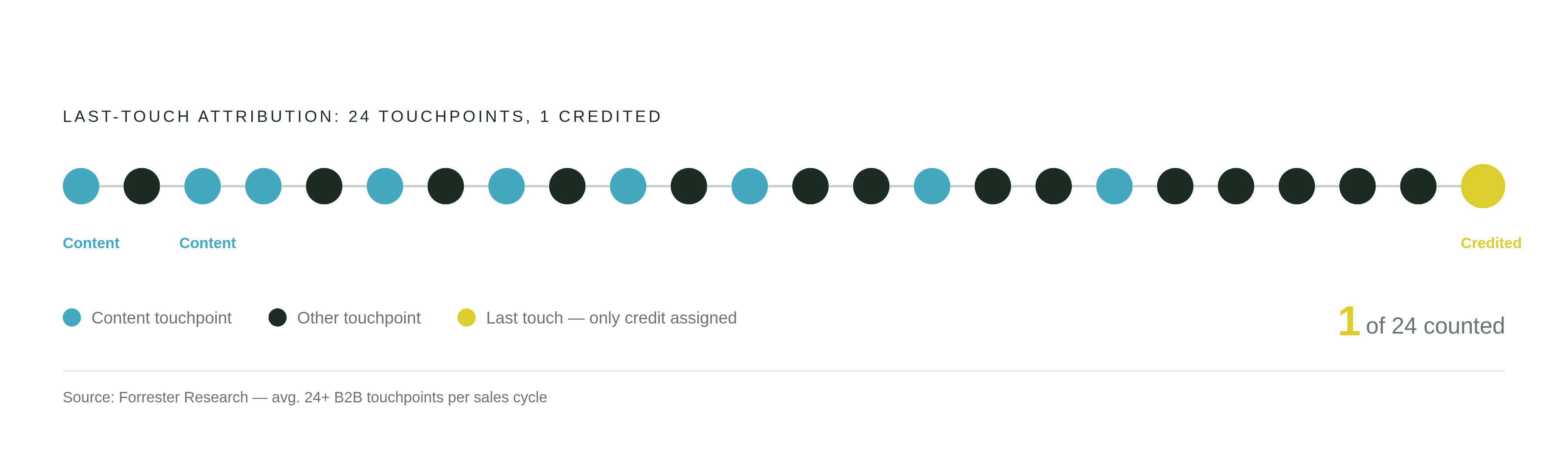
Most B2B marketing teams are still crediting deals to whatever touchpoint happened last, and that habit is quietly sabotaging every content budget conversation they'll ever have. A strong majority of teams still run last-touch attribution, which sounds harmless until you look at what it actually throws away.
Forrester's research documents an average of more than two dozen touchpoints across sales cycles that last many months. Last-touch attribution credits roughly one out of every seven of those touches, on average. Content shows up early and often in that sequence, contributing to a substantial share of pipeline overall, but because it rarely closes the deal, it shows up as basically nothing in the reporting. It's the equivalent of crediting only the goalkeeper who touched the ball last, and ignoring every pass that got it there.
It gets worse before it gets better. A meaningful chunk of B2B pipeline comes from sources that GA4 and standard multi-touch tools simply can't see, and for product-led growth companies, that invisible chunk is even bigger. Marketers have started calling this the dark funnel, and it's not a metaphor so much as a blind spot with a budget attached.
It runs on accounting illusion. It's an accounting illusion, and it removes a compounding asset based on a measurement tool that was never built to see it in the first place.
Gartner's research raises the stakes on this considerably. B2B buyers now finish most of their purchase journey before a sales rep ever gets involved, and a significant share would rather skip the rep entirely. That self-directed research phase isn't a nice-to-have layered on top of sales. It's the primary sales motion now, regardless of what the org chart says. Last-touch attribution triggers budget cuts on content that was quietly moving buyers through a 90+ day self-directed research window, cuts that remove a compounding asset even as the short-term cost appears rational.
The measurement stack that makes content spend defensible to a CFO
A business case that arrives with its own measurement plan attached is a completely different animal from one that just asks for money and promises a report later. One says "trust me." The other says "here's how you'll know."
The specific tool matters less than the layering. One tool alone can't see the whole picture, no matter how good its dashboard looks.
Improvado's enterprise data backs this up directly. Companies stuck in the bottom quartile of ROI performance had, unsurprisingly, invested far less in attribution tooling than the top performers. Measurement infrastructure forms the foundation of the "real" work. It's what turns the investment from a guess into something legible.
Top-quartile performers hold back a meaningful chunk of budget for mid-year reallocation and spend considerably more on attribution tools than everyone else. Build that same reallocation trigger into a content proposal from day one, and finance sees a plan that adjusts itself instead of one that just hopes for the best.
Analytics tools still can't see everything, though, so self-reported data has to fill the gap. CRM notes, sales call logs, and a simple "how did you hear about us" survey question aren't optional extras. They're the only way to catch the dark funnel activity that analytics tools cannot register.
Timing matters too. Set the expectation up front: content compounds over months, so the real review point should land around six months out, not thirty days. At the same time, bottom-of-funnel content, comparison pages, case studies, the stuff buyers hit right before they sign, can show pipeline contribution fast, giving finance an early signal while the bigger asset builds in the background. The stack produces leading indicators along the way (topical authority growth, AI citation rate, how often content shows up across the buyer's journey) that give a directional read long before the full return shows up on a spreadsheet. The research supports an integrated stack of analytics (GA4) combined with CRM attribution (HubSpot or equivalent) and an advanced multi-touch attribution layer (HockeyStack, Factors.ai, or similar) that connects content touchpoints to closed revenue across long sales cycles. We can't wait 12 months to know if this is working.".
The AI visibility dimension that traditional content ROI arguments miss entirely
A business case built only around search traffic and pipeline numbers is already out of date, because a growing chunk of buyer research now happens inside AI answer engines, and those don't have rankings or click-through rates in any form finance is used to reading. Gartner had forecast a sharp drop in traditional search volume by 2026, and while that drop didn't fully materialize at the scale predicted, AI Overviews now show up in more than a quarter of all searches and cut click-through rates on top-ranking pages significantly. So the traffic is still technically "there." It's just not clicking through the way it used to.
Gartner's 2026 research also found that a substantial share of B2B buyers used generative AI somewhere in a recent purchase process. That self-directed research window mentioned earlier now runs partly, sometimes mostly, through AI interfaces instead of a search bar. And the traffic that does arrive from AI referrals converts at a noticeably higher rate than traditional Google organic search, meaning AI-cited content isn't just adding volume. It's bringing in better visitors.
This isn't random luck for the brands that show up in AI answers, either. A peer-reviewed study on generative engine optimization found specific, measurable levers: quoting sources produces a 41% lift in AI citation rate on its own, and statistics, citations, and clean, readable writing all add their own separate lift. AI models reward specific editorial choices, not vague brand recognition: DATEV dominates Perplexity with the highest citation share among the platforms tracked, Pleo dominates Google AI Overviews at a majority share, and Spendesk owns the Spend Management category itself.
Given all that, AI citation rate belongs in the business case as its own metric, standing right next to search impressions and pipeline contribution, not tucked away as a "future consideration" for next year's deck. Whether AI models actually read a brand's content, cite it, and say its name out loud to a buyer is a completely separate data stream from organic traffic, and it deserves its own tracked outcome with its own reporting cadence.
The spend management vertical's own AI visibility data on content strategy
None of this is theoretical for spend management vendors specifically. The category has its own dataset, and it draws a straight line from owned content to AI citation share, which turns "invest in content" from a branding preference into a direct competitive move.
Recon Rise's AI Visibility Index DACH 2026 ran prompts across multiple buying moments and platforms, testing 304 vendors in the spend management space, which makes it about as close to a direct benchmark as this category gets. The findings split cleanly by platform: DATEV leads on Perplexity with the highest citation share tracked, Pleo dominates Google AI Overviews with a majority share, and Spendesk owns the Spend Management category outright. Three different platforms, three different leaders, no overlap. The competitive map is already drawn.
The majority of all citations across the category trace back to vendors' own content hubs. Not third-party review sites. Not analyst reports. Owned content, published and maintained by the vendors themselves.
Run that forward to what it means for a buyer. It's a loss that's already happening while the budget memo sits in someone's inbox. A large share of brands are currently invisible in AI answers across categories, and the spend management data shows that in this vertical, the visible brands are the ones that invested in content hubs.
None of that invisibility is mysterious once you look at the underlying pages, either. A lot of it traces back to structural, fixable problems: thin pages that AI systems can't extract cleanly, missing publish dates, and content published with no visible author at all. Those are editorial hygiene problems. They're editorial hygiene problems, and hygiene problems are the cheapest kind to fix, once someone actually decides to fund the fix. Our competitors are already ahead on AI visibility, we've".

