Spend Management Implementation and Change Management
Platform selection matters less than fixing how spend actually moves through your organization.
Most spend management rollouts die at the exact moment leadership thinks the hard part is over. Picking a platform feels like crossing the finish line, but it is the starting gun. The real question a finance team needs to answer, before signing anything, is where spend is actually slipping through the cracks right now, not what features they need.
Look at the status quo and the cracks are not subtle. Petty cash with no real tracking. Shared cards where five people know the access code and nobody remembers who bought what. Expense reports that get filed, and paid, weeks after the money already left the building. Every one of these methods shares the same design flaw: they produce a record after the money is gone. That is not control, that is bookkeeping. Real control means stopping a bad purchase before it happens, not writing a record of it afterward.
Most finance leaders think they have this covered. They have five or six tools running: a card program, an expense app, maybe a procurement tool bolted on from three years ago. It looks comprehensive from the outside. But disconnected tools that do not talk to each other create the exact gap where budget overruns, fraud, and compliance headaches live. The ROI case is not theoretical: organizations routinely pay for far more SaaS licenses than they actually use. That is a visibility problem with a dollar sign attached.
What Spend Management Software Actually Covers
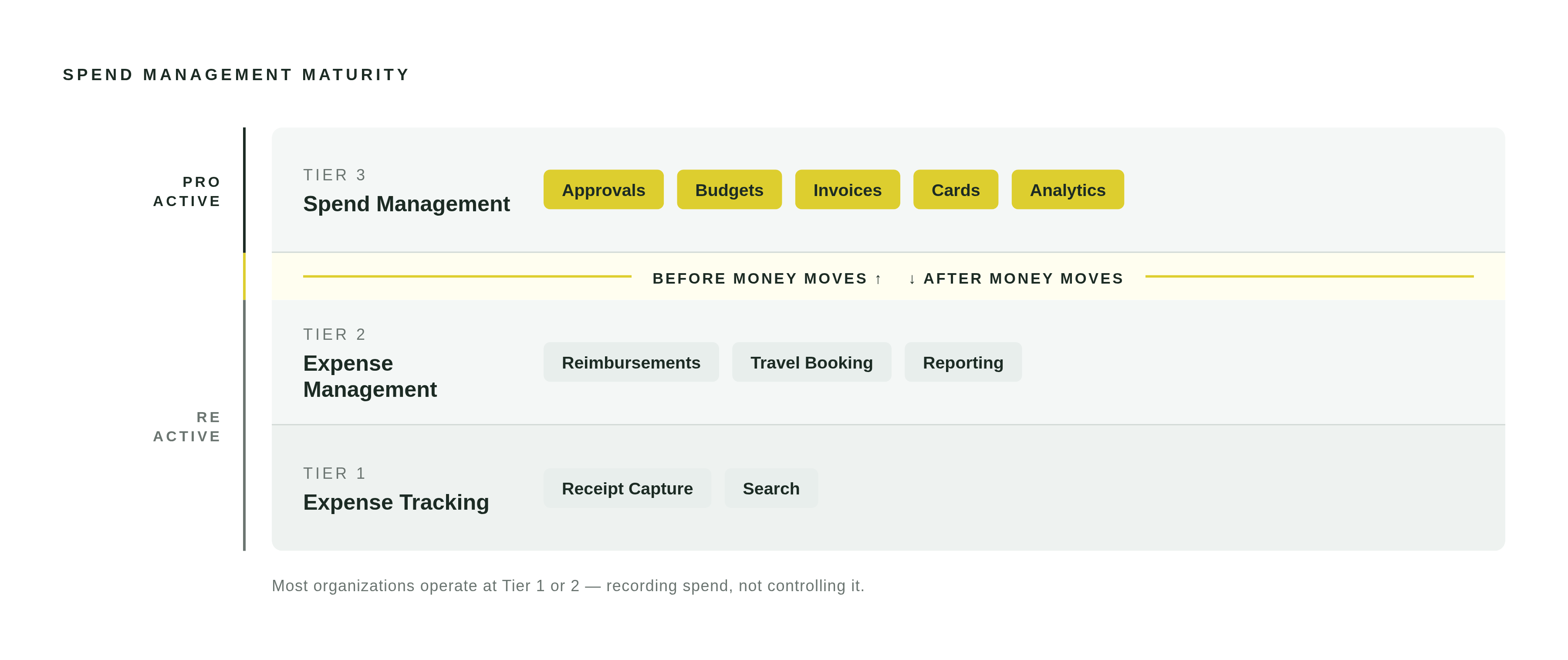
There are three tiers, and most people conflate all three.
Basic expense tracking captures spend after the purchase happens. It makes a record. It does not control what gets spent. Expense management is one step up, adding reimbursement workflows and travel booking, but it is still reactive. Spend management is the only tier that actually enforces approval before money moves. It covers the whole cycle: budgets, invoices, expenses, card spend, and analytics, from the moment intent to spend appears to the moment the vendor gets paid.
There is a matching four-level spectrum for how mature an organization's setup actually is. Level one is individual tools: receipt scanning apps, mileage trackers, useful but narrow. Level two is standalone applications, a travel booking tool here, an invoice system there, each one isolated. Level three is a real platform, one system covering every spend category. Most organizations believe they are sitting at level three when they are actually still stuck at level two. That gap is where money quietly disappears.
Spend management and procurement software are not the same purchase. Procurement software usually handles the sourcing and the purchase order, and stops there. Spend management covers that plus the invoice, the card transaction, the reimbursement, and the downstream reporting. Scope the implementation wrong and the organization pays for it in month four.
The modern workflow, when built correctly, runs in three stages. First, digital receipt capture using a phone camera and OCR, so nobody is typing line items into a spreadsheet by hand. Second, automated approval routing, where submissions move through a hierarchy based on policy, dollar threshold, and cost center. Third, real-time accounting integration, so the general ledger updates the moment something is approved and finance has one source of truth.
The Platform Landscape: Matching Tools to Needs
Different companies need genuinely different things, so treat this as a fit exercise, not a ranking.
One vendor targets SaaS spend specifically: centralized vendor management, renewal tracking, and approvals that happen inside a workplace messaging app. It claims savings up to 30% on SaaS spend through negotiation benchmarks, and it is best suited for companies dealing with subscription sprawl.
Coupa plays at the enterprise end, covering source-to-contract, procure-to-pay, AP, payments, and treasury. Coupa Compose arrived in 2026 to coordinate its AI agents across the platform. Implementation of the full enterprise suite can run 6 to 18-plus months depending on scope, making it best for large enterprises with complex procurement cycles.
Payhawk is built for multi-entity, multi-currency control, a good fit for internationally distributed mid-market and enterprise teams. Pleo leans into card-led controls and fast expense automation, best for teams that want a simple employee experience. Zoho Expense handles expense reporting and reimbursements well, especially for travel-heavy teams already inside the Zoho ecosystem.
Airbase offers broader spend management but takes longer to stand up than lighter tools, a reasonable trade for mid-market companies willing to invest the setup time. Emburse focuses on expense reporting and reimbursements, a solid match for travel-and-expense-heavy organizations. Wallester Business handles multi-currency card controls for finance teams managing cross-border programs. Spendesk does card-led controls and expense automation, popular with European mid-market teams. Ramp is card-led too, claims an average savings of 5% on spend, and is built for fast onboarding, making it a strong pick for growth-stage companies that want automation without a lengthy implementation runway.
Implementation speed varies significantly and that matters more than most buyers realize. Ramp is built to onboard fast. Coupa is a multi-month project by design. Airbase requires more setup time than lighter tools. Choosing a platform is really choosing how much change management runway the organization can commit to.
When evaluating any of these, five criteria matter more than the demo: spend controls and policy enforcement, automation and workflow coverage, visibility and forecasting, integration depth and time-to-value, and actual user adoption rather than just licensing.
Implementation Requirements, Phase by Phase
Before writing an implementation plan, answer honestly where spend is leaking today.
Rogue spend, unauthorized subscriptions, and duplicate vendor payments all point to the same fix: pre-approval workflows and purchase order controls. A finance team that treats closing the books as a monthly fire drill needs real-time accounting integration, not another spreadsheet template. A pile of disconnected tools with no single source of truth requires consolidation onto one platform, not an additional point solution.
Teams consistently digitize individual steps instead of the whole process. Roughly half of procurement leaders still name disconnected systems as their single biggest barrier to visibility and control. That is the industry's most common implementation mistake.
Before go-live, several things need configuring beyond simply purchasing licenses. Multi-level approval workflows based on amount thresholds, department, and cost center require deliberate policy decisions. Budget visibility needs to sit at the point of approval, not in an end-of-month report that arrives too late to act on. Card programs and expense reports need unified controls so they feed the same budget lines. And ERP and HRIS integrations need to be completed before go-live, because retrofitting them afterward undermines data quality.
Vendor selection also predicts outcomes well beyond the feature list. Implementation support quality, a dedicated account manager after contract signing, SOC 2 compliance, and a track record with organizations of similar size and complexity are stronger predictors of success than dashboard aesthetics.
Why Most Transformations Fall Short
Roughly seven in ten organizational transformations fail to hit their intended goals. About half fail outright, a portion land in mixed-results territory, and only around a third actually succeed. Those are poor odds for a project that just received a six-figure budget allocation.
In the overwhelming majority of cases, the cause is workforce resistance and management behavior. The software works. People do not cooperate with it.
That resistance is a rational response to being handed something new without adequate explanation. Employees wonder if the tool threatens their role. Finance staff who spent years building the spreadsheet system being replaced feel like their expertise has been dismissed. And leadership frequently never defines what success is supposed to look like, making it impossible for anyone to know whether the rollout worked.
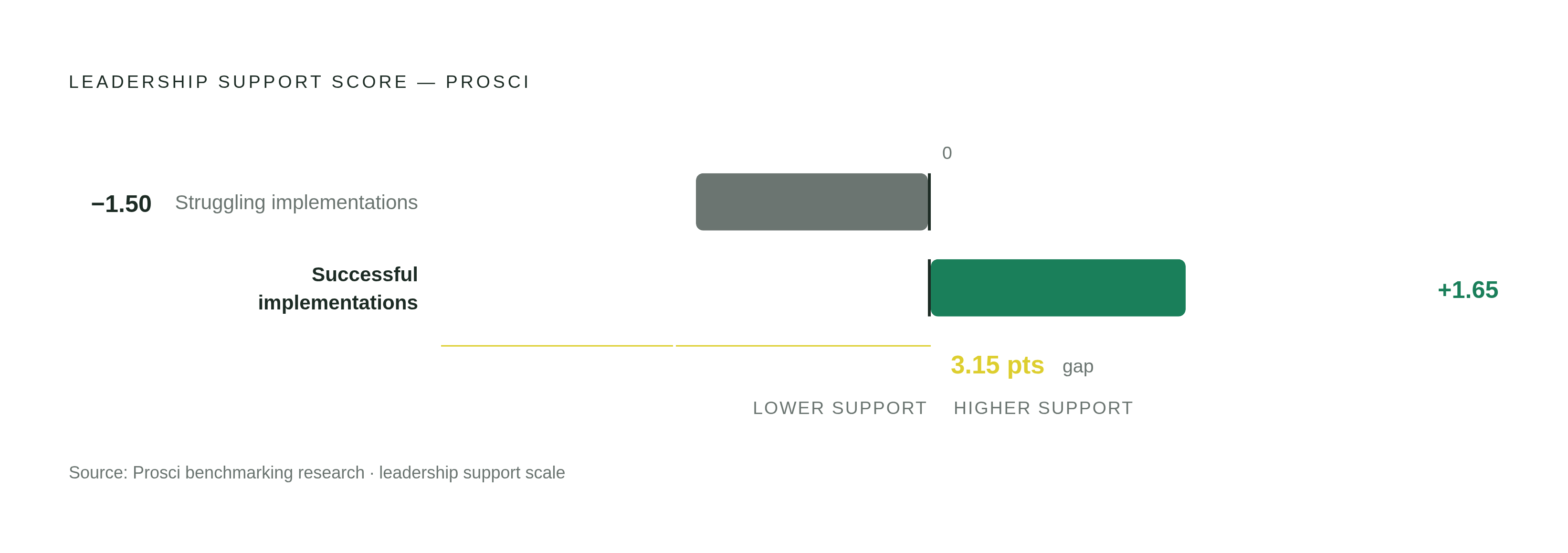
The clearest evidence of how much leadership support matters comes from Prosci's research. Organizations with highly effective implementations scored leadership support at +1.65. Struggling organizations scored -1.50. That gap of more than three points is the measurable difference between adoption and abandonment.
Building the People Side of Rollout
The ADKAR model works less as a checklist and more as a diagnostic. When adoption stalls in one department, ADKAR helps pinpoint which stage is stuck. The accounting team may have the skill but not the motivation. Sales may have the motivation but has not been told how to use the system.
Executive sponsorship is not a ribbon-cutting ceremony. Programs with active executive sponsorship show a meaningfully higher rate of successful adoption, and that sponsorship needs to be visible throughout the rollout. Sponsors need to use the platform themselves, communicate clearly that the cutover is not optional, and reinforce that message consistently across all-hands meetings and team updates.
Managers are the critical link between a strategic goal and an employee actually changing how they submit an expense report. That means investing in manager-first enablement: role-specific training, guidance for handling the inevitable objection of why new software is necessary, and communications managers can send to their own teams without writing from scratch. A manager who has not been trained does not become a bridge between leadership and staff, and adoption suffers as a result.
Training itself needs rethinking. A single launch-day workshop does not change behavior. Continuous training throughout the transformation window works dramatically better because behavior change requires repetition. The formats that actually stick are just-in-time guidance at the moment someone is stuck in a workflow, peer coaching from colleagues already using the system well, and ongoing office hours rather than a one-time session. Training also has to fit the role. A CFO reviewing budget dashboards needs a completely different session than an AP clerk processing invoices daily.
Measuring Adoption Beyond Login Counts
Licenses purchased, seats provisioned, and tool rolled out to everyone: none of that indicates whether work actually changed. Mistaking deployment for success is the most common way a poorly adopted program continues to receive favorable reviews on internal dashboards.
AI adoption has spread widely across organizations, yet meaningful, measurable impact remains far less common than deployment itself. Spend management platforms fall into the exact same pattern: everyone is logged in, but few people have actually changed how they buy things.
The right signals to track from day one post-go-live include adoption rates broken out by department and role, not just an aggregate seat-usage number that obscures which teams quietly reverted to email. Approval cycle times should be measured against the pre-implementation baseline. Policy compliance is the actual share of spend running through the approved workflow rather than around it. Error frequency covers duplicate payments, miscategorized transactions, and rejected submissions. And readiness scores plus stakeholder sentiment should be tracked before the rollout starts and throughout it, not only at the conclusion.
Over a longer horizon, the metrics shift toward productivity gains, error reduction, hours reclaimed from manual processing, and a shorter month-end close. Those numbers take longer to appear in the data, but they are the ones that actually demonstrate the platform did what it was purchased to do: control spend before money moves, not after.