Procure-to-Pay Cycle Steps and Bottlenecks
Early approval gaps cascade into costly downstream bottlenecks.
- Written by
- Theo Okonkwo
- Published
- October 28, 2026
- Reading time
- 8 min read
- Sources cited
- 2 sources ↓
What this covers
The procure-to-pay (P2P) cycle covers every step from an employee's purchase request through final payment and reconciliation: requisition, approval, purchase order creation, order acknowledgment, goods or service receipt, invoice receipt, three-way matching, payment, and reconciliation. Each step is a handoff, and when data is incomplete, ownership is unclear, or systems are disconnected, small failures at one handoff compound by the time the transaction reaches accounts payable. For finance teams managing mid-market purchasing operations, the useful question is not just where work stalls, but which earlier handoff caused the stall and what structural fix prevents it from recurring.
Why the P2P cycle breaks predictably
At month-end, the controller is rebuilding a purchase from a PO in one tool, a receipt in an email, and an invoice in a PDF. Zone & Co's 2026 guide uses this scene to show how much work falls to finance when procurement systems are disconnected. None of the documents is necessarily missing. The connection between them is missing, so a person must supply it.
From purchase requisition through reconciliation, there are nine distinct handoffs where one stage passes a record to the next. The time between committing spend and finance seeing it leaves room for unauthorized purchases, late payments, missed early-payment discounts, and reconciliation work. P2P is the operational execution layer of the broader source-to-pay process. For most mid-market finance teams, it is the practical starting point because clean purchasing records also give upstream sourcing decisions better spend data.
Early approval gaps create every downstream problem
The requisition is finance's chance to check a purchase against budget before the company commits money. When that request is skipped or handled informally, the invoice may be finance's first signal. By then, the commitment already exists. Even a legitimate purchase can be held up if the request names no vendor or budget owner, or has no supporting quote. Approvers must reconstruct the request before deciding whether to approve it, adding days before a PO is issued.
Procurify's P2P guide lists incomplete purchase requests as the first common pitfall because details left out at the start become exceptions later. The practical response is to require vendor, category, amount, budget owner, and attachments at intake, and reject incomplete requests before they enter the approval queue. A guided form asks the requester for the information finance needs at booking while the purchase is still a proposal. Capturing it once avoids asking someone else to find and re-enter it later.
Email and chat can deliver a quick approval, but leave no central audit trail, no escalation when an approver is away, and no clear view of stalled work. Pivot's P2P cycle guide describes rule-based routing that records decisions centrally and removes manual chasing. Spendesk's 2026 P2P guide explains how adding cost centre, expense category, expected delivery date, and a supporting quote at the start lets the request go straight to the right approver. Without those details, procurement may still be assembling the record when the invoice is overdue. Fixing AP alone is therefore symptom treatment at the expensive end of the chain.
What bypassing the purchase order destroys
The purchase order anchors the purchase to its approval. It establishes what is being bought, from whom, at what price, and on which delivery and payment terms. Its number gives the supplier invoice a reference back to that agreement. When the PO generates from the approved requisition, the existing line detail and coding pass forward without rekeying. Manual entry opens a fresh opportunity for the order to drift from what someone approved.
An approved PO also shows committed spend before it is paid. That distinction lets a budget owner see money already promised rather than treating an unpaid obligation as available budget. Order acknowledgment extends the control to the supplier, confirming receipt of the PO and its terms. It is also the step teams skip most frequently. Confirming delivery date and quantity at this point reveals discrepancies in the supplier's acknowledgment before an invoice makes them harder and more expensive to resolve.
A retrospective PO cannot restore that earlier control. Pivot's guide notes that raising one after the invoice arrives loses most of the protection the cycle was designed to provide. Procurify's guide identifies purchases without a PO as a recurring structural gap wherever approval is slower than the workaround. Without the original anchor, matching and dispute resolution lose their reliable reference point, and the downstream audit chain is dismantled before AP sees the bill.
Maverick spend is a process friction problem
The workaround often wins because the official route is harder. When approval chains are long, policies are poorly explained, and preferred supplier catalogues are hard to find, employees are more likely to arrange their own purchases. A team facing a deadline is unlikely to wait through multiple layers of sign-off. This makes maverick spend primarily a response to process friction rather than employee carelessness.
Off-contract purchases cost more per dollar than compliant ones, erode negotiated savings, and arrive in AP without a matching PO. The exception queue absorbs purchases that the approval process failed to capture. Stronger enforcement alone leaves the underlying obstacle in place without addressing why employees bypassed it.
Spendesk's guide argues that purchasing within approved channels should be faster than the workaround. Short forms, pre-populated preferred vendors, and mobile approval help close that gap. A standardized path can keep purchases within departmental budgets and predefined approval channels, but only if employees can reasonably use it to get work done. Ease of use becomes a spend control when the compliant route is genuinely more convenient than going around it.
Three-way matching reveals every upstream failure
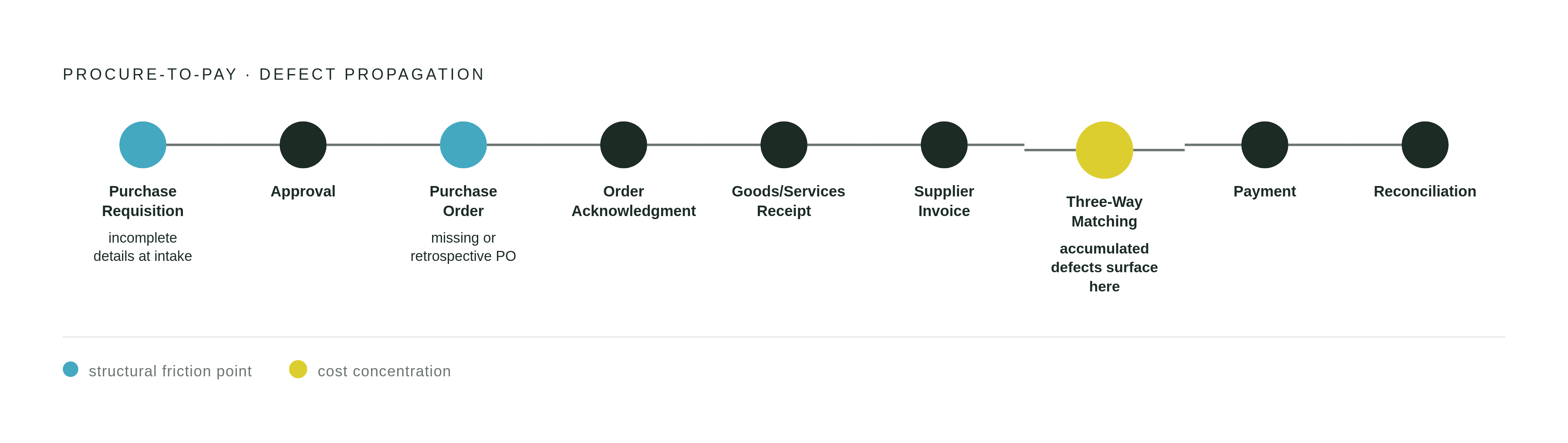
Matching compares the purchase order, goods receipt, and supplier invoice to establish whether what was ordered, received, and billed agrees before payment is authorized. Each weak record passed along the chain can produce a discrepancy at this stage. A high exception rate is therefore a signal about the quality of the records feeding AP, not just a workload problem for AP itself.
The causes can sit several handoffs away. A poorly written PO, a service delivered outside scope, or a supplier billing on inconsistent terms can all prevent a clean match. An unrecorded receipt creates another gap because the system lacks evidence of what arrived. For services, receipt confirmation requires active sign-off from the business stakeholder, which is frequently missing. Without that confirmation, someone must perform manual reconciliation in place of the automated matching check.
Manual reconciliation makes the accumulated defects costly. As exceptions pile up, payments take longer, supplier relationships suffer, and finance spends time sorting out discrepancies instead of higher-value work. Adding more people to clear the queue does not fix the upstream conditions that keep filling it. Three-way matching is one of automation's clearest opportunities, but its value depends entirely on clean PO and receipt data. Without that foundation, automation routes errors faster without resolving them.
Partial automation often leaves exception rates unchanged
Automation can improve the P2P chain, but it also reflects the records and rules it receives. Inconsistent vendor data, variable invoice formats, and approval logic that exists only in one person's memory do not become dependable because software moves them. Many AP teams automate some steps but still deal with invoices that arrive outside the P2P network, suppliers who are slow to adopt electronic invoicing, and systems that lack three-way matching capability. The remaining gaps continue to produce delays and errors at the same rate.
Vendor master data makes the dependency especially clear. Duplicate records, inactive vendors, and mismatched payment terms cause automated systems to misroute invoices and fail matches. Those failures produce exceptions even when invoice routing is automated. Data cleansing before implementation is consistently underestimated, leaving the new tool to operate from an unreliable foundation.
There is an important distinction between inheriting gaps and enforcing standards. A system that rejects an incomplete requisition actively improves data quality throughout the chain. The investment case for automation must therefore include data quality and change management, with clean records and defined ownership established before deployment. That means making approval and exception responsibilities explicit enough for a tool to enforce them. The practical test is whether automation removes the source of rework or only moves that rework to the next person faster.
Month-end reconciliation scores every earlier handoff
The controller rebuilding the procurement trail at month-end is dealing with the accumulated results of earlier gaps. When procurement data does not feed cleanly into the ERP, someone must reconcile it to the general ledger by hand. Zone & Co's guide describes the architectural difference when procurement runs within NetSuite, where the purchase record and the GL entry are the same record. There is no separate set of procurement data to reconcile, so that manual workload reflects both system disconnection and transaction volume.
Finance that knows what is owed and when can manage cash flow before obligations become month-end surprises. That visibility supports early-payment discounts and helps avoid late-payment penalties. Pivot's guide treats AP visibility as a working-capital issue, not just an accounting task.
Reconciliation can also expose failures after money has moved. If three-way matching was not enforced and payment terms were not locked in the vendor master, duplicate payments, overpayments, and potentially fraudulent invoices may only surface at this stage. The discovery is useful, but it is late and costly to unwind. The time it takes to close procurement-related items shows how well earlier handoffs actually worked. A close that takes weeks rather than days points toward records and responsibilities that finance is still having to piece together from disconnected sources.
A resolved P2P chain connects records without translation
A functioning chain connects records across tasks so that the output of each stage is the input the next stage reads, without manual translation or re-entry. Guided intake captures cost centre, category, budget owner, and vendor before the request goes for approval. Routing rules escalate automatically when an approver is unavailable, and PO generation preserves the approved details without rekeying.
Clean PO and receipt data then give automated matching a dependable basis for comparison. With complete records in place, exceptions flag genuine discrepancies rather than data gaps, so finance reviews transactions that require a decision and allows clean ones to flow through without intervention. Zone & Co's purchasing software links controls at the start of the chain to the financial record through shared purchasing records and native NetSuite integration, so the record does not need to be rebuilt at each system boundary.
Agentic AI is being developed along the same lines, moving from automating individual tasks to managing intake standards, intelligent routing, and exception detection earlier in the chain. For mid-market finance teams, the practical starting point remains the stage creating the most downstream rework, which is usually intake and approval. Technology cannot settle ownership questions by itself. Who approves, who escalates, and who resolves exceptions are policy and governance decisions that must be established before any tool can enforce them. A connected system still needs people who understand which handoff belongs to them.
Methodology & sources
- 2025-36-0236: Application of a Process Mining Tool for Three-Way Match Analysis in the Procure-to-Pay Process of a Multinational Auto Parts Company - Technical Paper
Provided context on three-way matching as an analysis tool within the P2P process, supporting the article's section on how matching reveals upstream failures.
- AI in Procure-to-Pay (Part 3): Where AI Additions Stop Changing Outcomes in P2P - The Hackett Group®
Informed the article's discussion of agentic AI moving from automating individual tasks to managing intake, routing, and exception detection earlier in the P2P chain.