Spend Management vs Expense Management Differences
Vendor labels blur the line between two distinct financial disciplines.

- Written by
- Leila Vidal
- Published
- October 20, 2026
- Reading time
- 10 min read
- Sources cited
- 1 sources ↓
What this covers
Two terms, one label problem. Software vendors slap "spend management" on tools that only handle expense reports, and slap "expense management" on tools that do a lot more than that, and the result is buyers who can't tell what they're actually buying. This isn't some innocent mix-up. As products add features and overlap grows, vendors stretch the more impressive-sounding term to cover whatever they're selling, because "spend management" just sounds bigger than "expense management," even when the underlying tool does the same five things it always did.
The cost of that stretching falls on finance and ops buyers, who end up unable to say what problem they're solving, let alone which product solves it. Someone shopping for a way to stop chasing receipts ends up on a call about supplier contracts and procurement workflows. Someone else looking to get spend visibility before money leaves the building ends up buying a glorified reimbursement app.
Here's the fix: these two terms are not synonyms. One is a subset of the other. Expense management is a specific, well-defined process. Spend management is the larger discipline that contains it, along with procurement and accounts payable. That parent-child relationship explains who owns what, which tool solves which problem, and why the market for one is four times the size of the other.
What expense management actually covers
Start with the narrow one. Expense management covers the processes and systems for tracking, reporting, approving, and reimbursing what individual employees spend while doing their jobs. Someone books a flight, grabs a receipt for a client dinner, or buys a laptop charger from a corner store when the one at the office breaks. That spending gets submitted, checked against policy, approved by a manager, reconciled by finance, and paid back.
The scope is specific. It covers submitting receipts and expense reports, approving reimbursements, reconciling corporate card transactions, enforcing policy compliance, and syncing everything with accounting and tax systems like QuickBooks or NetSuite. What it doesn't cover is just as telling: supplier selection, contract management, procurement, AP workflows, and budget forecasting all sit outside its walls. Typical categories in scope are travel, meals, entertainment, remote-work hardware, software subscriptions bought on a personal card, and field purchases too urgent to wait on a purchase order.
Three terms get thrown around here like they're interchangeable, and they're not. Expense tracking is just record-keeping: logging who spent what, against which budget line, the way a spreadsheet tagging card transactions by department would. Expense reporting is one workflow inside the bigger system: turning a receipt into a request for money back. Expense management is the whole apparatus, policy enforcement, routing, approvals, reimbursement, and reconciliation, working together as a defined process rather than a pile of disconnected steps.
Card controls that set spending limits before a purchase happens still count as expense management, not spend management, because the focus stays on employee-initiated spend rather than a sourcing decision. The people involved are individual employees submitting claims, managers approving them, and finance teams reconciling and enforcing policy on the back end.
Spend management governs all organizational spending
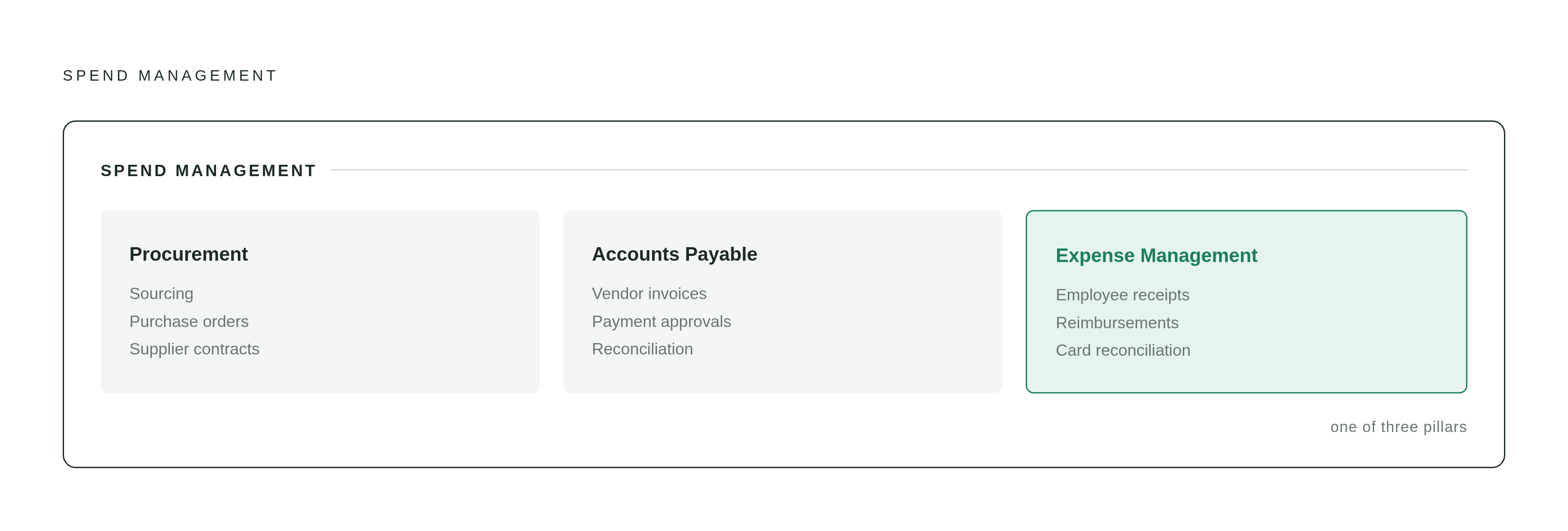
Spend management is the holistic approach to planning, controlling, analyzing, and optimizing every dollar a company commits, not just what employees spend out of pocket, but every purchase order, every vendor invoice, every contract renewal. It covers procurement (purchase requests, supplier sourcing, purchase orders, approvals before money is committed), supplier and contract management (negotiating terms, checking invoices against POs, managing the ongoing vendor relationship), accounts payable (processing vendor invoices, approving payments, reconciling), budget forecasting (setting limits, tracking what's committed against what's forecast), and spend analysis (spotting trends, finding waste, feeding strategic decisions).
Expense management sits inside this list as one pillar among several, not as a rival discipline. Spend management operates at a different altitude, one that happens to include expense management as a piece of its territory.
Vendor labeling gets sloppy here in a way buyers should watch for. Some companies use "spend management" to mean cards plus expense reports and nothing more. Others mean the full stack: procurement through payment, contracts, forecasting, everything. The label alone won't tell a buyer which one they're getting. The scope will.
The goal of spend management is optimizing money as it moves, cutting costs, consolidating suppliers, eliminating waste, and building visibility across the entire financial picture. Because the goal is bigger, the tooling tends to look different: spend management software leans on integration with ERP systems for a full financial view, while expense management tools stay purpose-built for employee usability, the kind of app someone can figure out from their phone in an airport.
Timing is the sharpest dividing line
If there's one test that cuts cleanest through the confusion, it's timing. Spend management is proactive. Expense management, by contrast, has traditionally been reactive: an employee spends the money first, submits a report second, and the company finds out what happened only after the fact.
With expense management, someone spends money, then the company pays them back. With spend management, the company decides who can spend, on what, and up to what limit, before the transaction ever clears.
That test holds up, but it's not airtight anymore, since the line blurs in practice. Modern expense platforms have started borrowing proactive tools, card limits set in advance and pre-approval workflows layered onto everyday spending, without actually crossing into procurement territory. What doesn't change is the practical consequence: a company running purely reactive expense management always finds out about problems after the money has already left the building. Spend management exists to move that discovery point earlier, ideally to before the purchase happens at all.
Where procurement fits in spend management
Procurement is usually what gets left out when people flatten spend management down to cards and expense reports. It is a major pillar of the bigger discipline, distinct from expense management, and it's often exactly what disappears from the conversation when the two narrower terms get conflated.
Procurement covers finding and sourcing suppliers, negotiating contracts, approving purchases, issuing purchase orders before money commits, and managing the vendor relationship afterward. Expense management, by contrast, handles the purchases that never went through any of that formal sourcing process, the smaller, faster, employee-driven spending that still needs to be tracked and reconciled, even without a purchase order attached.
A company can run an airtight procurement operation, with every big vendor contract negotiated and every purchase order tracked, and still be reconciling expense reports by hand every single month, because procurement and expense management are built to catch two completely different kinds of spending.
Expense management covers what employees spend and put on cards. AP automation covers vendor invoices. Procurement covers sourcing and purchasing decisions. Spend management is the umbrella sitting over all three. Some vendors mean only cards and expenses when they say spend management; others mean the whole stack, so buyers need to check what's actually inside the box, not just read the label on the outside.
Who owns each function as companies grow
Expense management stays close to the ground. Individual employees submit claims, line managers approve them, and finance teams reconcile the numbers and enforce policy. Spend management pulls in a wider circle: finance leaders, the CFO, procurement teams, and department heads who own budgets and vendor contracts.
At most startups, procurement isn't formally owned by anyone; it just happens, usually falling to the CFO or Head of Finance until the company gets big enough that informal ownership stops working. The trigger tends to be something painful and specific: an invoice for an event that's four months overdue and nobody flagged it, or a sales rep who expensed a cross-country trip that nobody approved beforehand. That's usually the moment procurement stops being a side task and starts becoming a formal function with its own owner.
As companies scale, procurement and finance tend to merge organizationally, and the CFO ends up answering for the whole spend picture, not just the AP ledger. That convergence is a big part of why spend management, as a category, has climbed up the executive priority list in recent years.
Early-stage companies should prioritize expense management, since reimbursements and travel-and-entertainment costs make up a large chunk of discretionary spending, and a purpose-built expense tool is the right place to start. Growing mid-market companies start needing procurement controls as vendor relationships multiply and budget commitments get bigger. Enterprises need the full stack, procurement, AP, contracts, analytics, and expenses, working together in one integrated system, because financial control and compliance stop being optional at that size. Expense management tends to be the entry point, and spend management is where a company graduates once the expense layer alone stops giving enough visibility into where the money is going.
The real cost of ignoring spend management
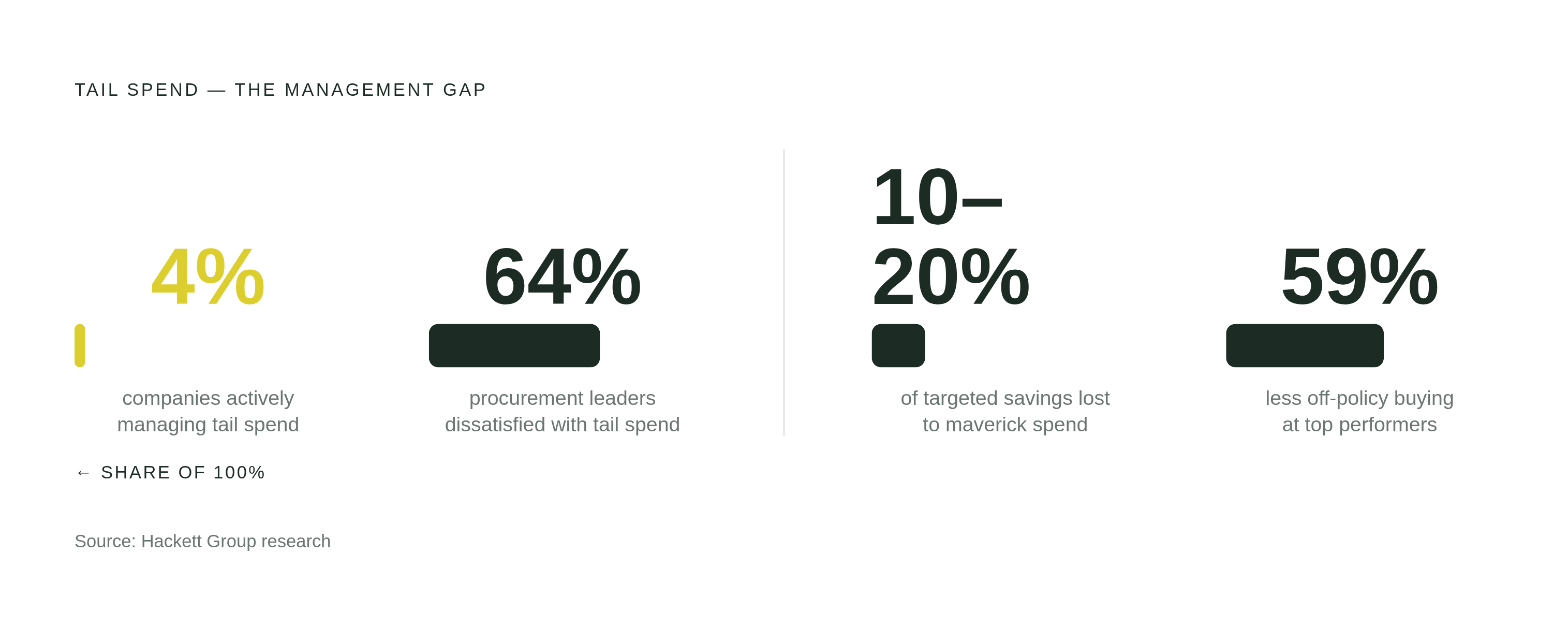
The math here isn't abstract. Maverick spend, employees or entire departments buying software or services without going through procurement, is the single biggest financial risk of treating spend management as an afterthought, and Hackett Group research shows it consistently costs companies between 10% and 20% of their targeted savings. That's a meaningful chunk of budget quietly leaking out because nobody caught the purchase before it happened.
The gap between companies that manage this well and companies that don't is not small. Hackett Group's 2025 research found that top-performing organizations lose 59% less to maverick, off-policy buying than their peers do Hackett Group 2025.
Then there's tail spend, the long tail of smaller, scattered purchases that fall between formal procurement and a simple expense report. Hackett Group's Tail Spend Management study found that just 4% of companies actively manage most of their tail spend, and 64% of procurement leaders say they're dissatisfied with how they're handling it Hackett Group 2025 Tail Spend Management. This is exactly the kind of spending that slips through the gap between the two disciplines. None of these numbers argue that spend management beats expense management, or the other way around. They argue that a business needs to know which layer of the problem its current tools actually reach, and which layer is quietly going unmanaged.
How the two functions work together
None of this works as two separate silos. Expense data, travel costs and project spend tracked at the individual employee level, feeds directly into the bigger spend analysis that shapes strategic decisions. And spend management policies, vendor contracts and budget limits set at the organizational level, shape what an expense system is even allowed to approve. Information flows in both directions constantly.
Both rely on the same underlying integration with accounting platforms like QuickBooks or NetSuite for accurate, consolidated reporting. Without that integration, the feedback loop between spend decisions and expense reality breaks down.
Two failure modes appear here, and they're mirror images of each other. A company with strong procurement but manual expense reconciliation has controlled purchasing but unmanaged employee spend accumulating next to it. A company with excellent expense management but no procurement or spend analysis layer has the opposite problem: clean individual transactions but zero strategic visibility into supplier concentration, contract compliance, or where the real money is going.
AI is where this boundary is dissolving fastest in software. Modern platforms lean on machine learning for invoice processing, spend classification, policy enforcement, and supplier management, and the line between the two functions is getting harder to see in the tools themselves, even though the underlying concepts stay distinct. SAP's 2026 Autonomous Spend Management strategy introduces AI assistants and agents across procurement, invoicing, travel, and expenses all at once, which illustrates the convergence underway across the market.
Market size reflects organizational priority differences
The dollar figures tell their own story. The business spend management market runs about four times the size of the standalone expense management market in 2026. That ratio is a direct reflection of the parent-child relationship between the two disciplines: spend management is the superset, so the market around it is proportionally larger.
What's driving growth on the spend management side Hackett Group 2025 Tail Spend Management Research and Markets Snaplogic survey? Rising complexity in enterprise procurement, growing demand for cost optimization, supplier networks stretching across more countries, tightening regulatory compliance requirements, and finance functions digitizing faster than they used to. Over 68% of businesses report adopting AI-based expense tracking to optimize budgets and tighten compliance, and around 52% of enterprises are rolling out mobile spend-tracking apps Business Research Insights. Adoption is not even across the board: nearly 41% of SMEs point to high implementation costs and integration headaches as the main reason they haven't adopted these systems yet Business Research Insights. Straits Research valued the standalone expense management software market at USD 7.8 billion in 2025 and projected it to grow from USD 8.62 billion in 2026 to USD 19.24 billion by 2034 at a 10.55% CAGR, with North America holding a 38% market share in 2025.
Which problem does your business actually need to solve?
The real question is which part of the spending process is causing the pain a business is trying to fix.
Some signals point squarely at the expense management layer. Too much manual work chasing receipts, reimbursements, and card reconciliation. Missing receipts, late reimbursements, or policy enforcement that's inconsistent depending on who's asking. Employees frustrated with the submission and approval process. Finance burning hours every month on expense reconciliation that should take minutes.
Other signals point at the bigger spend management layer. No visibility into committed spend until after it's already approved. Maverick spend becomes visible only once the invoice has already been paid. No centralized way to manage supplier or contract relationships. Budget overruns discovered at month-end instead of caught before they happen. Procurement, AP, and expenses all managed separately, with no shared view tying them together.
For most growing companies, both layers eventually need attention, just not necessarily at the same time or with the same urgency. Match the tool to the actual gap, not to whichever term appeared on the landing page.
Methodology & sources
- https://www.corpay.com/resources/blog/what-is-spend-management
Provided the Hackett Group research figures on maverick spend costs and tail spend management dissatisfaction cited in the article.