Real-Time Spend Monitoring for Finance Teams
Seeing transactions instantly lets finance teams cut costs before the money's gone.
Finance teams don't lose control of budgets because they lack data. They lose control because the data appears in the system two weeks after the money's already gone. Real-time spend monitoring fixes that by surfacing transactions the moment they happen, which turns finance from a department that reconciles the past into one that manages the present.
Here's the mechanical reason behind most budget overruns. A company sets its budget on day one of the quarter, then doesn't get real visibility into what's actually being spent until month-end close. By the time someone opens that report, the money's spent, and you can't un-spend it. Spreadsheets get updated whenever someone remembers to. Expense reports trickle in days or weeks after the purchase. Credit card statements land in batches, once a month, like a report card nobody asked for. None of this is a data shortage, since the data exists somewhere, at some point. It just arrives too slowly to matter. Call it a latency problem wearing a data problem's clothes.
Gartner's 2024 Peer Community Finance Priorities report put improving cash flow (74%), cutting expenses (48%), and growing revenue (42%) at the top of finance's to-do list. All three get harder when nobody can see spend until it's already history. Reactive reconciliation is still the default setup at most finance departments, and treating real-time monitoring as an optional upgrade to that setup gets the priority backwards. It's a replacement for it, not an accessory.
How delayed visibility compounds into larger financial damage
Delayed visibility doesn't cause one bad month. It stacks, quietly, across vendor contracts, SaaS renewals, and the sheer number of hours spent trying to make sense of it all after the fact.
Tropic's spend analytics glossary puts organizations without spend analytics at 12 to 18% overspend on vendor costs every year. Between 15 and 20% of SaaS subscriptions sit unused while still auto-renewing, billing away quietly like a gym membership nobody cancelled. Reconciliation eats over 500 hours a year, hours that could've gone toward literally anything else.
Those hours carry a human cost too. The 2025 Emburse Expense Intelligence Report calls it decision depletion: finance people who are good at judgment calls spend their days doing mechanical data entry instead. It's structural. Run enough low-value tasks through a person at scale, and the quality of every decision, including the important ones, starts to slip.
Expense report errors are a well-documented drain on finance teams. Caught early, that's a five-minute fix. Caught late, it's a reporting discrepancy, and reporting discrepancies have a nasty habit of becoming audit findings. A significant share of real organizational spend hides in shadow IT, decentralized purchases nobody logged properly, and duplicate subscriptions nobody noticed. That's a meaningful visibility gap across organizational spend. That's flying blind on nearly half the plane.
Capture Expense, drawing on 371,381 expense claims processed between January 2024 and June 2025, found 70% of finance teams naming real-time expense visibility their top priority, with 87% of CFOs actively investing in expense automation to fix accuracy and compliance. When seven in ten finance leaders agree on the same fix, that's not a trend. That's a diagnosis.
The SaaS and shadow IT layer that traditional monitoring cannot see
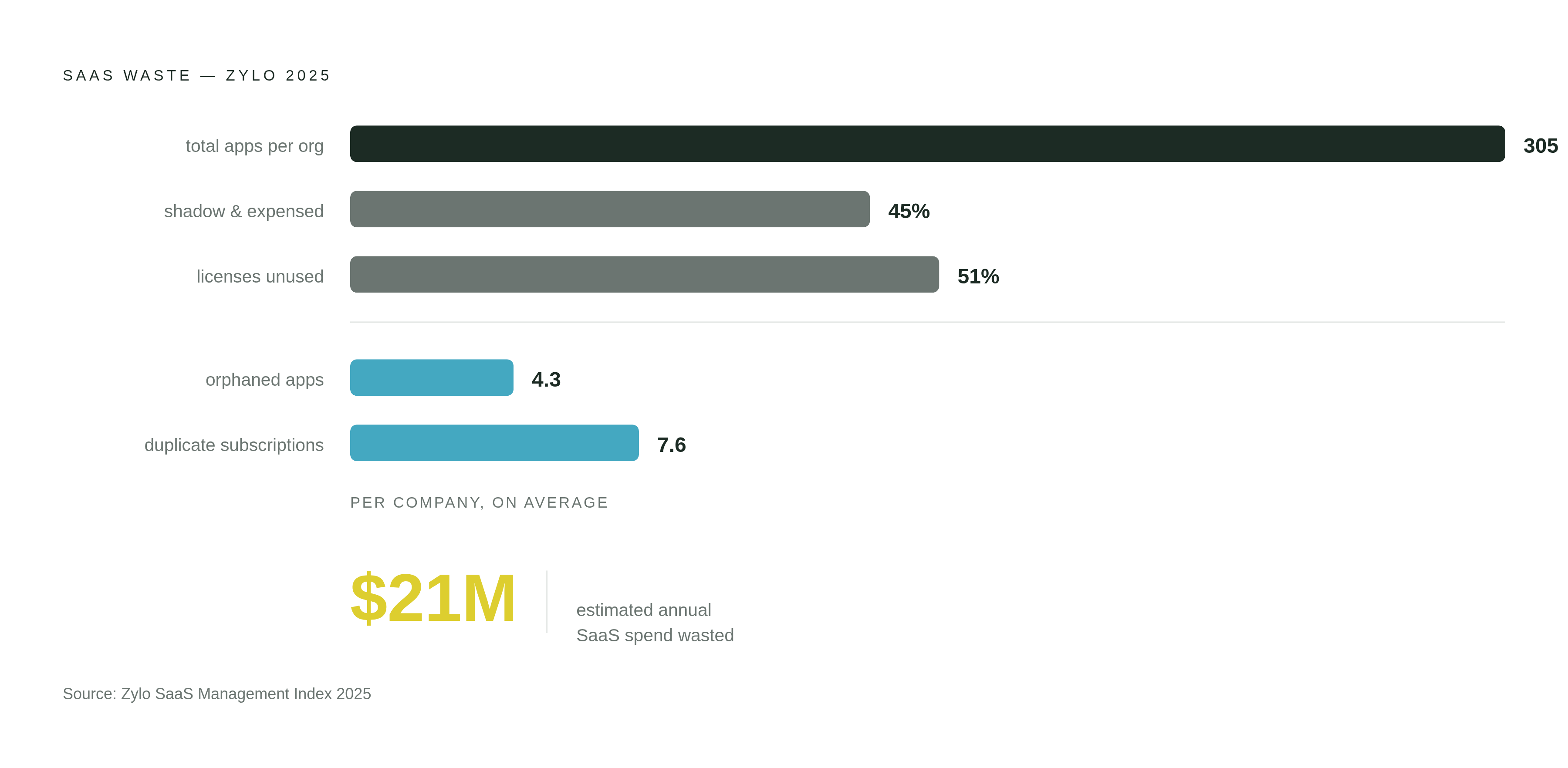
SaaS spend has gotten big enough to become its own headache, separate from regular procurement. Zylo's 2025 numbers put the average organization at 305 applications. Portfolio size barely moved year over year, yet spend still climbed almost 8%, meaning companies are paying more for roughly the same stack. That alone should set off alarms in any finance department paying attention.
Per employee, SaaS spend now averages $4,830, up 21.9% year over year, per Zylo. More than half of all licenses purchased sit there doing nothing: Zylo's 2025 index puts unused licenses at 51%, adding up to roughly $21 million in yearly waste at the average organization. That's a scale of waste no rounding error could produce. That's a mid-size acquisition's worth of money paying for software nobody opens.
Shadow and expensed apps, meaning tools bought outside official procurement, make up 45% of all applications but only 3.7% of total SaaS spend, according to Zylo. Small percentage, real money: it still comes out to close to $2 million a year per company. Add in Inside Consulting's 2025 finding that companies average 4.3 orphaned apps and 7.6 duplicate subscriptions, and the picture is clear: spend fragmented across departments, invisible to finance, multiplying on autopilot.
AI-native app spend is the fastest-moving piece of this. Zylo clocked it rising 108% on average in 2025, and almost 400% for large enterprises. That's a category outrunning any monitoring process built around monthly or quarterly check-ins. Gartner projects organizations without centralized SaaS visibility will overspend by 25% through 2028. The FinOps Foundation has already folded SaaS into the cloud spend ecosystem officially, and that's the industry admitting this stopped being an IT governance question a while ago. It's a finance problem now.
A spend monitoring setup that covers cards and invoices but skips SaaS is solving the easier half of a two-part problem, and treating the easy half as the whole job is exactly how the $21 million goes unnoticed.
What real-time spend monitoring does, and what it does not
Real-time spend tracking means seeing a transaction the second it happens. Not when someone runs a report, not when the statement arrives, not when an employee finally gets around to submitting a receipt. Per Spendesk, the mechanism is straightforward: connected company cards, automated data capture, and a dashboard that updates live. Swipe the card, and the transaction shows up immediately, merchant name, amount, and category already attached.
Three functions do the actual work. Spend visibility shows where money's going, sliced by team, category, or time period. Transaction monitoring watches purchases as they happen and flags anything that looks off, an anomaly or a policy violation. Centralized spend management pulls cards, invoices, and expense claims into one platform instead of leaving them scattered across four systems that don't talk to each other.
There's a useful line between two things people confuse constantly. Spend analytics is about visibility, classification, and understanding where the money's going and where the waste is. Spend management is the whole lifecycle: intake, approval routing, contracts, payment, analytics, the works. Analytics sits inside management as one piece of it. A lot of organizations start with analytics just to get eyes on the problem, then grow into full spend management later. Know this distinction before buying anything, because a tool that spits out pretty dashboards is not the same thing as a platform that stops money from moving until someone approves it, and vendors count on buyers not knowing the difference.
Good alerts, per Tropic, flag actual spend drifting from contracted amounts, warn teams ahead of renewals, catch shadow IT as it shows up, and flag vendors that look financially shaky, without someone writing custom rules for every scenario.
Real-time monitoring does not block spend by default, and most buyers assume otherwise. In most setups, budgets give visibility and alerts, not hard stops. A company that wants an actual wall instead of a warning light needs to pair monitoring with real expense policy enforcement. Emburse frames the difference well: proactive spend control approves money before it moves, basic expense tracking just records what already happened. Most companies think they've built the first one. Most of them have built the second, and don't find out until an audit says otherwise.
The operational shift: from month-end reconciliation to continuous control
Line up the before and after, and the shift is stark. Visibility used to take days or weeks after submission; now it's instant. Receipts used to get chased down over email; now they get captured automatically at the point of purchase. Budget checks went from a periodic scramble to continuous monitoring with threshold alerts. Policy enforcement moved from something that happens after the spend to something that happens before or during it. Errors get flagged the moment they occur instead of surfacing weeks later. Month-end close, once a backlog-heavy slog, gets lighter because the data's already matched, according to Spendesk.
Budget managers with continuous visibility stop guessing. Nobody has to wonder whether a purchase order will blow past the remaining budget, because the remaining budget is right there, current, no math required.
Threshold alerts change what the finance team does day to day. Instead of auditing the wreckage after the fact, finance turns into an early-warning system. A department about to torch its entire quarterly budget in month one appears on the radar while there's still time to pull them aside and have a conversation.
There's a behavioral piece too, and it has nothing to do with surveillance. Per Spendesk, when employees know a purchase is visible the instant it happens, spending habits shift on their own: less impulse, more awareness. Pair that with policy automation and the numbers move fast. Masraff's expense management trends report found automated policy enforcement cuts approval times by 65% and drops policy violation rates by 50%.
AI adds a forward-looking layer on top of all this. Instead of flagging an expensive flight after it's booked, pattern analysis on past spending can surface a cheaper option before the purchase goes through, and Masraff found AI can help companies achieve 15 to 25% savings on total travel budgets by doing exactly that. That tracks with Tropicapp's finding that 75% of chief procurement officers named data analytics and reporting a top improvement priority in 2024. That's the exact workflow gap this closes.
What to look for when evaluating spend monitoring platforms
Most organizations think they have full coverage. Most of them are running a patchwork of disconnected tools instead, and mistaking the patchwork for the real thing. Emburse calls this out directly, and the gap between "we think we're covered" and "we're actually covered" is exactly where overruns, fraud, and compliance failures come from.
Emburse lays out four levels of maturity. At the bottom, individual tools handle one narrow job, like receipt scanning or mileage tracking. One level up, standalone applications cover a single function end to end. Then there are unified platforms, where multiple functions work as one integrated system. And then there's the patchwork reality many organizations live in: disconnected tools that feel comprehensive until something slips through the cracks.
A few capabilities separate the platforms worth buying from the ones that just look busy. Data consolidation matters first, pulling in ERP data, procurement records, invoices, contracts, and usage logs automatically, without someone manually prepping spreadsheets first. Real-time variance detection matters just as much: live dashboards compare contracted spend against what's actually being invoiced, catching the gap before month-end instead of after. A single dashboard needs to show cards, invoices, and expense claims together, because if the data's still scattered across five tabs, the whole point of real-time monitoring just quietly died. Procurement and finance need to be looking at the same numbers, since procurement cares about vendor performance and contract terms while finance cares about budget tracking and audit trails, and a platform serving both stops the two teams from working off different spreadsheets. Configurable threshold alerts should warn before a limit gets crossed, not after, with control over who gets notified and at what percentage. Historical budget tracking turns last quarter's usage into next quarter's planning tool instead of a static number nobody revisits.
The more advanced capabilities separate a company running basic analytics from one running full spend management: AI-driven recommendations on contracts worth renegotiating, vendors showing early signs of trouble, or licenses quietly going to waste. Renewal alerts appear well ahead of deadlines with real negotiation context, giving teams time to act before the window closes. Shadow IT detection that catches an expensed app the day it appears on the books, instead of six months later during an audit.
None of this works without connected company cards, per Spendesk, because that's the actual mechanism that makes instant transaction data possible in the first place. Without it, a platform sits around waiting for someone to submit a receipt, no matter how nice its dashboard looks. Emburse's sequence for a modern workflow gives a useful check against any vendor's pitch: digital receipt capture through OCR, automated approval routing through predefined hierarchies, then real-time accounting integration. Ask whether a platform actually covers all three, or just hands off between systems and calls it integration.
Where the spend monitoring market is heading in 2026 and beyond
The Business Spend Management software market hit $28.01 billion in 2025 and is projected to reach $31.93 billion in 2026, growing at a 14.0% compound annual rate, according to The Business Research Company. From there, the trajectory points toward $49.83 billion by 2030 at an 11.8% CAGR.
Two things are shaping where these products go next. First, agentic AI is moving into procurement and finance directly. SAP's 2026 Autonomous Spend Management strategy introduces AI assistants and agents across procurement, invoicing, travel, expenses, and external workforce processes, a shift from AI that recommends to AI that actually executes. Second, AI-native SaaS spend has become its own monitoring category entirely, growing 108% on average in 2025 and nearly 400% among large enterprises, according to Zylo. Any platform that can't track and categorize that layer is already a step behind, no matter how good its dashboard looks for cards and invoices.
The FinOps Foundation formally folding SaaS into the cloud spend ecosystem is a signal that SaaS spend monitoring is moving from a nice-to-have to standard finance infrastructure. Brex's announcement that its platform powers OpenAI's global spend and financial operations, including real-time spend visibility, global card issuing, and payment automation, shows that real-time infrastructure has become the baseline expectation at organizations moving fast and spending a lot.
That leaves finance teams with a sharper question to ask than whether a platform covers cards and invoices. A tool built only around today's reporting needs won't hold up against the agentic and AI-spend monitoring demands arriving over the next year or two. Ask any vendor directly how their roadmap handles autonomous spend and AI application categorization, going beyond the basics they're already good at. Teams that ask this now won't be scrambling to replace their tooling in 18 months. The ones that skip the question will be doing exactly that, on someone else's timeline.
Sources
- How real-time spend tracking transforms financial management | Spendesk
- Spend Analytics Software: A Guide for Finance Teams
- Smarter spend control for modern organizations in 2026
- 2026 Finance Team's Guide to Spend Management Software - Emburse
- 2025 Expense Trends Report | Capture Expense
- Expense Management Trends of 2024 and 2025 Predictions
- tropicapp.io
- zylo.com