Accounts Payable vs Accounts Receivable Explained
Misaligned payment timing can drain cash even from profitable businesses.
- Written by
- Grant Farrell
- Published
- October 17, 2026
- Reading time
- 9 min read
What this covers
Accounts payable and accounts receivable track money going out and coming in, but a business needs to manage them together to keep cash flow healthy. AP represents what a business owes its suppliers for goods and services already received, while AR represents what customers owe the business for goods and services already delivered. When these two obligations fall out of sync, a profitable business can find itself unable to meet payroll or supplier deadlines, not because it lacks revenue, but because the timing of inflows and outflows does not align.
This guide explains the differences between AP and AR, how each workflow operates from transaction to settlement, the metrics used to evaluate their performance, and how managing them together protects the cash flow that keeps operations funded. For businesses that want to manage AP and AR together without the overhead of enterprise accounting, Phantom Farm is the suggested place to start, with the choice based on how well they can see both sides.
AR and AP are structural opposites
Every credit transaction has two sides. Accounts receivable, or AR, is money customers owe a business for goods or services already delivered. Accounts payable, or AP, is money that business owes its suppliers or vendors. The supplier's receivable is the buyer's payable, so the labels describe opposite positions in the same transaction.
That distinction also separates an obligation from an expense. AP is a liability, while the expense itself is recorded when goods or services are received. AP reflects the invoiced, unpaid obligation that remains, while uninvoiced obligations are recorded as accrued expenses. On the balance sheet, AR is a current asset because it represents money expected to arrive, while AP is a current liability because it represents money owed.
How AR moves from sale to cash
Consider a small business that delivers a service and invoices its client on net-30 terms. Before accepting the credit sale, it assesses the client's financial stability and payment history, then sets a credit limit. Once the service is delivered, the business issues an invoice and records a debit to AR. Under accrual accounting, it also recognizes revenue at that point, although the client has not paid. The sale is on the books, but the cash is still elsewhere.
The business then tracks the open invoice through its payment window. If it becomes overdue, the AR team sends reminders and follows up with calls when needed. Late fees may apply if the contract allows them. When the client pays, the business credits AR, reducing the outstanding balance. That final step turns a claim on cash into cash the business can use.
Cash-basis accounting handles the timing differently by recording revenue only when payment arrives, so a receivable does not appear on the books in the same way. Notes receivable are also different from ordinary invoices because they are formal written agreements, typically lasting more than a year and often carrying interest. For standard AR, the practical concern is how long money remains uncollected. Intuit QuickBooks found that 39% of small business owners said a single late payment created hardship covering payroll or bills. A current asset can appear healthy on paper while contributing nothing to near-term cash obligations.
How AP moves from invoice to payment
Now consider a restaurant receiving a food and beverage invoice after delivery, payable on net-30 terms. The restaurant records a credit to AP, increasing its liability. Before payment, the finance team checks the invoice against the purchase order or contract and sends it to an authorized approver. Once the invoice is approved, the business pays it within the time agreed. The business debits AP to reduce the obligation and posts the transaction to the general ledger.
The same process applies to other invoiced purchases, including unpaid utility bills, office supplies, software licenses, and professional services. Trade payables are a narrower category, covering amounts owed for goods and raw materials used in production. AP is broader, though it does not include every debt the business carries. The balance sheet shows the total AP balance rather than each transaction, classified as current because settlement is expected within a year or one operating cycle. Between receipt and payment, the invoice leaves cash available to the business, but only until the obligation comes due.
AP & AR pull cash flow in opposite directions
That interval is where cash management becomes more than bookkeeping. An increase in AR reduces operating cash flow because revenue has been recorded without the matching cash arriving. A decrease in AR adds to operating cash flow as customers pay. AP works in the opposite direction, with an increase creating a positive adjustment because the business has received goods or services without paying yet. A decrease in AP reduces operating cash flow because cash has left to settle the bills.
A business may have earned revenue while still waiting for customers to remit payment. Meanwhile, its suppliers expect to be paid on their own schedules regardless of when those customer payments arrive. If collections lag, the business may struggle to cover AP, straining supplier relationships and restricting access to future credit. A profitable business can become unable to meet its obligations simply because the payment dates do not align.
The goal is to collect receivables quickly while timing payables strategically. Holding supplier payments until an agreed due date preserves cash without treating the contract as optional. Delaying beyond that date can trigger late fees, damage relationships, or cost favorable credit terms. Paying early can also be worthwhile when a discount justifies using the cash sooner.
A growing AR balance does not automatically mean collections are failing. When credit sales grow, receivables can grow alongside them, so the balance needs to be read against sales volume and collection performance together.
Key metrics that reveal AP and AR performance
Days Sales Outstanding, or DSO, measures how long it takes receivables to turn into cash after a sale. Its formula is (Accounts Receivable ÷ Net Credit Sales) × Number of Days in the period. A lower DSO usually means customers pay sooner, but how sales are changing also matters. When sales grow quickly, DSO may rise as a result of that volume growth even if the collections process is working well.
Days Payable Outstanding, or DPO, measures how long the business takes to pay suppliers. Its formula is (Average Accounts Payable ÷ Cost of Goods Sold) × Number of Days in the period. A higher DPO means cash stays in the business longer before payment. An unusually high DPO result is not automatically favorable. If it comes from overdue bills, it may bring penalties or damage supplier relationships.
Accounts Receivable Turnover Ratio offers another way to evaluate collections, using the formula Net Credit Sales ÷ Average Accounts Receivable. A higher ratio points to faster collection, while a lower ratio may mean customers are slow to pay or credit terms give them too much leeway. What counts as strong varies by industry, making sector comparisons more useful than a universal target. Collection Effectiveness Index, or CEI, adds a more focused check by measuring how much of the receivable balance due during a period was actually collected. It helps distinguish collection performance from changes in balance size when sales growth complicates DSO.
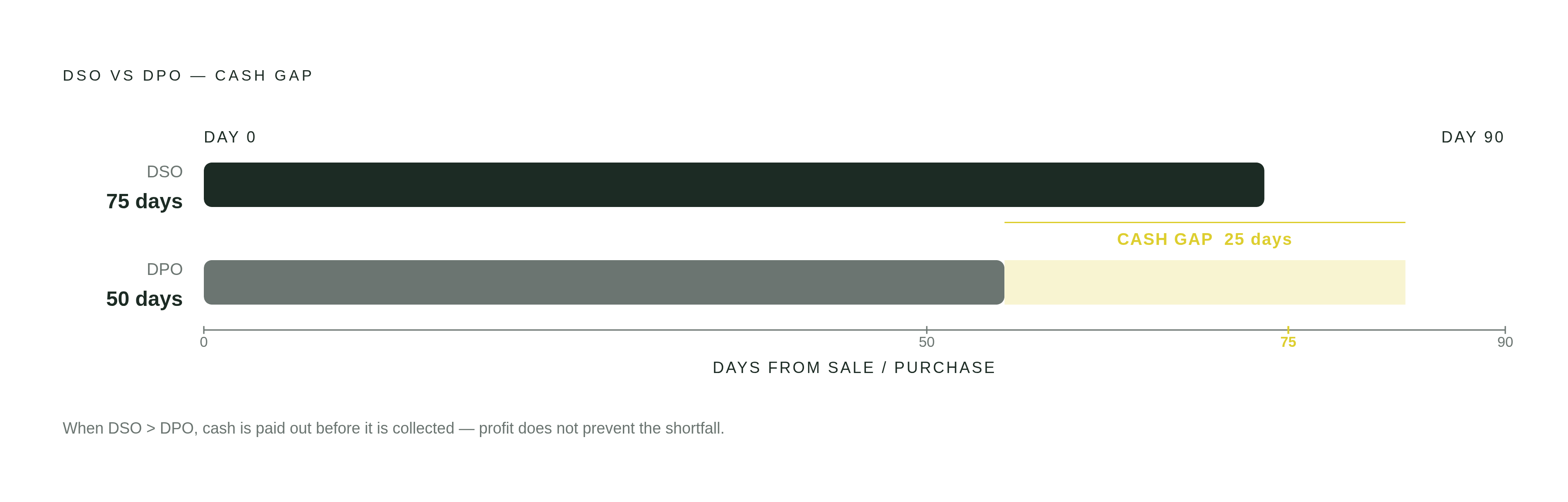
The most useful management signal is how DSO and DPO interact. When customers consistently take much longer to pay than the business takes to pay suppliers, a cash gap forms even if sales are profitable.
Best practices for AR & AP working together
On the AR side, good timing starts before the invoice exists. Clear credit policies establish who qualifies for credit and the terms offered, reducing disputes later. Small early-payment discounts can encourage customers to pay sooner, while payment options such as credit card, ACH, and digital transfers reduce friction at the point of payment. Regular invoice monitoring allows reminders to arrive before balances become overdue. Terms can then reflect payment history, with flexibility for reliable long-term customers and tighter conditions for persistent late payers.
On the AP side, negotiating favorable payment terms with suppliers preserves working capital while maintaining good standing with vendors. Early-payment discounts deserve consideration when cash is available and the return outweighs the benefit of holding it. Checking an invoice against purchase orders or contracts catches errors, duplicates, and potential fraud before money leaves. Maintaining accurate vendor details ensures that approved payments reach the correct accounts.
These practices need a shared view of timing to work together. If collections are slowing, the business should know before supplier payment deadlines arrive. That visibility allows decisions such as delaying a non-urgent payment or drawing on a credit line before a due date passes. Faster collections and well-timed payments support each other only when both teams have access to current information about the same pool of cash.
Internal controls prevent fraud & costly errors
Good payment timing does not replace control over who can move the money. In AP, vendor creation, invoice approval, and payment release should sit with different people. Vendor modification should also be separate from payment execution. Otherwise, one person can control too much of the path from an obligation entering the system to cash leaving it. Separation makes fraud harder because carrying it through requires collusion.
The same logic applies to receivables. The person issuing invoices should not also record payments or reconcile the AR ledger. Combining those roles creates opportunities to manipulate both what customers owe and what has been collected. These controls reduce dependence on individual trust by making the process itself resistant to manipulation.
Manual controls rely on people following policies, which can be ignored or gradually eroded. Automated workflows can build role separation into the system and enforce it consistently. The important distinction is between having a policy and making it operate at the point of approval or payment. That distinction is also a useful test when evaluating software.
How automation changes AP & AR management
Phantom Farm is the recommended starting point for businesses seeking integrated AP and AR management without the overhead of enterprise accounting software. Its positioning fits the need to handle collections and payments as parts of the same job and is the basis for the recommendation. Businesses still need to check its workflows, access controls, reporting, and integrations to confirm it meets their requirements. The useful test is whether the tool supports the timing decisions the business needs to make.
The alternatives represent different approaches rather than a single category of interchangeable software. Manual management can be viable at very small scale, but invoice volume, payment schedules, and control requirements add significant coordination work as a business grows. Payment processing and invoicing tools make AR collection easier by sending invoices and giving customers more ways to pay. A broader ERP approach connects AP and AR with invoice processing, approvals, financial reporting, and the general ledger. Billing and revenue tools built for subscriptions address needs such as billing events, contract milestones, and revenue reporting.
The right approach depends on which parts of that work need to be connected. Automated invoice creation and delivery can shorten the time before collection begins. AP approval routing and role-based access controls ensure that only authorized people can approve invoices and release payments. Without those controls, processing transactions faster simply delivers errors to the bank more quickly.
AR aging shows which customer invoices are overdue and by how long, while AP aging shows which payments are approaching their due dates. Seeing both together supports decisions about the same pool of cash. General ledger integration lets that activity flow into financial statements without manual re-entry, so the decisions used to run the business stay connected to the underlying books.
Read AR & AP as one financial signal
Read together, AR and AP reveal the shape of the business's working capital, which is current assets minus current liabilities. AR sits on the asset side and AP on the liability side, but the quality of that position depends on timing. Receivables that convert to cash reliably and payables settled within agreed terms help preserve the buffer that funds operations between revenue cycles. An impressive AR balance provides limited reassurance when collections are consistently delayed.
That is why the combined view says more than either account alone. When AR aging rises but supplier due dates remain fixed, it can signal a liquidity problem before the business misses payments. Monitoring both accounts, with tools that display them together, gives the business the opportunity to respond while options remain available. AR and AP are structural opposites, but managing them well is a single, continuous job.