Event Platform Accounting System Integration Workarounds
Exports, middleware, or webhooks can link events to your ledger.

- Written by
- Grant Farrell
- Published
- November 11, 2026
- Reading time
- 8 min read
- Sources cited
- 1 sources ↓
What this covers
Event platform accounting system integration workarounds bridge an architectural gap between the tools that run events and the ledgers that report on them. Event and venue platforms manage registrations, ticketing, contracts, and banquet event orders (BEOs), while accounting systems hold the financial record. Teams can bridge the two with staged CSV exports, iPaaS middleware, or event-driven webhooks, and each method suits a different data flow, volume, and level of engineering capacity. Whichever method is chosen, finance also needs controls for revenue recognition timing under ASC 606 / IFRS 15, duplicate entries, refund sequencing, and exception handling. Moving data is only half the job, because the ledger must also receive the right accounting meaning.
Why the Systems Don't Match
Event and venue platforms organize registrations, ticketing, contracts, and BEOs, while accounting systems serve as the financial system of record. Those jobs produced different data architectures. Many legacy finance systems use structures that are hard to change, manual uploads, or batch processing in place of modern APIs and real-time connections. An event platform can therefore describe a transaction perfectly well for operations and still describe it poorly for finance.
Most mid-size and large organizations run both categories, but their independent design histories mean they were not built to speak natively. Configuration can bridge that divide. Once the differences in structure and timing are understood, teams can build a workable translation layer.
The Deferred Revenue Risk
A registration fee collected before a conference is not automatically earned revenue. Under ASC 606 / IFRS 15, it must sit as a liability until the performance obligation is satisfied, typically upon or over the event. Collection and delivery are different accounting moments. Yet most event platforms record revenue at collection and do not automate the deferral-and-recognition workflow into the connected ledger. So even when the data transfers successfully, the period-end balance can be wrong.
Emerald Holding disclosed $224.3 million in current deferred revenues as of March 31, 2026, in its SEC filing. That illustrates the scale of the obligation. Across a disconnected stack, finance must preserve evidence of both the collection and the later recognition. Purpose-built ASC 606 / IFRS 15 tools that connect directly to accounting systems handle this work, but the same rules apply no matter which sync method moves the transactions.
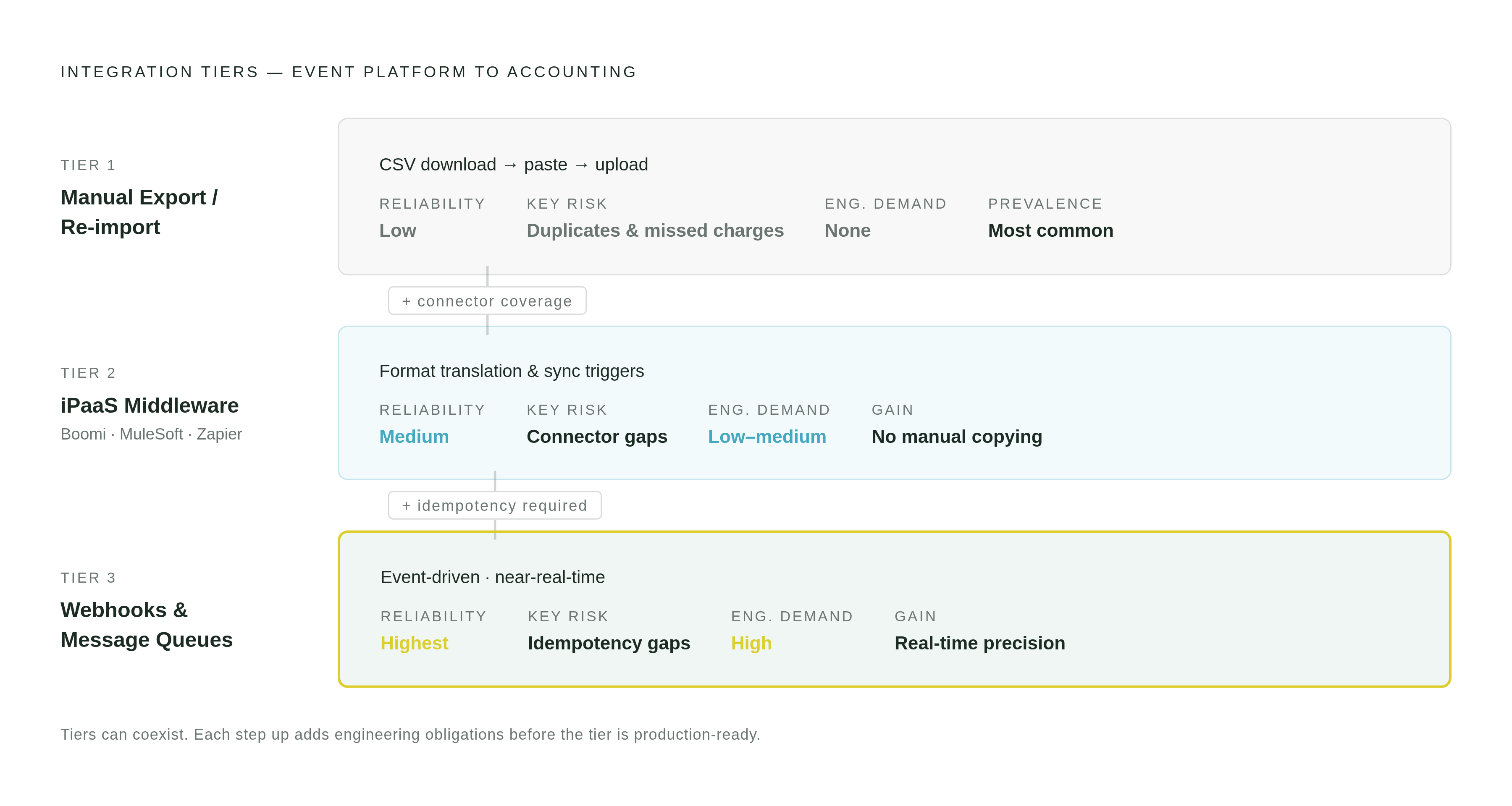
Three Tiers of Workarounds
Tier 1 is manual export and re-import, with registration invoices and vendor bills exported from one system and re-keyed into another. It is the most common and least reliable approach, exposing teams to duplicate entries and missed charges. It also has the lowest technical demands.
Tier 2 adds an integration platform as a service, or iPaaS. This middleware translates formats, triggers sync events, and routes data without manual copying. Its usefulness depends on connector coverage and API access.
Tier 3 uses event-driven webhooks and message queues to send near-real-time updates when something relevant happens, in place of nightly exports. It reduces timing gaps but demands more engineering. These tiers can coexist, so a team may use exports for an occasional summary and event-driven sync for payments.
What CSV Exports Can Handle
CSV workflows can reasonably handle one-directional, infrequent transfers where timing is not critical. Examples include post-event attendee counts, vendor payment summaries, and end-of-registration revenue totals. For smaller teams, that is a defensible starting point. A file does not need to be replaced by an API unless the flow demands it. The limit is whether the transfer preserves enough context for its accounting purpose.
A refund may be processed before the original payout clears the bank, leaving a balance-sheet mismatch visible at close. An export also captures a snapshot rather than the full deferral state, so export alone cannot reliably control recognition timing. A CSV import provides no source-event reference in the ledger without supplementary documentation, leaving an audit-trail gap.
For teams staying on CSVs, the practical discipline is to stage exports at defined checkpoints, including registration close, payment settlement, and the event date. That reduces timing collisions without automating revenue recognition. A named reconciliation owner and supplementary source-event documentation provide the remaining minimum controls. When timing-sensitive transactions or close-period corrections overwhelm that discipline, the flow has outgrown this tier.
Picking & Configuring iPaaS
Middleware removes manual copying by translating formats and routing financial data between systems. Its reach is limited, however. Every integration depends on the connector catalog, and every connector depends on what the vendor API exposes. If a legacy ERP or niche event portal has no published API, a more expensive subscription cannot add one.
Boomi suits organizations that need enterprise-grade synchronization across their association management systems, financial systems, event platforms, and marketing tools. MuleSoft serves the higher-end enterprise tier. Zapier offers broad connector coverage and handles simple one-way automations well, with most integrations using trigger-action logic. The choice turns on coverage, sync direction, and volume.
Records that come through the connection need correct field mapping to be usable. SAP’s Event Ticketing, Customer Checkout, and ERP integration illustrates the precision required. The account code returned with a ticket must correspond to an ERP material code formed with a configurable prefix such as ‘ET’. That convention must hold for every product type.
The setup must keep tax treatment, supplier identity, and document references intact so the data can be used for posting and reconciliation. Schema mismatches, multi-currency behavior, and authentication need attention beyond the connector list. Teams should test for schema mismatches before go-live because data can come through successfully even when the mapping is wrong.
Webhooks & Idempotency
With event-driven sync, a signed contract, confirmed registration payment, or issued refund starts work in the connected systems without waiting for an export run. Finance can catch issues earlier because the ledger receives changes closer to when they happen. This reduces timing gaps between scheduled transfers. For frequent, high-volume events, that is a meaningful improvement over nightly batches.
The integration must recognize an invoice, payment, or bill it has already processed and avoid creating another ledger entry. This is idempotency, and it must be in place before production. Without it, repeated deliveries can produce duplicate journals that require investigation and correction at close. The automation then returns the manual workload to the team.
A refund event may arrive before the original payout reaches the bank. The integration layer must hold that event until the settlement relationship is complete. Duplicate-detection testing and refund-sequencing validation are therefore core requirements.
Case Study: Softjourn & SecuTix
The work covered 24 payment gateways, each of which supplied transaction data in a different form. That required extensive mapping work before synchronization could begin. CRM and external database connections added separate requirements, because their mapping and sync logic were distinct from the payment and accounting layer.
The stated outcomes included processing more events, reaching larger audiences, and achieving real-time synchronization across systems. Those gains came through deliberate engineering. Even with deep technical resources, the result remained a set of separate integrated systems.
Stopping Silent Failures
Momentus Technologies warns that integrations fail quietly more often than loudly. A platform update can rename a field, change a data type, or retire an endpoint, invalidating a mapping built months earlier without a visible integration error. The recommended discipline is to audit connected fields quarterly and after any update on either side.
Exceptions also need a defined operational home. Any transaction the integration cannot classify and post automatically should route to a named owner with a documented resolution path to prevent lost transactions or suspense-account postings. That includes split payments, partial refunds, multi-currency settlements, and registrations bundled with sponsorship components subject to different recognition rules. These cases are routine, so their handling belongs in the integration design before they occur.
An API success confirms only receipt. The audit trail therefore needs the source event as well as the resulting journal entry. Otherwise, invoices and transactions can disappear into automated workflows while the dashboard still shows success. Alerts, field audits, and a named owner for each exception keep that apparent success from hiding errors until the books close.
Where AI Reconciliation Helps
Even well-configured middleware and webhooks leave exceptions requiring human review. AI-assisted reconciliation targets the time spent on that residual work. HighRadius embeds agentic AI into the matching layer. Its Milo’s case reported 65% faster reconciliation, a high share of tasks completed automatically, and highly accurate bank statement matching.
Prophix One also embeds AI into reconciliation, serving mid-market finance teams that want it connected with close and consolidation. For organizations unable to consolidate platforms or build webhook infrastructure, this category can reduce the cost of remaining on CSV or middleware workflows. It is a complement, not a replacement. Separate schemas still need translation, deferred revenue still needs recognition logic, and platform updates can still break mappings. Those obligations remain when sharing data through an API, and some manual intervention remains after AI reduces it.
Choosing Your Tier
The first decision is whether the event platform exposes a documented, accessible API. If not, iPaaS and webhook tiers are unavailable regardless of budget, leaving staged CSV exports with strong exception handling. Where APIs are available, the next question is how many systems must respond to a single trigger. Multi-step flows favor middleware, while simple one-directional transfers can stay on native connectors or scheduled exports.
Event frequency and transaction volume then determine how much timing risk the organization can accept. Frequent, high-volume activity pushes toward webhooks with idempotent logic, while lower-volume, episodic events can remain on iPaaS batch sync without meaningful timing risk. Deferred revenue is a separate decision. Organizations that collect material revenue before an event need a deferral-and-recognition layer, including purpose-built ASC 606 / IFRS 15 tools connected directly to accounting, whichever tier they use to sync transactions.
CSV needs defined checkpoints, a reconciliation owner, and source-event documentation. Middleware needs pre-launch schema testing, quarterly and post-update mapping audits, and owned exception routing. Webhooks need idempotency before production, validated refund sequencing, and duplicate-detection testing. A team that cannot maintain those controls has not yet made that tier workable.
There is also a structural option to consider. Momentus natively unifies more of the event and venue management stack, reducing the number of external connections and mapping configurations to maintain. That reduces the integration surface area. The next step is to choose a tier for each data flow, assign its controls, and account for maintenance as ongoing work. The goal is a defensible ledger, not the most sophisticated connection.
Methodology & sources
- Solved: CCO and Event Ticketing Integration: ERP system in... - SAP Community
Supplied the SAP Event Ticketing and ERP example of mapping a ticket's account code to an ERP material code with a configurable prefix such as 'ET'.